
Have you ever witnessed what delayed deliveries do to business?
Most of us in the apparel industry have faced it. But unfortunately no one calculates the actual loss to business due to this. Instead it leads to emotional changes and counter charges. It is this lack of accountability for lost opportunities, which essentially does not allow for measurement and hence there are no improvements that can be seen.
You may think that I am being harsh; but am I really? Why otherwise is the sourcing landscape so cluttered and chaotic?
Delay in delivery is a common term heard in our daily lives. All business functions are affected by these, from the merchandisers to the sales staff.
In most cases, the onus of these delays lies with the sourcing team, for they are the link between the brand and the vendors/manufacturers, accountable to get goods into the warehouse on time.
And when asked why the delays occurred, the sourcing team invariably gets into emotional discussions and goes through hundreds of emails, trying to figure out when what went wrong.
That happens because instead of planning and monitoring a Time and Action Calendar (TNA), the sourcing team works on vendor promises, commitments and prayers to god.
If we were to analyse the sourcing function, it’s nothing but simple project management and TNA is that planning tool which helps and enables efficiencies. It highlights issues on a timely basis and allows for proactive measures to be taken, minimising losses for the organisations
The benefits of the TNA are immense, yet for some reason, it’s not utilised to its potential in our industry.
To understand the TNA better, we need to understand the 3 components of sourcing which keep this machine rolling.

PREPARE: Ensure all pre-production planning is in place. For example, gold seals, tech packs, approvals, counter quotes, compliance checks, vendor partner selection. Make sure that the orders are all actionable and not some excel sheet that’s mailed across; there should be no gaps in data.
PLAN: Ensure that fabric/yarns are all pre-planned, capacities with Mills are blocked, vendor capacities are taken well in advance and commercials are closed. And most importantly backward planning for all timelines is done from the targeted delivery date and this plan (TNA) is confirmed with the vendor.
PROGRESS: Monitor the plan daily, create checkpoints and take proactive measures to ensure delivery is on time.
TNA is a tool that takes care of all pillars of sourcing and helps a merchandiser keep track of orders through the manufacturing process.
From preparing to planning to monitoring progress, a TNA helps in organising the workflow and ensuring that issues are dealt with proactively and do not cause business losses.
It’s the best tool a merchandiser can equip themselves with, to ensure the smooth flow of all orders.
WHY DO WE NEED A TNA?
The apparel industry is a complex one and sourcing apparel products is even more so.
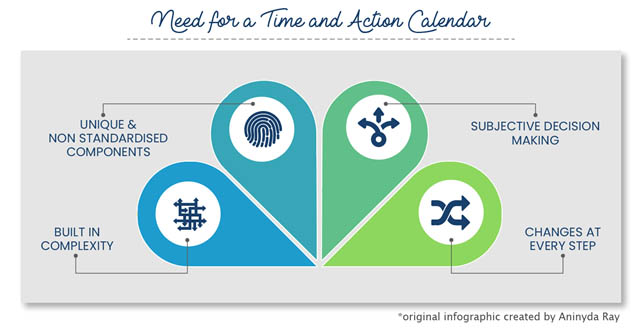
BUILT-IN COMPLEXITY
In a year we deal with 2-4 seasons, which are further divided into monthly drops. And the total number of styles per month may vary based on the size of the brand, categories the brand caters to and the sub-brands, it has. In essence, a merchandiser has to deal with about 100-200 styles, each at different stages of the manufacturing process with a different end date. Each of these styles have 20-30 different components, such as fabrics, interlining, buttons, thread, labels, and many more…
So, a merchandiser is dealing with about 2000/6000 components, each of which is important and can impact the delivery. For example, if the correct thread is not supplied on time, the garment cannot be stitched. If the washing chemical is not supplied on time, the garment cannot be finished. Even something like a hangtag can lead to delays.
Adding further to this complexity is the fact that every product is unique and most of the components cannot be standardised.
UNIQUE AND NON-STANDARDISED COMPONENTS
The fact that fashion companies by default and design keep changing a majority of the products in every drop, leads to so much variety that they end up using many unique and non-standardised components in the products. Each style we make has something unique of its own which makes standardisation of all components rather difficult.
If we look at other industries, we may find that the same components are used across products and many are standardised. For example, in the automobile industry, the same engine, chassis, tyres may be used in different models of cars. Only the outside elements may change, minimising the number of components being used and hence simplifying the supply chain. Also, the rate of new product introduction is nowhere close to fashion.
This is unfortunately not possible in the apparel industry, for every component is visible and impacts the consumer’s decision-making. And most of the time, the consumer wants variety. The embroidery used on one style will not be used on another, the fabric colour will vary from style to style, the stripe pattern will be different, and so on.
The merchandiser then is actually dealing with multiple unique components daily. And what makes this further difficult is the fact that the decisions making isn’t easy.
SUBJECTIVE DECISION MAKING
This is not the right shade of blue, this button does not look good, this embroidery is not aesthetically pleasing…
We have all said or heard these words often. For most of the decisions made in the apparel industry are marred by subjectivity. There is no right or wrong, it’s just a matter of perspective, derived based on our individual experiences. Now, imagine the impact this causes on the supply chain!
Most of the times, merchandisers don’t even know if the fabric is the right shade, or the embroidery looks aesthetically pleasing. This subjectivity also leads to multiple changes.
CHANGES AT EVERY STEP
Subjective decision making, changing consumer preferences, market insights, or last-minute add-on requirements – all of these have an impact on the apparel supply chain. And it’s imperative that these are addressed.
These add to the built-in complexity of this supply chain, making it difficult for the merchandiser to always keep track. These decisions are in most cases, taken by people who are not even a part of the process such as designers, sales teams, business heads, etc.
This subjectivity is one of the very unique problems of this supply chain
Given this complexity, it’s humanly impossible to remember everything by the merchandisers. No amount of to-do’s, emails and lists can help organise. Yet, I have always noticed that the merchandisers tend to plot everything in their minds and expect things to flow smoothly. And experience tells us that anything that can go wrong, will go wrong.
Hence, I always maintain – the only way this business can function, is by planning a TnA and following it like law…
Once the order flows in, the TNA should be plotted and calendarised. Then it’s a matter of tracking it on a daily basis and proactively solving any problems before they arise. It’s only with a TNA plan that a merchandiser can anticipate these problems and ensure they do not hinder the delivery of the product, hence ensuring business flows smooth.
It’s all so common-sense and of course everyone does it. So why are we even discussing it? The reality is that if you really ask sourcing merchants for their TNA, most will look blank and the few that do have it may not be updating it regularly.
What is the problem that people have with ‘planning’? I don’t know, but it is simply not done. Maybe they feel it will throw up new challenges by exposing the risk factors, hence increasing mental anxiety and work. Or maybe people like to simply be paper pushers, doing a postman’s job…That way if anything goes wrong, it’s always someone else’s problem.
The main thing is ‘ownership’. If sourcing teams have ownership, they will ‘plan’ for success. And I have seen that if the planning is done properly, that is 80 per cent success with in-time deliveries and quality. But it’s when they allow vendors to dictate their fate that companies suffer.
Unfortunately, Indian companies and their CEOs do not spend adequate time on sourcing and supply chain. This in turn leads to the apathy we see in the back-end today.
What do you think? Please do write and comment to enrich this discussion.