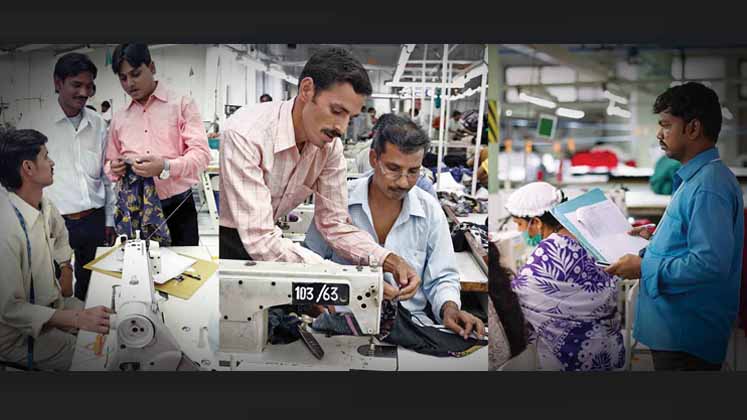
It is a strong perception across the Indian apparel manufacturing industry that young professionals, who have done attained technical degrees like B. F.Tech (Apparel Production), Master of Fashion Technology (MFT) from National Institute of Fashion Technology (NIFT) or any such degree from other prestigious fashion/textile institutes will not opt for technical jobs in garment factories (shopfloor) or if they do take up such jobs, they will not be very happy about it.
Challenges at garment factories’ shopfloor; ease of working with e-commerce, fashion brands, technology companies; less packages in factories and no job stability are few of the main reasons why young professionals don’t prefer garment factories.
Most of the academia, industry professionals and young talent who have passed out from prestigious institutes agree with these points.
Swapan Kumar Kalra, Factory Manager, Richa Global, Noida is vocal on this issue as he believes that there is a lack of qualified professionals in factories and in future this is going to be more serious as there is no strong ‘Team B’ in the factories as young talent are not joining apparel facilities.
“Increasing overall pressure at all levels can be managed with proper planning and execution by skilled and experienced people; so young professionals are very much required in the factories as they can gain experience, utilise their skill, knowledge and energy to perform and achieve factory’s targets. In Delhi-NCR, there are big export houses but except for a few exceptions, the good working culture is missing. An operator doesn’t wish that after completing education, his kids work in garment factory so how can we expect an educated professional who has better opportunities to work here,” Swapan says and further adds that as the domestic market is booming compared to export, e-commerce, retail is naturally attracting more young talent.
“Yes, in the last decade or even more than that, this trend was very much there and it was mainly due to boom in retail, e-commerce and brand segments…,” says Manish Tribhuwan, Industry Expert and Founder Member, NIFTWeCare. NIFTWeCare is an initiative of NIFT alumni, to mentor & support NIFT students and prepare them for their life and career.
He further adds that to retain young and qualified professionals, the industry has to give them a conducive working environment, progressive management, leadership and grooming apart from investing heavily in technology. “Today’s young professionals don’t have patience & they strongly wish for speedy implementation of the ideas to see the result. These implementations are much faster in fashion retail as data & technology plays a faster & bigger role in the business in comparison to apparel manufacturing,” Manish says.
An important point here is that the number of girl students is increasing in fashion institutes and compared to boys, girls are more comfortable working in the front end of retail or e-commerce rather than on factories’ shopfloor.
Kallika Malhotra, MFM (2018-20), NIFT, Shillong worked with BYJU’S as her passion was education and now she is moving towards becoming a wellness coach. She tells Apparel Online, “Less salary package is the main reason that young talent prefer to explore jobs in other profiles and not in garment factories. In my circle, most of the NIFTians choose jobs in other segments rather than the garment factories.” According to her, compared to garment factories, such young professionals are getting at least 20 per cent to 30 per cent more money by working in the e-commerce or retail sector.
“Things like pressure, deadlines, different work culture… are something we are very much trained in during our masters’ degree and allied projects, activities but the big thing is money,” says Kallika.
Akanksha Verma, (MFM 2019-21, NIFT Hyderabad) is working with SMYTTEN, Gurgaon (one of the largest product discovery and trial platforms offering product samples to try from more than 500 premium brands). She believes that post-Covid, e-commerce is a booming sector and there is hardly any chance that it will have any negative impact, so this is a promising career. “Stability in job irrespective of all challenges is a major concern now, so I prefer an e-commerce company,” she tells.
Akanksha Sharma, another NIFTian who got a job in India’s most respected buying house Triburg, also echoes the same opinion. She also feels that overall, there is a need to improve the working culture and atmosphere in the garment factories.
S. B. Akiwate, Training & Placement Officer, DKTE’s Textile & Engineering Institute adds an interesting observation, “Students who are born and brought up in metro cities and have overall good and aggressive personality, strong communication skills get jobs in e-commerce and retail sector while students from rural areas who are talented as well as hardworking but anyhow don’t get a job in these sectors opt for apparel manufacturing or textile units. There may be some exceptional cases but in general this is a growing trend.” He further adds that the overall ratio of DKTE’s students is 60 per cent into manufacturing and 40 per cent into retail or e-commerce etc.
“Facilities like Work from Home, flexible timing, learning opportunities, more fun during work and comparatively good packages attract students to other options compared to the garment factories,” he adds.
Ichalkaranji-based DKTE’s Textile & Engineering Institute is an autonomous and highly prestigious institute.
Prof (Dr.) G.K. Tyagi, Director, The Technological Institute of Textile & Sciences, Bhiwani says that he and other faculty encourage students to go for start-ups and to explore new areas as these will create more options and opportunities for the students.
The question that arises here is if this trend is creating problems for factories or not as they already have their experienced professionals and if it is an issue for the industry, then what are the factories doing to attract the young technical professionals.
To know NIFT’s take on this and if it is taking some steps to motivate young professionals to work in garment factories’ shopfloor… Apparel Online approached the institute but didn’t get any reply.
The manufacturing sector is India’s core strength (in the apparel business especially) and the Government’s focus with initiatives like ‘Make in India’ is also promoting manufacturing but at the ground level, there are not much efforts from any stakeholder to attract young and skilled professionals on to the manufacturing floor. “Higher management has to think and work in this regard, then only can we expect that qualified young professionals will prefer to work in garment factories’ shopfloor,” concludes Swapan.