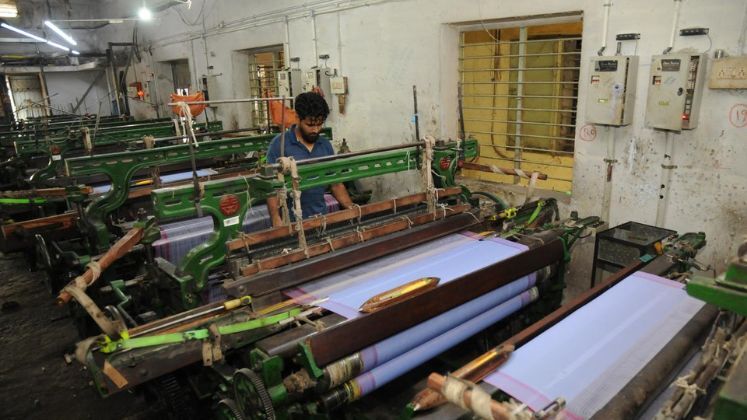
Tamil Nadu’s 5.68 lakh power looms, with over 89,000 in Salem and 19,350 in Tharamangalam alone, will soon have to upgrade their processes or face restrictions, as a new study has reported hazardous sound levels, especially in the traditional shuttle looms, with a lot of the workforce being subjected to noise levels greater than permissible limits.
The study was done by the Centre for Environmental Studies (CES) of Anna University and reviewed by the Tamil Nadu Pollution Control Board (TNPCB) and shared with associations like Tamil Nadu Small Industries Development Corporation Limited (TANSIDCO), indicates serious threats to health and the environment regarding not just noise but also air quality, which many of the workers are subject to being in every part of the manufacturing process.
The study recommended replacing shuttle looms with shuttle-less rapier looms, and a second recommendation was to install soundproof barriers with transparent creative components, which may help to comply with Central Pollution Control Board (CPCB) norms with regard to nearby residential areas.
But challenges to scalability are required both in terms of cost and practical feasibility. They indicated that in terms of converting the loom, it will cost and range between Rs. 1–1.5 lakh for each machine. Officials and stakeholders in the industry suggested that, due to these factors, the possibility of turning over all the looms is currently impractical. Most operators in Tharamangalam, especially for example, focus on production of textiles that are subsidised by the Government. They produce uniforms, dhotis, towels and polyester blends for the government’s welfare schemes, making them heavily dependent on the existing looms.
The Department of Handlooms has stressed that product-specific issues must be considered and indicated that these decisions cannot be rushed. TANSIDCO has suggested that a funding model could be developed with up to 70 per cent of the cost being covered by a mix of Government subsidies, long-term bank loans and owner contributions.
Problems such as the lack of trained mechanics to operate equipment, difficulty to convert older looms to newer types like the air-jet or water-jet models, and the absence of supply chains to efficiently procure supplies exacerbate the challenges for firms. The loom associations have broadly subscribed to the CES recommendations; however, they requested the recommendations occur in a phased or banded manner. The proposal is currently before the National Green Tribunal (Southern Zone).