- Lack of professionalism, training and quality issues are hampering growth of the industry
- For high quality standards, vigilance at the level of ground zero, i.e. at the fibre stage itself has to be maintained
- With additional cost of 50 paisa, fabric mills can be induced to use the loom stop motion by which quality can be improved many times
In the transition from an unorganized to organized sector, the home fashion industry in India has come a long way. While earlier buyers were sourcing value-added products in home textiles only, the increasing size of the industry have encouraged them to look at volume-oriented products like towels and bed sheets also.
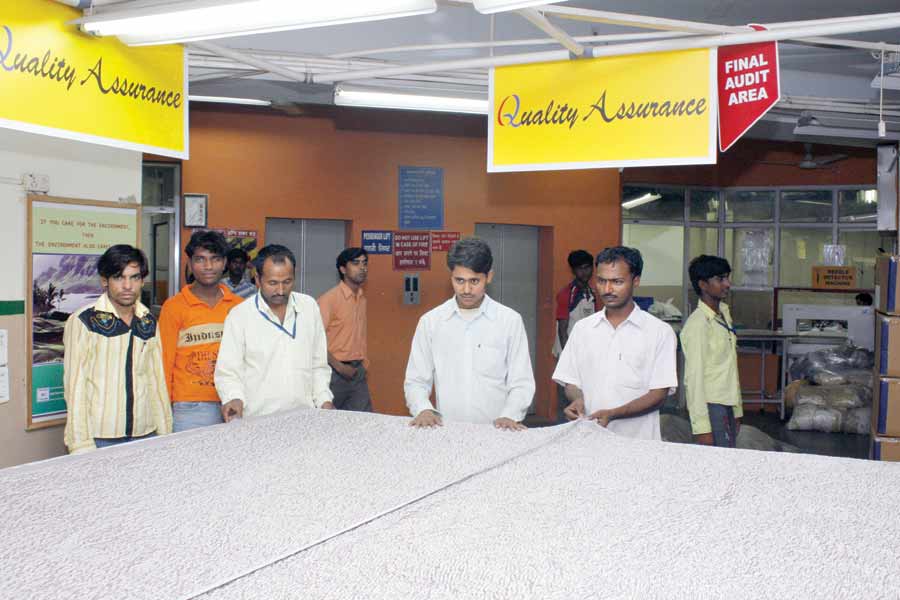
However, India is still not known for quality of its products, instead it is known for delayed delivery schedules and issues in quality. That is not to say that no changes have come about. Seeing that a lot of business was going to Pakistan, mainly in bed sheets and covers due to non-availability of wider width fabric in India, many players in Southern India were encouraged to invest in technology for manufacturing wider width fabrics. As a result, today we have many companies not only in South but in the North also who can deliver around 130 inch of width in fabric.
From power looms to latest machines, the industry has grown a lot in the last few years. However, lack of professionalism, training and quality issues are hampering its growth. To compete with other countries and remain competitive in prices and delivery schedules, many companies even moved manufacturing to China, but did it help? The answer is no, for the simple reason that a global buyer does not care whether the company sitting in China is an Indian or French; what matters is the product, price and quality.
It has been observed that most of the errors or wastages occur at the operator level. However, the industry is not using well-defined training programmes for operators to improve efficiency and productivity levels
There is no way that players can continue with their chalta hai attitude when it comes to quality and lead times. The productivity level in home textile units varies from 60 to 65%, which is even less then what is generally seen in the apparel sector. Standardization of production process, control over quality, training of operator for enhanced efficiency and productivity, and most importantly the commitment and professional approach, are some of the areas where industry has to work on.
For high quality standards one has to be vigilant at the level of ground zero, at the fibre stage itself. Right selection of cotton or other fibre for making yarn, proper selection of machinery for making fabrics, installing auto loom stop motions to enhance fabric quality on loom itself could be the first step towards achieving the goal of continuous quality development. Loom stop motions are a sensor system that acts as a real check to contain defects on the loom itself but in the unorganized fabric weaving industry where productivity takes over quality; these simple systems are ignored to decrease work pressure and produce more.
Barring a few, this lack of sensor system is the most prominent cause for the fabric defects especially from the power loom sector which still produces a major portion of fabrics for use in the export industry that too for the bulk produce items such as cushion covers and table linen. Hence, there is a need for the awareness as well as will to ask fabric producing companies to introduce these common quality practices to enhance fabric appearance value and play less on the spoils and rejects.
The intention is not to do the problem solving, but solution lies in killing the problem forever. In Southern India, the centre for power loom and auto loom fabric production, price for checking fabric is 10-15 paisa per metre and for a strict checking it is usually another 5 paisa per metre.
Further, by spending few more pennies, let’s say 50 paisa more and by requesting the fabric mills to use the loom stop motion, quality can be improved many times. These simple processes not only save a lot of time but will help in reducing wastage and will provide good quality products with almost zero flaws.
The fabric being sold by the power loom sector gives an average yield of 80% of the fault free fabric; however, it is the balance 20% which is not free from defects. It is this 20% fabric which is a waste, will decrease the quality standards and will add on the final cost of products that will ultimately put pressure on price margins, a critical issue in the competitive market today.
Another change that can help in improving the current situation is through standardization of checking the fabric. Every company has a different parametre or methodology to check the quality of fabric and if the method remains same for everybody, then the quality standards can be easily maintained. The formula is very clear, quality is directly proportional to efficiency and is inversely proportional to prices – the more will be the quality and efficiency, less will be the price pressure.
Zero defects – an ultimate symbol of quality cannot be achieved overnight, but it is a slow and steady process. Start by increasing the yield of defect-free fabric from 80 to 90% and so on, so that one can definitely reach the ultimate goal of getting 100% fault-free fabric, high quality standards and hence improved productivity and lead times. The industry has to work on minimization of defects and increase the fabric yield as one small step, because existing market prices cannot be challenged but can definitely improve the fabric yields to get better margins. And for this the invisible cartelization existing in the fabric market is to be breached.
It has been observed that most of the errors or wastages occur at the operator level, however, the industry is not using well-defined training programmes for operators to improve efficiency and productivity levels.Though discussions on how to cut cost and increase productivity are regularly conducted, they are not passed on or explained to entire supply chain. Only big companies like Welspun, GHCL and Alok have training facilities for workers.
Another problem in the industry is lack of qualified persons at production level. It is important to specify the minimum qualification, requirements and expectations for every post so that the right candidate is selected at every level.
High attrition rate and absenteeism is also a cause for a lot of delays and inefficiencies in the home textile industry. Human Resource Development (HRD) is often neglected in the industry and due to this one is never able to find the root cause for high rate of attrition and absenteeism. Regular interaction of workers with owners, motivation, incentives and appraisals affects the performance and hence efficiency. To accelerate the growth of industry, it is imperative to upgrade process, standardize operations and create proper HR policies.
The widening gap between North and South India and other competitors can be avoided only if we work towards a common goal of attaining world-class quality standards.
Last but not the least, quality is actually a mind set. If your vision is geared towards producing the world class products, providing service to the globe as one nation and the top management of the company makes it a point that rather than an excuse they must execute the principles of quality management at each and every stage of production will only provide the solution. Hence would quote “That the solution to the issues lies within us, the need of the hour is introspection, investigation and implementation of solutions to achieve what is required.”