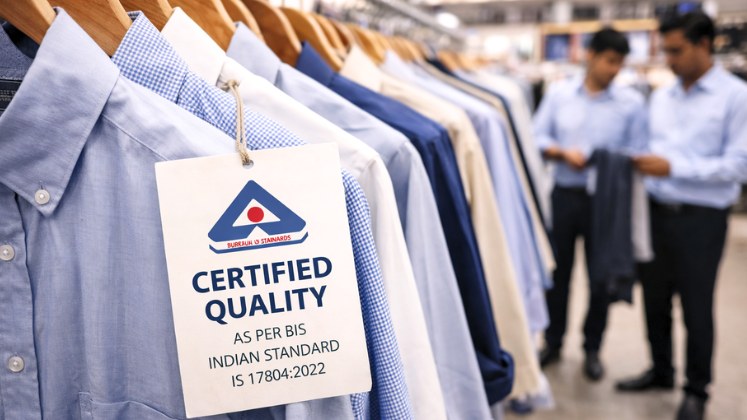
India has introduced new quality standards for woven shirts and trousers in a move aimed at improving manufacturing consistency and boosting competitiveness in the domestic apparel sector.
The standards, issued by the Bureau of Indian Standards (BIS), establish clear benchmarks for garment construction, including fabric strength, stitching durability, colour retention and shrinkage limits. Officials said the initiative seeks to bring long-overdue uniformity to a segment that has historically operated without harmonised quality norms.
Unlike sizing regulations, the new framework does not prescribe standard body measurements or fits. Instead, it focuses purely on performance and durability parameters that directly influence consumer experience and product reliability.
The move is part of a broader government push to strengthen India’s quality infrastructure across both mass-market apparel and technical textiles. By formalising benchmarks, authorities aim to ensure consistent product standards across price segments—from local markets to premium retail—while also supporting institutional buyers and bulk procurement agencies with clearer evaluation criteria.
Industry experts note that much of India’s garment manufacturing has traditionally relied on company-specific specifications rather than national standards. The introduction of BIS norms is expected to improve process efficiency, reduce variability in output, and enhance overall product credibility in the domestic market.
The development comes at a time when India’s apparel sector is expanding steadily. The domestic shirt market is valued at over ₹39,000 crore, while the trouser segment is projected to reach ₹78,480 crore by 2027, driven by rising incomes and urbanisation.
Although India remains a significant exporter of garments—particularly shirts—the new standards are unlikely to directly impact export volumes. Manufacturers will continue to adhere to the specifications of importing countries, while complying with BIS norms for products sold within India.
The initiative follows similar efforts to align Indian apparel standards with global benchmarks, particularly in sensitive categories such as children’s wear, as the government seeks to reduce non-tariff barriers and strengthen the country’s position in international textile trade.