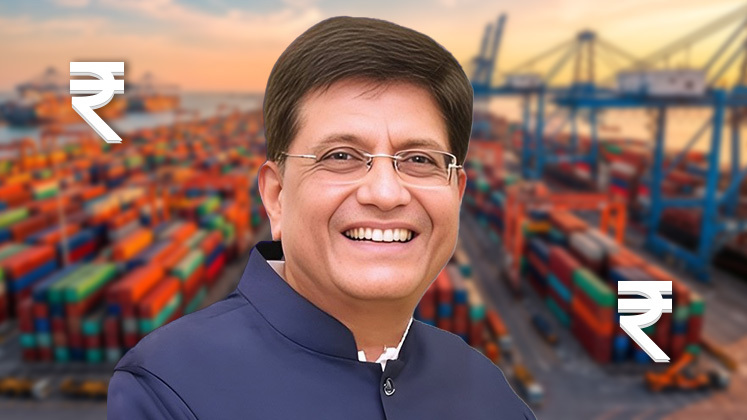
The Government of India has announced seven targeted measures to strengthen outbound shipments, with a particular focus on micro, small and medium enterprises (MSMEs) and emerging export destinations. The initiatives form part of the Rs. 25,060 crore (US $ 2.75 billion) Export Promotion Mission (EPM), unveiled by Commerce and Industry Minister Piyush Goyal.
The mission, first announced in the Union Budget 2025–26, seeks to consolidate multiple export-support schemes under a unified framework, simplifying procedures and increasing digital access. Spread over six years, it aims to reduce cost pressures, address logistical bottlenecks and expand export opportunities beyond traditional hubs.
To strengthen exporters operating through digital channels, the government has introduced two key credit instruments, a Direct E-Commerce Credit Facility which offers support of up to Rs. 50 lakh (US $ ), backed by a 90% guarantee, to ease financing constraints for smaller exporters. Secondly, there is an Overseas Inventory Credit Facility that provides up to Rs. 5 crore (US $ 549 million) with 75% guarantee coverage and an interest subvention of 2.75%, capped at Rs. 15 lakh (US $ 16,500) annually. This measure is designed to help exporters maintain inventory overseas and manage international sales more efficiently.
These instruments are intended to improve liquidity and reduce financing barriers for e-commerce-driven exporters.
To address short-term working capital constraints faced by MSMEs, the government will provide a 2.75% interest subvention on export factoring transactions processed through RBI- or IFSCA-recognised entities. Assistance is capped at Rs. 50 lakh (US $ 55,000) per MSME annually and will be administered digitally to enhance transparency and speed.
For exporters entering new or high-risk markets, support mechanisms such as confirmed Letters of Credit and credit enhancement schemes will be made available to mitigate financial risks associated with international trade.
Under the Trade Regulations, Accreditation and Compliance Enablement (TRACE) programme, exporters will receive reimbursement support to meet international quality standards. The scheme provides 60% reimbursement under the Positive List and 75% reimbursement under the Priority Positive List.
The annual ceiling is Rs. 25 lakh (US $ 27,500) per exporter, aimed at strengthening competitiveness through compliance with global certification requirements.
The Facilitating Logistics, Overseas Warehousing and Fulfilment (FLOW) programme will enable exporters to access overseas warehousing and global distribution networks. Approved projects may receive up to 30% support for eligible costs over three years, subject to MSME participation norms.
Additionally, the Logistics Interventions for Freight and Transport (LIFT) initiative will reimburse up to 30% of eligible freight costs, capped at Rs. 20 lakh (US $ 22,000) annually, benefiting exporters in the North-Eastern and landlocked hilly regions where transportation costs are typically higher.
The INSIGHT programme will provide financial assistance covering 50% of project costs — and up to 100% for proposals from government institutions or Indian missions abroad — enabling exporters to access trade intelligence, market research and facilitation services.
The mission targets labour-intensive sectors, like garments, MSMEs and districts beyond established export clusters.
Goyal stated that the initiative would unlock substantial investment opportunities in advanced technology sectors, including artificial intelligence and quantum computing, leveraging India’s talent base and positioning the country at the forefront of applied innovation.
Dr A. Sakthivel, Chairman of the Apparel Export Promotion Council (AEPC), observed that the Export Promotion Mission would act as both a strategic buffer against global uncertainties and a catalyst for unlocking opportunities in new and established markets. He stated that its comprehensive framework addressed the entire export value chain — from raw material procurement and compliance to logistics, branding and financing — thereby empowering small suppliers and Indian brands to expand through e-commerce channels while enabling larger firms to fulfil high-volume international orders.