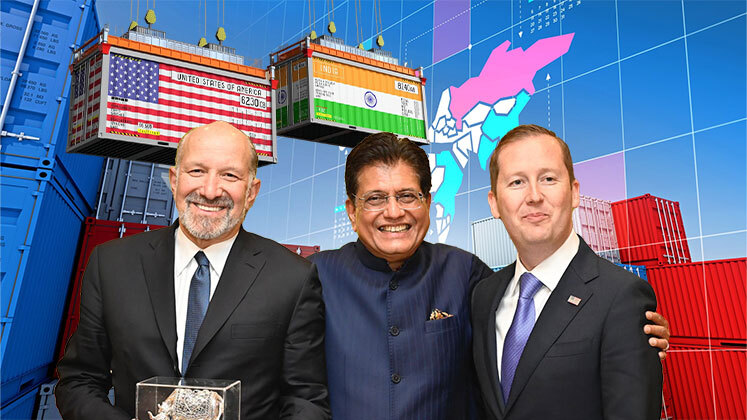
Piyush Goyal on Thursday held discussions on bilateral trade and economic ties with visiting American Commerce Secretary Howard Lutnick, days after the Supreme Court of the United States struck down sweeping global tariffs imposed by US President Donald Trump.
The meeting assumes significance as India and the United States are in the process of finalising the legal text for the first phase of a bilateral trade agreement.
Following last week’s Supreme Court ruling, the United States moved to reset global tariffs at 10% for a period of 150 days. However, President Trump subsequently indicated that the rate could be raised to 15%. In light of the evolving legal and policy situation, India and the US decided to defer a proposed three-day meeting of trade negotiators aimed at concluding the interim pact.
Earlier this week, Goyal stated that bilateral trade discussions would resume once there was greater clarity, signalling New Delhi’s intention to continue pursuing a trade agreement with Washington despite the legal setback to the US administration’s tariff framework. President Trump, responding to the court’s judgement, maintained that the ruling would not alter the trajectory of the India–US trade deal.
Under a joint statement issued on 6th February outlining the framework for an interim agreement, both sides had proposed reducing an earlier 25% reciprocal tariff to 18%. The revised rate, however, is yet to be implemented pending the finalisation of the legal agreement. Indian exports that were previously slated to face an 18% duty are now expected to see a marginal reduction under the temporary 10% tariff regime, offering limited relief to exporters.
The United States retains the option of invoking Section 338 of the Tariff Act of 1930, which permits retaliatory duties if a country is found to discriminate against American exports, though the provision has not been used in modern practice and requires substantial evidentiary backing. President Trump has also indicated the possibility of using Section 301 of the Trade Act of 1974, which addresses unfair trade practices but necessitates lengthy investigations before tariffs can be imposed.
Against this backdrop of legal uncertainty and shifting tariff policy, Thursday’s meeting underscores the strategic importance both nations attach to concluding the first phase of their bilateral trade agreement.