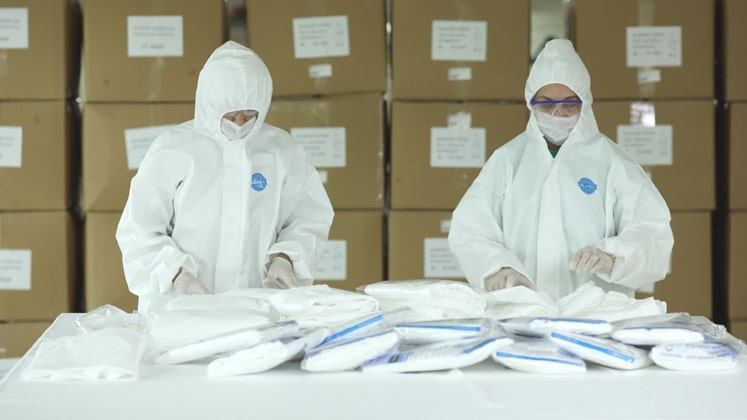
Earl R. Miller, the US Ambassador to Bangladesh, tweeted yesterday (25 May), “Pleased to welcome #Bangladesh to the club of world-class, large-scale #PPE manufacturing nations. This @Beximco_Group – @Hanes flagship partnership is the best of United States & Bangladesh working together to beat #COVID19…”
Pleased to welcome #Bangladesh to the club of world-class, large-scale #PPE manufacturing nations. This @Beximco_Group – @Hanes flagship partnership is the best of 🇺🇸 & 🇧🇩 working together to beat #COVID19. #InThisTogether #PPEfromBeximco #USBDPartnership pic.twitter.com/4fC6cJzKaj
— Earl R. Miller (@USAmbBangladesh) May 25, 2020
Beximco Group, Dhaka, yesterday air-shipped 6.5 million PPE gowns to the US brand Hanes for ultimate delivery to Federal Emergency Management Agency (FEMA). A proper function was organised at the Dhaka Airport in this regard.
Irrespective of Bangladesh’s internal need for PPE and production of the same, one should praise Bangladesh and Beximco Group for this milestone achievement.
At the same time, Indian manufacturers strongly feel that the country should also now allow the export of PPE. And they have plenty of reasons in their favour, including a huge capacity of PPE manufacturing, enough availability of raw materials, enough supply to domestic demand and a lot of export enquiries from many countries on good prices, etc.
Apparel Resources spoke to many PPE manufacturers from North to South, and all of them shared the same opinion – yes, export of PPE should be allowed in the country as early as possible.
India has a huge capacity for PPE, as around 4.5 lakh PPE suits are being manufactured daily, and the number can increase further as many factories are still not utilising their full capacities for the same. There are few companies producing PPEs during night shifts, while some have higher capacities but lesser orders. There is no dearth of raw material also, be it specific fabric or tape required for PPE.
Bengaluru, Delhi-NCR and many cities of India are making PPEs. Even the apparel manufacturing hub Ludhiana has the capacity to produce 2 lakh PPE suits and 1 lakh metre fabric for the same per day.
Modelama Exports, Gurgaon, one of the well-known apparel export houses of India, is producing 8,000 PPE kits every day, while it has the capacity of 25,000 pieces per day. Arvind Rai, Director of the company, shares that they have less orders currently, so they are not utilising the full capacity.
Also Read: What goes into making a body coverall?
It is a good sign that on the request of the Association of Indian Medical Device Industry (AiMeD), the Government is planning to allow the exports of surgical three-layer masks and N95 respirator masks, as India now has a surplus capacity in these product categories.
Invest India, an initiative of the Indian Government, in one of its reports, claims that PPE in India is a Rs. 7,000 crore industry in the making. The report also says that India has a current stock of around 1.5 million PPE kits while more than 20 million kits are being prepared by the industry against the orders.
“To milk this opportunity, India would need to ‘re-evaluate’ some of the current bilateral and multilateral trade agreements,” the report reads.
As per reports, the global PPE market size was estimated at US $ 55.60 billion in 2019 and is expected to reach more than US $ 59.50 billion in 2020.
Also Read: PPE export can’t be allowed as of now, says DGFT
Raja M. Shanmugham, President, Tirupur Exporters Association (TEA), tells Apparel Resources, “Yes, the Indian Government needs to open up once it gets assured of its nation’s needs. I believe that our requirements could be fulfilled in one or two months of production, only post which we need to leverage our strengths to the global demands.”
Raja also suggests, “At this point, the Government can allow PPE exports above a base price, say if it is fixed at US $ 15 as the base price then a price above that could be allowed for exports.”
It is also worth mentioning here that the majority of PPE production is with organised players who have easy access to export orders and work systematically. Apart from top-level export houses like Shahi Exports, Modelama Exports and domestic giants like Arvind Ltd. amongst many others, Government bodies like Indian Railway, Navy and Ordnance factories are also producing PPE.
Indian Railways has made important contributions in the effort to domestically produce PPE. Having in-house production of PPE, more than 1.2 lakh coveralls have been produced by the Indian Railways so far. It has a production capacity of more than 4,000 pieces per day.
Indian Railways has made important contributions in the effort to domestically produce Personal Protective Equipment (PPEs), sanitisers and face covers to fight against COVID-19.
🥼 1.2 lakh PPEs
🧴 1.4 lakh litres Sanitizer
😷 20 lakh Face Covers pic.twitter.com/uSSJ0rS6G9— Piyush Goyal (@PiyushGoyal) May 23, 2020
Vandeep Ratra, Director and CFO, GBKC Fashions, Dehradun, who boasts of the state-of-the-art infrastructure for PPE production, underlines, “I think it’s time that India should be on world’s mind when it comes to the sourcing of medical textiles, as India has all the resources and infrastructure which are required. Given the fact that China has been leading in the sector so far, but with the current void that has been created because of the virus spread and sentiments of people against China, it’s an opportunity for us to bridge the gap and let the world know about our capabilities.”
He also raises an interesting point of compliances, “Companies will have to just focus on getting additional knowledge with respect to the compliances which are required to export the products. As most of these products fall under the definition of Medical Devices, it attracts different compliances which might be country-specific. For exporting PPE, isolation gowns and other related products to European countries, these products should be CE-certified which is obtained by following Directive 89/686/EEC on PPE and Directive 93/42/EEC & Regulation (EU) 2017/ 745 on Medical Devices as defined by the European Union. Most of these products require testing from a recognised laboratory as per various test methods defined in EU directives.”
Similarly, for exporting to the US, the manufacturing entity must register itself with the US FDA and should appoint a US agent who will manage the operations from the US.
Also Read: PM, CM, MOT and Indian Navy… PPE is the talk of the town!
TT Ltd, Delhi, a company known for its innerwear and casualwear, is also producing PPE kits. Sanjay Jain, MD of the company, and one of the well-known faces of Indian textile industry, is of the observation, “It depends on demand-supply position – the prices have fallen indicating that the supply pressure has reduced, and hence, the Government should analyse the position and open from 1 July (if declared now, companies can start booking orders for July shipment).”
A company that earlier used to export the same products shares on the request of anonymity, “We were majorly into the export of similar products, and now as our clients are in the dire need of the same, we can’t serve them. However, we understand that domestic supply should be a priority for all, and now that India has a huge capacity, there shouldn’t be any further delay in allowing the export of PPE.”
On a concluding note, Christine Rai, Chairperson, Buying Agents Association (BAA), says, “India must ensure we have enough PPE for our domestic/internal use, obviously. So, we should make sure India has enough for its own needs. Let the supply chain economic mechanism apply to this product. Producing countries are China, India, Bangladesh, Vietnam and Indonesia. Stopping it serves no purpose, except creating a glut in the domestic market. If it is already an accredited export company, they should be given priority to export.”
Also Read: Venturing into coverall manufacturing? Here’s what you need to know!