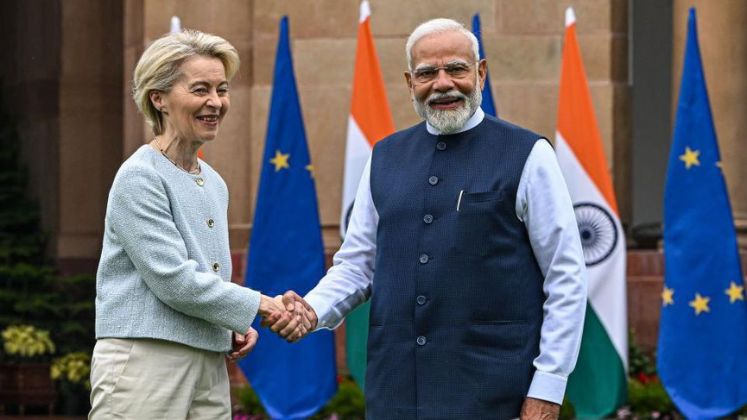
Due to the continued uncertainties surrounding global trade, India and the European Union (EU) agreed to finish the planned free trade agreement (FTA) in two phases at the end of the eleventh round of negotiations.
The choice to take a phased approach was made in the midst of a tumultuous international trade environment, which was partly impacted by tariff activities that US President Donald Trump started. By the end of this year, the second stage of the negotiations is expected to be concluded. Market access proposals for goods, services, and investment were the main topics of discussion between the two parties.
Prime Minister Narendra Modi and European Commission President Ursula von der Leyen have pledged to finalise the agreement by the end of 2025, which has fuelled the strategic drive for the pact.
India is using a similar two-phase approach in its negotiations with the United States, as it has done in the past while negotiating trade agreements with Australia. The need of tackling fundamental trade concerns at the first stage for an “early harvest” has been stressed by Commerce Secretary Sunil Barthwal.
Trade in goods and services, investment, technical trade barriers, rules of origin, customs and trade facilitation, government procurement, dispute resolution, intellectual property rights, and sustainable development are just a few of the 23 chapters that make up the India-EU discussions.
Regarding the ongoing negotiations of the India-EU Free Trade Agreement, Dr. Mukesh Kansal, Chairman of CTA Apparels, stated that it is hoped that a well-paced, phased strategy will result in a robust interim agreement as India and the European Union commence the 11th round of FTA talks. With reduced taxes, easier regulatory processes, and improved market access, this free trade agreement has enormous potential for the textile and clothing sector. In addition to boosting exports, a prompt and fair deal with the EU will also support long-term economic expansion and international competitiveness.