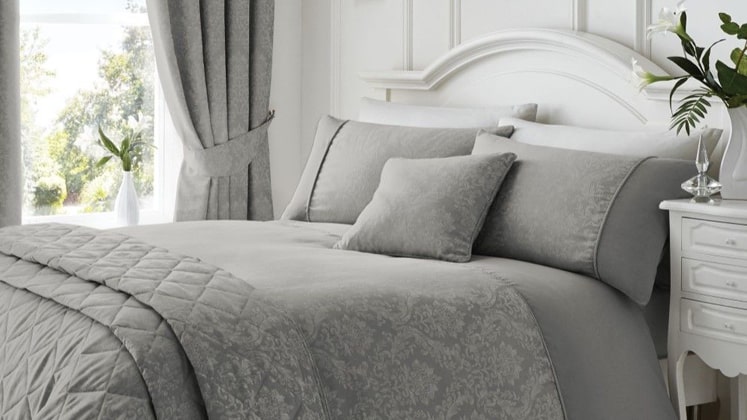
The home textile industry is witnessing a sturdy growth driven by factors such as rising consumer spending on home renovation and fashion sensitivity toward household furnishing which got sharp boost during pandemic period as people were keen to make their homes look good. Another factor that also ramped up demand of home textile goods all through 2021 is the rising health awareness of the consumers. Since bed linen (such as pillow covers) and towels cause serious transmission of virus at quick rate, people now prefer to have more quantities of these products in their homes to avoid any sort of infection.
USA – the largest home textile market in the world – nearly stands at US $ 70 billion valuation in 2021 in this category and the same is expected to grow at a CAGR range of 5-7 per cent during 2021-2026, as per various reports. The country is also home to the world’s biggest home textile/furnishing retailers offering exquisite home textile goods through their multichannel retail options. Walmart, JCPenney, Bed Bath & Beyond, Pottery Barn, Hollander Sleep and Décor, Target and West Elm among many others have noted at least double-digit growth in their home textile retail sales during 2021, and some reported growth as high as 35 per cent on Y-o-Y basis (such as Hollander Sleep and Décor) that give great outlook for 2022 onwards too.
This retail data is well supported by the import data in home textile category. Team Apparel Resources (AR) analysed US custom data and found that the total home textile imports of the country during 2021 valued US $ 5.76 billion, up by 38.17 per cent on Y-o-Y basis.
Where does India stand?
The countries like India that have held superiority in this segment for years didn’t miss the train either. All projections regarding healthy export demand, as the impact of the pandemic subsides, and ‘China Plus One’ sourcing strategy have come true and benefited the country’s home textile exporters that produced around US $ 7.34 billion worth of home textile goods during 2021, 60 per cent of which (~US $ 4.40 billion) went to the export-oriented markets.
USA, being the top export destination of India, constituted around 58 per cent of total exported value as India clocked US $ 2.60 billion from its home textile goods shipment to USA, outpacing China that could ship just half of India’s value and accommodated US $ 1.29 billion from its home textile export to USA. As compared to its other Asian counterparts, India stands far ahead by massive margin as Bangladesh’s shipment of home textile goods to USA valued US $ 450 million in 2021, while Vietnam could ship just US $ 17.77 million worth of home textile products to USA!
What’s interesting is India’s growth in all major seven export categories* both as compared to 2020 and pre-pandemic period of 2019. On the other hand, China fell in its shipment to USA in four categories in 2021 as compared to 2019.
*seven major home textile export categories – Table Linen; Bed Linen (knitted); Bed Linen (woven); Bed Spread (Quilt); Terry Towel, Cotton Pillow and Curtain
Four Home Textile categories in which India dominated in the US market…
Of all the seven categories, India remained miles ahead of China in its shipment in Bed Linen (Woven); Table Linen; Cotton Pillow; and Terry Towel. The collective export in these four categories valued US $ 2.45 billion in 2021, noting 45.83 per cent growth from 2020 and 31.72 per cent growth from 2019.
On the other hand, China’s figures aren’t positive as it declined by 17.58 per cent to US $ 889.64 million export values in the four aforementioned categories in 2021 from US $ 1.08 billion in 2019, though it upped its shipment by 15.60 per cent as compared to 2020.
Markedly, India’s export goes in line with USA as the latter’s import of home textile goods upped in 2021 in these four categories as compared to 2019 and 2020 and that signals towards India’s edge over other countries.
Here is India’s performance in each of these four categories:
- India shipped US $ 145.70 million worth of Table Linens to USA during 2021, noting 30.59 per cent growth over 2019 and 43.56 per cent growth over 2020.
- The shipment of Bed Linen (Woven) valued US $ 1.24 billion in 2021 and the category grew by around 33 per cent over 2019 and 49 per cent as compared to 2020. Markedly, this value is around 55 per cent of what USA imported in the category – US $ 2.28 billion.
- Cotton Pillow’s export clocked US $ 204.58 million revenues. It grew significantly by 42.57 per cent in 2021 as compared to 2020, while the growth over pre-pandemic period was 11.22 per cent.
- Terry Towel is becoming one of the most exported home furnishing categories from India and the data is evident of the same. India clocked US $ 869.86 million from its shipment of terry towel to USA during 2021, noting 36.65 per cent growth over 2019 and 43.37 per cent growth over 2020.
| Item-wise value increase/decrease in home textile imports by the US from the world |
|||||
| Major Home Textile Categories | 2019 | 2020 | 2021 | % change between 2021 and 2019 | % change between 2021 and 2020 |
| Table Linen | 373.68 | 261.94 | 338.11 | -9.52 | 29.08 |
| Bed sheet-Bed linen (Knitted) | 142.46 | 142.05 | 341.94 | 140.02 | 140.71 |
| Bed sheet-Bed linen (Woven) | 1979.86 | 1696.59 | 2279.61 | 15.14 | 34.36 |
| Bed spread-Quilt | 108.04 | 107.86 | 133.75 | 23.80 | 24.00 |
| Cotton pillow | 344.79 | 267.22 | 355.29 | 3.04 | 32.95 |
| Terry Towel | 1615.05 | 1441.65 | 1983.46 | 22.81 | 37.58 |
| Curtain | 209.23 | 252.84 | 329.66 | 57.56 | 30.38 |
| Total | 4773.12 | 4170.16 | 5761.83 | 20.71 | 38.17 |
| (Value in US million $) Compiled by: Apparel Resources |
|||||
| Item-wise value increase/decrease in home textile imports by the US from India |
|||||
| Major Home Textile Categories | 2019 | 2020 | 2021 | % change between 2021 and 2019 | % change between 2021 and 2020 |
| Table Linen | 111.57 | 101.49 | 145.70 | 30.59 | 43.56 |
| Bed sheet-Bed linen (Knitted) | 13.26 | 9.01 | 15.98 | 20.54 | 77.31 |
| Bed sheet-Bed linen (Woven) | 929.45 | 829.49 | 1235.97 | 32.98 | 49.00 |
| Bed spread-Quilt | 31.83 | 37.46 | 46.00 | 44.55 | 22.80 |
| Cotton pillow | 183.94 | 143.50 | 204.59 | 11.22 | 42.57 |
| Terry Towel | 636.58 | 606.74 | 869.87 | 36.65 | 43.37 |
| Curtain | 53.66 | 55.24 | 77.82 | 45.03 | 40.88 |
| Total | 1960.29 | 1782.94 | 2595.93 | 32.43 | 45.60 |
| (Value in US million $) Compiled by: Apparel Resources |
|||||
| Item-wise value increase/decrease in home textile imports by the US from China |
|||||
| Major Home Textile Categories | 2019 | 2020 | 2021 | % change between 2021 and 2019 | % change between 2021 and 2020 |
| Table Linen | 189.78 | 122.46 | 144.86 | -23.67 | 18.29 |
| Bed sheet-Bed linen (Knitted) | 47.30 | 44.19 | 166.07 | 251.09 | 275.83 |
| Bed sheet-Bed linen (Woven) | 442.58 | 296.80 | 320.93 | -27.49 | 8.13 |
| Bed spread-Quilt | 40.51 | 43.78 | 54.83 | 35.36 | 25.24 |
| Cotton pillow | 64.33 | 43.46 | 47.64 | -25.94 | 9.63 |
| Terry Towel | 382.71 | 306.89 | 376.20 | -1.70 | 22.59 |
| Curtain | 106.80 | 152.02 | 184.83 | 73.07 | 21.59 |
| Total | 1274.01 | 1009.59 | 1295.38 | 1.68 | 28.31 |
| (Value in US million $) Compiled by: Apparel Resources |
|||||
Home textile exports are on right track; it’s just a matter of keeping the momentum intact…
India is home to world’s largest home textile manufacturers such as Welspun, Trident, Indo Count and Himatsingka among many others, and they are ever-growing in their revenues all because they have been able to observe market sentiments right. These companies have created world-class production capabilities providing single window solutions to the leading home textile/furnishing retailers and brands across the globe.
Not just the big ones, but the mid-level players located pan-India have been managing to grab a good chunk in the global market share as they are improving their infrastructure to cater to increased export demand. It’s worth noting here that half of the home textile exports to USA is contributed by MSMEs. As said by the industry experts, in conversation with Apparel Resources, the next growth drivers are the markets such as UK, Europe, Australia and Japan where India collectively ships around 40 per cent of its home textile products and has the potential to grow both in volumes and values.
Growth continues even in tough time as COVID-19 proves to be ‘blessing in disguise’…
Of all major players in the segment, Welspun Group recently announced that it is moving towards touching US $ 1 billion revenues in home textile alone. For the first nine months of the current fiscal year (FY ’22), the revenues of the company climbed by 35.80 per cent to approximately US $ 955 million, all thanks to strong growth witnessed in towels, bedding, rugs and carpets. The company is also expanding its manufacturing footprint, with capacity increase in towels, bedding, rugs and carpets in the coming months.

Giving reasons for robust Y-o-Y growth, BK Goenka, Chairman, Welspun Group, mentioned, “Our markets like US and UK have been showing strong consumer spending. In India, economy is coming out of pandemic-led slowdown with strong demand supported by monetary policies and fiscal stimulus from Government.”
Commenting on the India’s growth in home textile category during 2021, Padma Shri Rajinder Gupta, Chairman, Trident India – a leading textile conglomerate, in his official statement sent to team Apparel Resources, says, “India has inherent strength in cotton-based textiles. This is due to ample raw material availability, skilled and competitive workforce, some of the world class manufacturing set-ups and government focus to develop as well as support textile segment, as it is one of the largest segments which is providing employment in the country after agriculture.”

The growth witnessed by Welspun and Trident India is not just a one-off incident. The derisking strategy of buyers who are going for shift in sourcing goods from more than one country has been benefiting Asian manufacturing hubs such as India. Furthermore, the banning of Xinjiang Cotton (which accounts for 20 per cent of world’s cotton production) by the USA brings additional advantage for India and its home textile players, pushing them to capitalise on the growing opportunities and bank on ‘China plus One’ sourcing strategy of buyers. Apart from this, the expertise of Indian factories in catering to mass, premium and value-added home textile market for over last 10-15 years has been keeping the exporters in good position.
Nabarun Dutta, Business Head (Home Textile Division), Daks India Industries Pvt. Ltd., also echoed the same as he mentioned, “The buyers are now asking for value addition in home textile products, moving from commodity products for which Karur (Tamil Nadu) has been a go-to location for buyers for a long time now.” Daks India’s home textile business has grown three times in 2021 over 2020, as buyers from USA, Europe, Latin America and Australia have increased orders in recent times due to a lot of geo-political situation. Since people have started staying back at home and paying attention to their home and kitchen interiors, Nabarun informed that kitchen linen has been a hit category that majorly consists of table runners, woven mittens, kitchen towels, aprons, napkins and gloves.
“People were not ordering outside food during Covid-19 times and were preparing it in their kitchens only… This trend has boosted the sales of kitchen linen drastically that has seen around 150 per cent growth on Y-o-Y in 2021,” shared Nabarun.
Bedding is another product that has been, reportedly, emerging in the global home furnishing market. Decorative pillow; throws; and pouffes are seeing immense inclination from the consumers and the same is evident when we talk to the exporters. “Since people are still staying at home and, in family get-together, playing games to bring back nostalgia in their lives, we have developed a pillow category using which one can play indoor games. A leading retailer from USA has recently come to India and visited us, after two years since Covid-19, and they were very excited to include this product in their home textile segment,” stated Nabarun.
“In Terry towel, we have strong foothold in the market already and, with our forthcoming capacity expansion in sheets, we are already on mission to build a strong customer base in sheets as well,” further says Rajinder Gupta, while informing, “We feel there is a very big scope of growth for India in these segments, that is why we have ambitious expansion plans in both sheeting and towels. Apart from this, we are expanding in floor coverings and top of the bed segments as well. India is playing a very significant role in home textile supplies globally and will further strengthen its position due to strong raw material base. The growth of India should remain continued as the retailers worldwide want to reduce their dependency on China and India will get very big advantage due to this.”
Endorsing this growth story in kitchen and bedding textiles, Pranab Mahajan, Director, Mahajan Overseas (P) Ltd., commented, “We have grown by around 12 per cent on Y-o-Y basis in 2021 wherein we have been able to grab a good chunk of business in cushions; throws and kitchen linen.” Along with bed linen and kitchen linen, what has been a profitable home textile product of late is towel…

The towel manufacturers have reported a great growth not just in normal times during pre-pandemic but also in Covid-19 time.“Towel is a main category for hospitals and even for a home where hygiene conditions matter a lot. Even when factories across the globe were closed in pandemic time, the buyers went on to search for towel vendors amidst rising demand for towels which is an essential commodity for them. We have seen around 25 per cent increase in our revenues in top-line and around 20 per cent growth in bottom-line during 2021 on Y-o-Y basis,” commented SM Dwivedi, CEO, Sara Textiles that has been producing around 500 tonnes of towel per month which translates into 1.20 million pieces.

Demand for value-added and eco-sustainable products is at an all-time high that comes with good value proposition…
When Pranab Mahajan mentions that his company is grabbing ‘good chunk’ of business, this goes without saying that requirements from buyers are coming more for organic, recycled products as Mahajan Overseas is the first certified, Green Silver-rated home textile factory in India. Apart from this Panipat-based company, the other factories have also accepted and encouraged the sustainable route for growth.
“…Design Price Delivery and Out of Box (DPDO) is our mantra for sustainable growth. We are targeting growth of 7x in the ongoing year all because we have been aggressively focusing on sustainable and eco-friendly fabrics to produce our home textile collection. We have developed ‘Out of Box’ fabrics from the paper pulp and used it in new pillow collection that is usable till 8 washes. Similarly, our ‘Acchara’ collection is made out of leftover fabric in block printing process. Along with this, we are also using eco-sustainable fabrics – linen, cotton, hemp and tencel, which are in heavy demand in European market as these fabrics make minimal impact on planet and decompose rapidly,” mentioned Nabarun.
All these products, mixed bag of commodity and value-added categories, fetch good revenues for Daks India as the company sells a pillow for as minimum as US $ 1.50 which goes as high as US $ 22, whereas average unit price of its main pillow category is US $ 7.50 for a filled which is at par with the global standards. “These products go to buyers such as Walmart, JCP, Target, KAS and Amazon amongst many others,” stated Nabarun.
As far as Sara Textiles is concerned, it is one of the few companies in India which has been shipping around 97 per cent of its products in the overseas markets – such is the demand it is witnessing for its cotton-based products. Recently, the company added value-added bathrobes and jersey bedsheets for mattress in its basket that are fetching good revenues.
“Both these products are value-added products… Bathrobes are made from towel’s fabrics only and we are producing this for Walmart USA. The normal towel sells for around US $ 6.50 per kg, while bathrobes’ unit prices are US $ 9 per kg,” averred SM Dwivedi who further shared Sara Textiles will be doubling its production capacity by March 2023 for towels and bathrobes.According to experts like Amit Jain, Founder, A&M Consulting who has been Trident’s President in the past, home textiles can do what information technology (IT) did to India on the global stage. Amit says, “In current ET 500 companies, only 16 are from textiles. Out of these, 39 per cent are from home textile sector and 80 per cent of these are in export business. The last year has been a dream one for Home Textile business. As a result, the Trident Group has the second highest market cap amongst these companies, after Page Industries (Jockey).” He adds, “In last two years, the sudden spurt of demand and anti- China feeling led to major advantage to Indian manufacturers who have been getting even the value-added business based on their investment in innovation and sustainability.”

Will FTAs help Indian factories keep up the momentum in the markets other than USA?
The market for home textile worldwide is likely to show remarkable growth in the years to come especially in North America and Europe that collectively are the biggest consumers constituting 60 per cent of the global home textiles imports. Markedly, India’s share just stood at 43.84 per cent two years ago in 2019 in the US market (in the aforementioned seven categories) and it has increased by another 1.30 per cent till 2021 to reach 44.13 per cent. Rapid urbanisation, improved standard of living coupled with increasing spending power in the non-traditional countries are some of the key factors supporting the revenue growth of the exporters dealing in home textile industry. With all these factors working in India’s favour, Team Apparel Resources analysis predicts, India will be able to increase its share in the US market to 48-50 per cent in 2022 in the top seven home textile categories.
USA is believed to be a not-to-lose market for India after the dominance shown in last few years, however, as industry stakeholders do project, the special trade agreements with UK, Middle East and Australia shall help in growth in these geographies too. The Ministry of Textiles (MoT) is keen to get made-ups/home furnishing (and apparels too) included in the early harvest programme being worked out between India and the UK as a precursor to a full-fledged Free Trade Agreement (FTA).
It is pertinent to mention here that apparel exporters of Bangladesh, Vietnam and Pakistan have a tariff advantage of about 10-11 per cent because of the special schemes they qualify for. If India and the UK agree on tariff cuts, it would increase the competitiveness of Indian home textile exporters tremendously. India shipped US $ 323 million (up 30.81 per cent on Y-o-Y) worth of made-ups/home textile products to UK in 2021, as per Ministry of Commerce and Industry (India), and this is the second highest export value of India after USA that imported US $ 3.46 billion* worth of made-ups from India. One can clearly see the gap in export revenues between the top two export destinations and this gap can be filled if FTA with UK takes place.
*This is overall home textile exports to USA from India in 2021; while the tables and statistics mentioned in the beginning part of this feature just state the export value in top seven product categories only.
FTAs are important but the significance of MMF-based home textile products can’t be overlooked as well. The basic raw material price has been a big deterrent to growth of Indian exports to the Western part of the world and, with availability of the raw material at international price, this sector too should grow in 2-3 years.
Factories are staying optimistic amidst rising costs and other challenges…
It’s true and undeniable fact that the short-term hurdles such as rising cost of logistics and raw material in business may persist but the progressive companies in the home textile division continue to remain positive about the growth opportunities on a long-term basis. The orders are certainly increasing and the factories are meanwhile finding ways to subside the pressure of skyrocketing prices.
“Definitely, the performance has increased tremendously and there is a big positive increase in the volumes. But, the industry is still suffering due to some reasons. The past has been great, present time is reasonable but future’s projection is not so clear. One reason is – import of long fibres now put under a duty of 10 per cent in the last budget. India produces made-ups majorly out of Egyptian cotton and Supima Cotton and the US market’s premium buyers are looking for premium products made out of these cotton. This cotton constituted around 25 per cent of our exports last year but import duty changed the equation! Earlier our towels were selling at over US $ 8 per kg and the prices have shrunk to below US $ 7 per kg, all because we are now using more of Indian cotton which is not giving ‘brand value’ to our products,” claimed SM Dwivedi.
“Amidst improving market conditions in overseas markets, we are trying our best to not get carried away! We are still holding our grounds as we believe, sooner or later, benefits, in terms of profits, will be seen in our business as soon as the prices of raw material come down,” commented Ramesh Verma, President, Handloom Exports and Manufacturers’ Association and Director of Diamond Exports.
The factories are not just grappling with high raw material costs but are facing challenges due to high freight rate and container availability issues that factories of such scale believe can be growth impediment factors, if the situation continues in long run. “Due to this situation, units like ours have not gained much…However, we are hoping these issues get resolved in near future. Until that happens, we are trying to stay in the competition with complete positivity,” averred Vineet Sharma, Director, Artex Home Fashions.