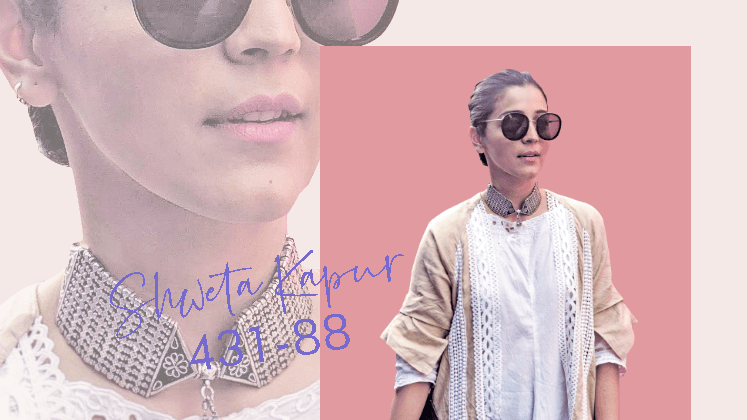
Reckoned among the top trailblazers of the fashion industry today, Shweta Kapur of 431-88 is known for her immaculate tailoring and silhouette rendering that can make any woman feel good about herself.
An alumna of London College of Fashion (LCF), Shweta credits the inspiration behind starting her own design label to the dysfunctional relationship she suffered with her body. “From eating disorders to borderline depression, I often used clothes to hide under,” said Shweta, adding, “Sacks of fabric pretending to be clothes used to be a safe haven and dark colours used to fill my wardrobe.”
All that changed when Shweta joined LCF and started learning pattern cutting. Wanting to make a difference, she realised how one could cut and sew a fabric to give shape and structure to the body.
Apparel Resources India gets candid with the promising Indian fashion designer to know more about what goes behind creating a solid footing in the fashion world, what’s the reality behind all that glamour and what skills are needed to create a niche in today’s competitive fashion design industry landscape.
AR: Did you get formal training in the field of fashion designing? Please elaborate on your educational and experiential journey, and how it prepared you for the future.
SK: I studied womenswear at LCF, after which I had the opportunity to work with Burberry. Post this, I moved to New York to work with VPL, where the idea of athleisure got seeded in me. VPL, New York was pretty hands-on being a small company, and between designing and sourcing, I assisted the head designer on shoots for Vogue Espana, which she used to style off and on. Burberry, in contrast, was far more structured as a company and probably the closest I have ever got to in a corporate work environment. The contrast between the two helped shape the idea of what I wanted my company to be like one day.
AR: How did you come up with 431-88 as your label name – what is the significance of the term?
SK: 431-88 is a brand that is for women on the go. I wanted something that resonates with them and their lifestyle. Numbers surround us and dictate our identities in more ways than one. 431- 88 is a part of a phone number that I grew up with and being part of a generation that is always glued on to their phones, it felt like a natural fit, hence the name.
AR: What kind of skills can the aspiring and upcoming designers hone to excel in the field of fashion design in today’s competitive landscape?
SK: Going beyond just design and technical knowledge, I think the most important skill to hone is how to be yourself – market that and make money off it. The world doesn’t need more empty products; what it needs is smart design which prods us towards a more sustainable and responsible future. Fashion as an industry is getting outdated and we need to address that. Consumers are now spending more money on experiences and less on consumer products; so to attract that spending towards you, your product needs to be rock solid and tell a story that strongly relates with your consumer. Stronger hold in niche markets or product categories is far more lucrative than being present in all markets and categories.
I think the most important skill to hone is how to be yourself – market that and make money off it. The world doesn’t need more empty products; what it needs is smart design which prods us towards a more sustainable and responsible future.
AR: What all crafts/techniques do you work with? How do you translate them over your garments?
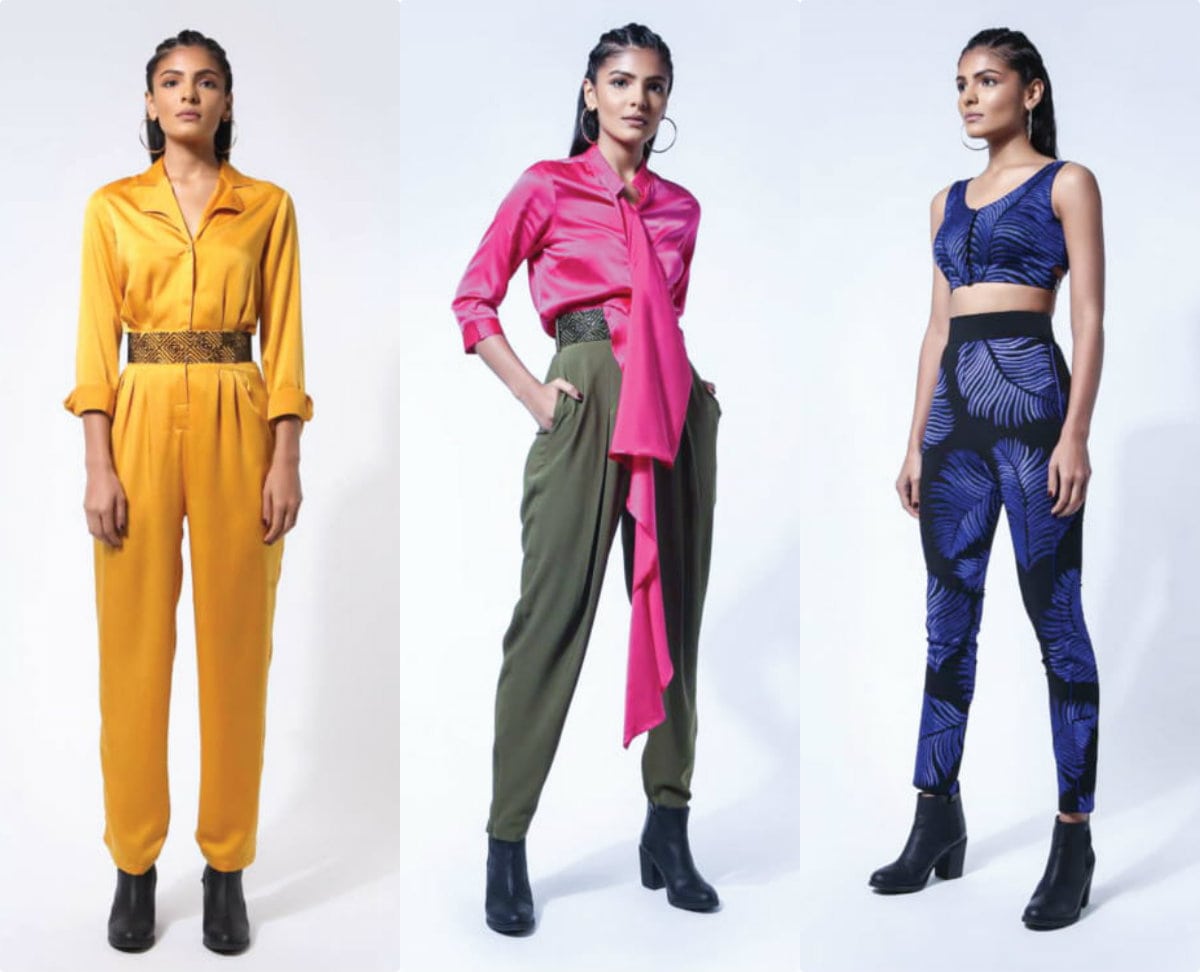
SK: A technique I have carried on with me is playing heavily with fringes which I did in the last two seasons and I wanted to incorporate that into my designs seamlessly. Hence, you would see the use of that detail in my saris, skirts and shirts. The fringes give the otherwise structured garments a movement.
AR: You are pushing the boundaries of how Indian home-bred fashion is perceived. What led you to opt for this aesthetic?
SK: I just focused on what I knew best and what I felt was missing in the market. When I started, the market was flooded with boutique designers who were hiding bad fits and stitching with heavy embroidery. It was messy and loud as an aesthetic. My generation of designers brought with them a fresher and cleaner approach to fashion; starting from design and going all the way to presentation.
This aesthetic just came naturally to me because I’m quite straightforward as a person and like to tell it as it is without the flowery language that used to surround fashion design at that time.
Stronger hold in niche markets or product categories is far more lucrative than being present in all markets and categories.
AR: What are some of the main materials/fabrics you work with? Are they outsourced or created by you in-house or a mix of both?
SK: My main criterion for fabric selection is how it feels on my hand. It needs to feel soft and comfortable on the skin when worn. I use a lot of cotton and silk from India along with technique enhanced fabrics from Japan that we develop with the factories that we work with. I also make sure that the fabrics used are easy to take care of and don’t crease easily, keeping in mind the needs of our woman who is always on the go. While Indian fabrics have a lot of charm with history and storytelling ability, Japanese fabrics are equally fascinating in the way they are made.
AR: The fashion industry is constantly evolving and one sees trends change in the blink of an eye. How can a brand stand out in such a scenario and how do you rise to the competition?
SK: Like I said before, a brand has to know exactly what it is. Market that and make money off it. It’s never been more important to stand up for core ethos and develop products based on it. Once you identify your niche market, and constantly focus on your own growth, competition and market trends will not affect you.
AR: It takes a set amount of capital to start your own business but not everybody is blessed with the economic conditions to make that happen. What would your advice be to such aspiring individuals? How can they navigate through this?
SK: First and foremost, one must understand that it takes a lot of capital to set up a business, and fashion usually has a really slow return in the beginning. So be ready to bleed out for the first few years.
Today it’s not enough to just be a good designer, you also have to be good at business, marketing, selling and networking. Be ready with a business plan that goes beyond making 2-4 nice looking collections. Find an investor, collaborate with like-minded individuals and always hire the best. Cheap talent will make you lose more money.
AR: What are some of the challenges you faced while setting up your label and how did you overcome them?
SK: The key challenge faced by us was to get the consumer to understand that more embroidery does not mean more value for money. It took them a while to pay a higher amount for a plain well-cut shirt made in premium Japanese cotton. But once they started wearing our products and felt the fabric on their skin, they slowly converted. Even for our saris, which are made from plain pre-pleated fabric with no embellishment, the customer was really apprehensive about spending money on it earlier. It took two seasons for the market to embrace it but when it did, it blew up to a different degree. Now our saris are always almost sold out and we sell at least one on Instagram every day. Also, because of the experimental nature of the current customer, a lot of our contemporary wear is being used for weddings and our saris are being used for dinners and occasions where one would normally opt for a dress.

AR: What, according to you, is more important for a brand today – participation in fashion weeks, exhibitions or social media engagement?
SK: Fashion weeks have made designers a bit jaded. We need to move beyond the idea of using one space, one runway, one pool of models and talent. Let each designer use his/her own voice and vision and create something from scratch. The whole idea of going for fashion shows and fashion weeks in the country is getting boring. At every fashion week, industry insiders usually sigh when asked about which show they are going for. Out of the 50-odd shows, there are usually only 1 or 2 which move people. People outside the industry are usually not that interested since it has become ‘been there done that’. Spectacular productions are usually saved for the finale show. Shows, which are exciting, are usually the off-venue ones, which give us something to think about. Don’t get me wrong, people love the idea of a fashion show and for designers it’s the highlight of the season, but the concept and execution of the same needs to change, that’s it. Fashion is aspirational and shows need to highlight that.
Millennials, who are a majority of our target market, are more comfortable shopping on their phone. There is always a huge boost on Instagram post our show since no one is willing to wait for six months for the clothes to reach stores. It’s the cheapest marketing tool and has the maximum returns.
Everything that the brand does is on Instagram. We get queries everyday from customers around the world and have a dedicated team who only handles customers on Instagram and WhatsApp. Millennials who are a majority of our target market, are more comfortable shopping on their phones, than going to a store, parking, trying on clothes and then buying. There is always a huge boost on Instagram post our fashion show since no one is willing to wait for six months for the clothes to reach stores. It’s the cheapest marketing tool and has maximum returns. It all depends on the audience of various brands. While social media and runway shows give us a higher return, exhibitions and pop ups work for others.