Additive Manufacturing or 3D Printing is an important component of Industry 4.0 which is commonly used in heavy-duty industries or aerospace industry, but hasn’t gained much traction in garment industry yet! Many 3D printing projects came in garment development – some failed and some saw decent movement. But, what was never thought of by the industry is the 3D printing of sewing machines’ attachments and National Institute of Fashion Technology (NIFT), Delhi (India) realised this gap back in 2016 when it started researching on the subject.
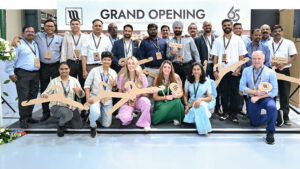
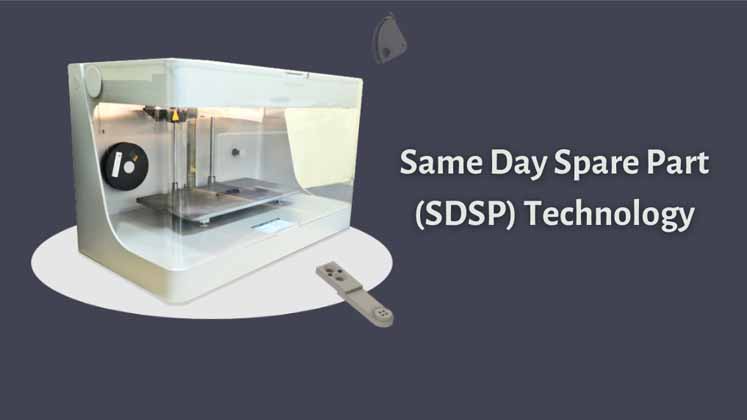
After a successful research, NIFT recently launched its 3D printing project for sewing industry called – Same Day Spare Part (SDSP) printing, which it believes can play an important role in manufacturing the frequently replaceable small parts at the point of consumption. The aim of this project is to deliver or make available the spare parts within a single day and the name SDSP is inspired from Single Minute Exchange of Dies (SMED) concept.
What SDSP is all about?
While most of the sewing machine spare parts are currently manufactured in China, rest of specialised parts are supplied by respective Original Equipment Manufacturer (OEM). As NIFT says, fashion is about change and slight modification of a style can necessitate a specific spare part at production stage and availability of the right part at the right time can become a challenge. A presser foot of a particular specification may cost only 20 cents but may take 4-5 days to import. Same Day Spare Part (SDSP) challenges the industry stereotypes with 3D printing technology.
According to Manisha Kinnu, Director, NIFT Delhi Campus,there is a huge gap in the market for Indian manufacturers of machine parts and attachment for the apparel industry. “Indian apparel manufacturers have to depend on import for their day-to-day operations. This creates logistics delays and many times causes additionally increased costs. While MNCs and large factories may be able to afford this, the MSMEs need to find alternate solution to this problem. Our SDSP project aims at simplifying this entire process,” comments Manisha.
SDSP enables apparel manufacturers to 3D print a spare part or attachment themselves or get it delivered within a day if outsourced, and save time as well as cost. Explaining the mechanism, Deepak Panghal, Asst. Professor, NIFT, says, the printing process starts with reverse engineering process followed by the development of CAD model for any attachment such as Hem Folder, Presser Foot or Button Feeder. Slicing process comes next which is followed by the process parameter set-up for printing that needs to be defined – called ‘topology optimisation’.
“It goes for printing then and when printing is done, it is removed from the built plate from printer. We have to remove support material that is used during printing and after that the part can be directly plugged and played on the machine. The same process is followed for more spare parts that are there in our catalogue,” mentions Deepak.
Since SDSP project is best suited for non-metallic material, NIFT opted for Onyx which is a composite base material. Onyx is a micro-carbon fibre filled nylon that yields accurate parts with near flawless surface finish. It is believed that few materials have the versatility of Onyx; it offers high strength, toughness and chemical resistance when printed alone, and can be reinforced with Continuous Fibres to yield aluminium-strength parts. Today, there are more than a million Onyx parts in the field transforming manufacturing.
Here is how the industry reacted on SDSP technology…
Apparel Resources has always advocated the use of technology within the garment manufacturing landscape and, when we got to know about NIFT’s new project, we got in touch with the Indian industry ranging from spare part manufacturers to sewing machine dealers to garment manufacturers to know their point of view and perspectives…
Avinash Misar, Director and CEO, Advanced Material Division, Texport Syndicate (India) Ltd.who is also Vice-Chairman of Indian Technical Textile Association (ITTA)and holds strong knowledge in composites as well as additive manufacturing congratulated NIFT on the launch of this 3D printing project for sewing industry…
He then opined that though 3D printing is a proven technology, the set-up is not an easy one and it comes at a certain cost that may seem nominal to big organisation but is certainly not a nominal one for MSMEs.
“Just like other industries, sewing machine parts can also be developed out of resins (or composites, whatever you want to call it) and they are known to be strong materials. However, designing of spare parts in 3D printing set-up is not an easy-to-go process. The entire process needs to be streamlined and it’s not like printing one part at a time, other part on another day and so on. It’s an industry in itself. If I have 1,000 sewing machines, I would require at least 1,000 spare parts of various types at any point of time. So, for 1,000 parts, I am not going to start a 3D printer at a time when import of such parts are not that much costly. Using composites to 3D print spare parts is good idea as it is proven material for increasing strength but thinking that garment manufacturer will install 3D printers and they will make spare parts as and when required, is a far-fetched idea. If you put a 3D printer, you need a separate space, equipment, you need to arrange and place all necessary accessories and material which I think is not conceptually right and it will be costlier, especially for MSMEs,” asserts Avinash.
Avinash then suggests that it is however a good idea for a company of supplier who is already into spare parts business as they can put up a 3D printing plant, and churn out as many spare parts that the industry may require!
“For example – if a factory needs 20 spare parts of JUKI or any other sewing machine brand, the spare part manufacturer with their 3D printing facility would replicate the same and supply them to the factory. This technology is a boon for spare part manufacturers and suppliers, though installing it directly at garment factories won’t be viable,” concludes Avinash.
Sanjay Mehta, Founder, C K Trading Co.,a Kolkata-based renowned spare part and sewing machine part dealer,also opined his views when contacted by us…Sanjay said the technology seems good but deploying it in the Indian sewing and garment industry may take serious efforts yet the outcomes might not come as planned…
He reasons, “From my experience, I can vouch for the fact that less than 1 per cent manufacturing is being done in India for sewing machine attachments and spare parts.In-house manufacturing is still grappling with high cost of operation despite the use of technology and, most of the times, the cost of the product is 50 per cent higher than the part which is imported. So, setting up 3D printers in garment factories will incur significant cost – both tangible and intangible. Secondly, I believe there is no shortage of spare parts against demand from the garment industry in India and imports are being done on time and in low cost!Delivery time within India for spare parts is just one day, so no production is stuck in factories. Amidst such situations, why would a factory invest in setting up in-house operations of 3D printing, hire a whole new team, further invest in their training and maintenance…”
Sharing his opinion, Bhavya Anand, Business Development Manager, HCA – a leading sewing machine dealer in India – commented that in the first instance, the whole idea of 3D printing of spare part sounds excellent, however there are some issues that may irk the commercialisation of this project.
“First of all, linking of attachments made up of different material than the one used in the entire assembly may or may not work efficiently. Due to friction and abrasion during the sewing process, especially in overlock and interlock machines where speed goes as high as 6500-7000 RPM (if run continuously in some operations where long stitch time is required), it causes significant loss to the tensile properties of the threads and needle temperature rises to nearly over 350℃. I’m not sure if the composite material used to 3D print spare part can withstand temperature beyond 150℃! If it fails to withstand high temperature, the material of spare part may get melted and fabric that’s being stitched may get damaged…Another factor to ponder upon is the ‘play’ that will take place at the spare part connecting area to sewing plate assembly which is not at all good for precision sewing,” shares Bhavya.
NIFT lays plans to market the technology…
As per what Dr. Prabir Jana, Professor, NIFT told to Apparel Resources, NIFT would like to take SDSP platform to the industry as a knowledge and R&D partner. The premium fashion technology institution will research and develop parts on its own as well as custom develop for any manufacturer.
“NIFT will also help anyone wanting to develop the capacity to design and develop their own. Weare also partnering with 3D printer service providers, so in the beginning investment on printer can be avoided,” informs Dr.Jana.
So, how the industry will be benefited? Firstly, either a cluster of manufacturers avail the service from service bureaus or by installing a printer and printing the parts for their members from the e-catalogue. This eliminates the need for design and development expertise. Secondly, a large manufacturer with multi-location manufacturing facility can develop in-house expertise to design and develop parts for themselves in-house. Thirdly, the existing machine parts suppliers will start printing some of the parts in India and supply to their customers!