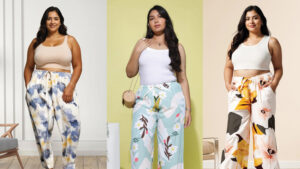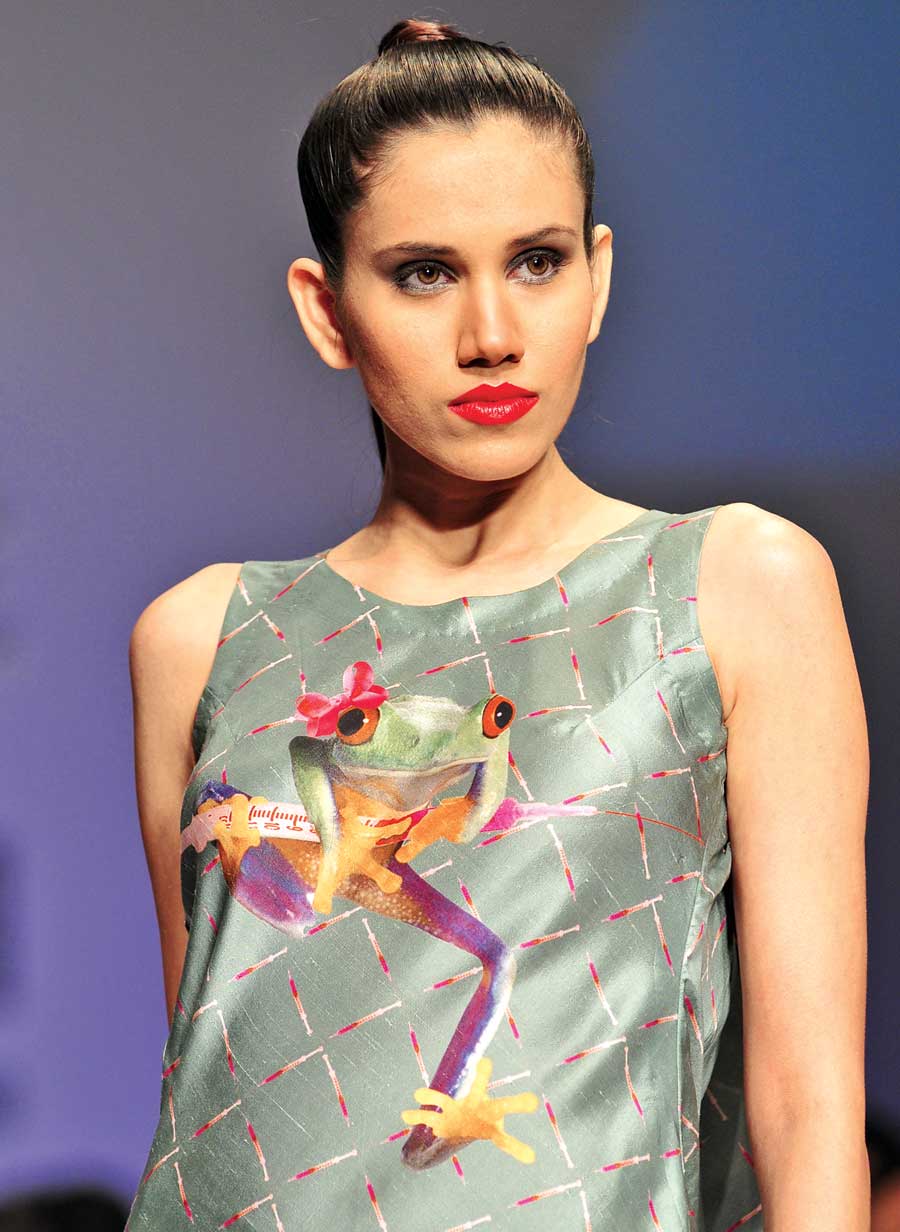
The demand for digital printing is on the rise with forecast for S/S 2011 indicating the same as a moving trend. Interestingly, even the domestic market is picking up the lead and Indian designers too have started experimenting with the technique. Not to be left behind, Home Fashion is also getting a boost with regular demand for digital printed cushions, kitchen towels & bed linens both in the domestic market and international market.
While the cost of the technology is still a constraint for many manufacturers, the value that it can give in terms of design options and curbing plagiarism can surmount the cost. The industry admits that the demand is almost doubling year on year and from a low quantity business there are indications that it could in the next few years become a printing technique for mass production.
As off today more and more international stores have started demanding digital printed apparels with low volumes per designs but in regular intake giving boost to regular orders throughout the year,” says Ketan Talwar, Director, Tex India Enterprises (P) Ltd. Talwar has installed a digital printing machine which he is using both for his export needs and also offering the service to other exporters. Most of the exporters who are working in digital prints are reluctant to share the name of the buyers they are working with. Some of the exporters who have worked with digital printing are RMX Joss, Shahi Exports, Bombay Rayon, Orient Craft, Vikram Overseas, Matrix Clothing to name a few.

The buyers opting for digital printing in the international market are high fashion boutiques, high fashion brands, designer labels and sportswear companies. The buyers in the domestic circuit are mostly silk stores, boutiques and fashion designers. “The best market for regular demand in digital print fabrics and apparels is mostly in Europe in particular Italy, Germany, UK and Spain. Few US stores are also asking for digital prints but the demand and taste changes so fast that the orders are few and far between.” This is the general perception of all those working in the international market.
Currently, the trend in digital printing is towards ‘real photographs’ which means reproduction of photographs, whether a person’s face or a scenery. Paintbrush images are not in demand these days. “To save cost most of the buyers are asking for placement prints instead of overall prints,” says Abdone, Fashion Designer with Vikram Overseas. “The 60’s Cycladic look will come out strongly in digital printing trends for Summer 2011.
Further, geometric prints and optical prints will also be in vogue in a Kaleidoscope of colours,” he adds.
No doubt keeping the print cost down is one of the biggest challenges in digital technology. Highlighting how user of the technology can control cost Vinod Krishnamurthy, MD, Texsoco says, “It is important to have a complete infrastructure to reduce working cost, which includes facilities for both pre- treatment and post-treatment requirements. Further, there is a need to have better colour profiling for various fabrics to control ink density.
[bleft]The buyers opting for digital printing in the international market are high fashion boutiques, high fashion brands, designer labels and sportswear companies[/bleft]
We provide it as a chargeable service as it takes effort and time. The quality of the ink is equally important.” Vinod who is the agent for Mimaki digital printers in India is upfront when he suggests that the user must be very sure of what market segment he wants to service before making an investment in technology and working team. For example a high-end designer costing the company Rs. 40,000 per month or more can’t justify for just one machine, the running cost would shoot up.
Indeed selecting a technology for digital printing is not easy. There is much more to it than the machine. Many times users find that the colours are not matching what they see on the desktop or sometimes the clarity/sharpness are not there. This is so because they buy sub-standard machine or buy machine of one make and the software/inks from another and hence the results are not effective. It is thus important to invest in a complete system and not mix and match to save investment cost. “So buying a complete system translates into 90% efficiency in production and less down time,” says Ayush Rathi, Director Karan Impex. Ayush is marketing digital printers from MS Italy. One of his machines is running at Vishal Prints in Surat and since the company is printing about 35,000 metres continuously from the digital printer the cost per metre comes to around Rs. 25-30, which is nearer to a rotary printing cost. No many can achieve these results as there are many variables that affect the cost.
Technology providers are stretching themselves to support the industry to use digital printing. “We currently provide design training and if asked give designs to customers for which we have a team of 4-5 people. We produce samples free to all customers who come to buy the machine and even help to the extent of building business,” says Vinod. He further adds, “It takes a lot of effort and money in giving these support. Customers have to understand that the solution provider will be like a consultant doing a setup customized to his needs. Unless this synergy does not happen the industry cannot benefit.”
It is imperative to appreciate that the international buyer needs a setup to deliver quality and price. As most people do not follow the right procedure for optimization of technology either the product comes expensive or the product is inferior. What the buyers want is a maximum of $ 2 printing on a garment but that can only happen with quantity and commitment.
Digital Printing by Indian Designers
Most Indian designers agree that if the sampling and production costs of these prints come down, the demand for the technique will go up immensely in India.
Comparatively, more than 80% of the international designers depend on digital prints for the simple reason that it gives their clothes and designs exclusivity, a finish that no screen print can give and colour fastness as well apart from them being given the fabric quantities before the stipulated time.
“I have been doing a lot of digital prints since the last 5 years now. As I get inspiration from nature, the best and fastest way to depict my sensibilities, colours, and artworks was via Digital Printing,” says Rajdeep Ranawat. Rajdeep’s Spring / summer 2010 collection at the WLIFW inspired by deep sea life, corals and used motifs like starfish, algae, ferns, sea urchins, etc. was done by digital printing. As the quantities in digital print are small they are suited to the needs of designers. “Clients looking for quality and high standards in original prints from a designer don’t mind paying that extra bit to possess such designs on themselves,” adds Rajdeep.
More designers take the plunge ”I love digital printing and I am going to use the concept in my designs this time. I am doing a small capsule collection of clothes and shoes for which I am working with an Indian illustrator to create unique patterns. In terms of designs, a few, abstract prints in bold colours or tribal inspiration patterns and ergonomic shapes and design look fantastic.” – Sabbah Sharma.
“Yes digital printing is definitely catching up. I have used the same for quite a few pieces in my summer collection and usually the quantities are small. Prints inspired by the colours and patterns of the tropical forests are wonderful. The market for digital prints will increase as prints allow a lot of scope for variance.” – Varsha Bhawnani.
“Digital printing is definitely picking up as a trend and I have also used a lot of digital printing in my latest collection for my label ‘ANITA DONGRE IINTERPRET’. I think digital print dresses are definitely in this season. It’s perfect for the Spring Summer season.” – Anita Dongre.
Exclusivity is the major attraction “In designs, we develop our own design based on the mood board planned for a season. S/S 2010 was a line celebrating the iznik art found in Turkey, which was incorporated on fabric in the form of digital prints. Any new technology gets popular because of innovation, but sustained effort is involved in taking the concept to another level.” – Lina Tipnis.
A Negative voice “I don’t plan to do digital printing in my designs now; I tried to do it a few years back but didn’t find much success as the technology used is ridiculously expensive. The time when I attempted digital printing the colours faded as the printer didn’t treat the fabric after printing, small samples costed me a lot. Digital printing requires an expensive fabric and especially white in order to get best results. This is one technology I am very skeptical about.” – Jattinn Kochhar.