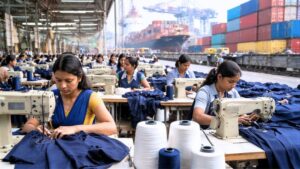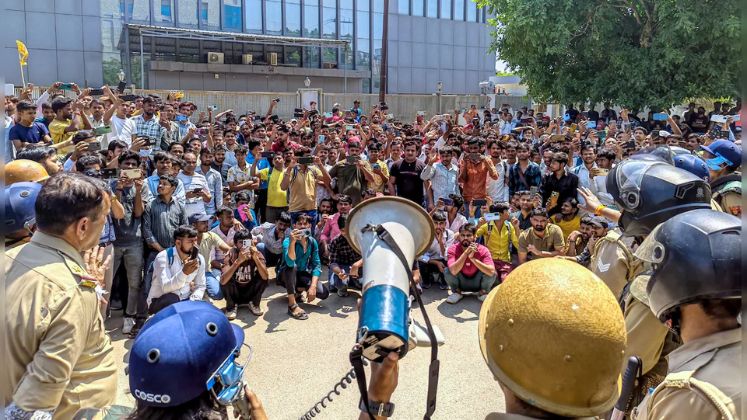
Thousands of garment and factory workers in Noida’s Phase 2 Hosiery Complex have launched large-scale protests demanding a substantial revision in minimum wages, with unrest entering its fourth day as of 13th April.
The agitation was triggered by a recent wage hike in neighbouring Haryana, prompting workers in Noida to demand pay parity amid rising inflationary pressures. Protesters highlighted that Haryana had announced a 35% increase in minimum wages, significantly raising salary benchmarks across skill categories.
The demonstrations turned violent in parts of Noida on Monday, with incidents of arson, vandalism and stone-pelting reported in Phase 2 and Sector 60, according to police. Several vehicles and properties were damaged, while traffic congestion caused major disruption for commuters across affected areas.
Protesters pointed out that the Haryana government recently announced a 35% increase in minimum wages. Revised monthly wages for Haryana workers now stand at Rs. 15,220 (US $163) for unskilled workers, Rs. 16,780 (US $179) for semi-skilled, Rs. 18,500 (US $198) for skilled, and Rs. 19,425 (US $208) for highly skilled workers.
Workers in Noida are seeking a minimum monthly wage ranging between Rs. 18,000 (US $193) and Rs. 20,000 (US $214). They have also expressed dissatisfaction with existing annual increments, which they indicated were limited to Rs. 250 (US $ 2.68)–Rs. 350 (US $3.75).
In addition to higher base wages, workers are demanding double pay for overtime, compulsory weekly offs, medical coverage, and timely disbursal of bonuses.
In response, the Noida administration and the Uttar Pradesh Labour Department have introduced a series of measures aimed at addressing worker concerns. Industrial units have been directed to ensure mandatory weekly offs and double pay for overtime. Authorities have also provided assurances regarding medical coverage and the payment of annual bonuses by 30th November. Furthermore, factory owners have been instructed not to terminate employees without notifying the district administration, with regular inspections planned to ensure compliance with labour regulations.
In an exclusive conversation with Apparel Resources, an apparel manufacturer stated that the unrest extended beyond garment workers and was affecting a wide spectrum of industries across approximately 11,000 industrial units in Noida, with the garment sector accounting for around 20%–25% of the total.
He further indicated that the disruption had led to shipment delays and affected production timelines, compounded by ongoing geopolitical challenges in the Middle East, and noted that operations at the facility had been suspended for the day due to escalating tensions.
He added that industrial associations were engaging with district magistrates in Noida and Greater Noida to find a resolution, while emphasising that restoring law and order remained the immediate priority before wage-related decisions could be finalised.
The agitation, which reportedly began in Gurugram, has since spread to Noida and Faridabad, signalling broader regional discontent.
Following directives from the Chief Minister, the Labour Department has constituted a committee to address the industrial unrest. The panel will be chaired by the Industrial Development Commissioner and will include senior officials such as the Additional Chief Secretary for MSME and the Principal Secretary for Labour and Employment, along with representatives from labour unions and industry bodies.
The Noida apparel cluster remains one of India’s largest garment manufacturing hubs, with exports estimated at approximately Rs. 55,000 crore (US $5.89 billion) as of March 2026.