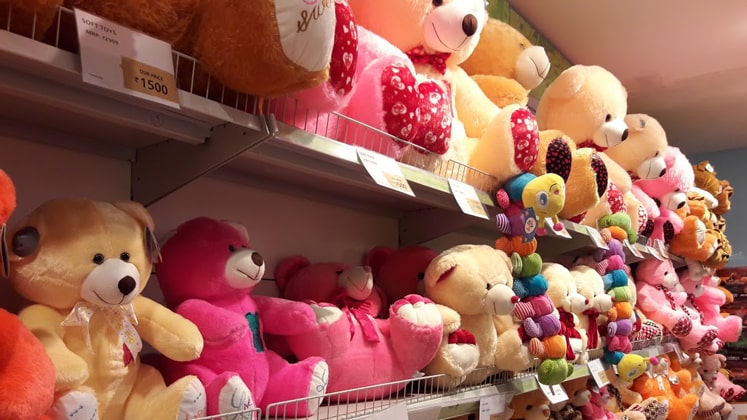
Diversification in allied products is one of the best strategies to grow but at the same time, there are very less opportunities for garment manufacturers where they can diversify. But soft toys manufacturing can be a good option for apparel manufacturers, especially now as overall things are in the favour of the toy industry, and the biggest of them is Government focus.
In May 2019 when India’s conglomerate Reliance Retail acquired the largest toy retailer, Hamleys, UK, the message was loud and clear that the toy industry is going to be a big attraction in India.
Now, two years later, the Indian Government has come up strongly to support toy manufacturing in India as the Ministry of Education, Ministry of Textiles and Ministry of Commerce are now intensively focusing on increasing the toy industry in India. India has now graded the toy industry in 24 major sectors and a National Toy Action Plan has also been prepared. 15 ministries and departments have been included in it to make these industries competitive and make India self-reliant in toys.
The Ministry of Education organised the first-ever Toycathon in which around 1,29,000 students from across the country, educational institutions and start-ups participated in support of the Indian Toy industry.
And this aggressiveness of the Government seems natural as India’s share in the US $100-billion global toy market is just nominal as around 85 per cent of the toys sold in the country are imported.
The point which should be a concern or opportunity for the Indian textile and apparel manufacturing industry is that the global stuffed animal and plush toys market size was valued at the US $ 7.98 billion in 2018 and is anticipated to expand at a CAGR of 7.61 per cent over the forecast period of 2019 to 2025.
As per various research reports, North America is anticipated to be the largest regional market by 2025 due to increasing sales of custom-made toys, such as action figures and cartoon toys. On the other hand, Asia-Pacific is estimated to register the fastest CAGR over the forecast period.
Based on the product, the stuffed and plush toys market is segmented into stuffed animals, cartoon toys, action figures and others. The stuffed animal products segment led the global market in 2018 accounting for a share of more than 42 per cent. The rising popularity of various cartoon shows is estimated to drive the demand for these toys, thereby contributing to the segment growth.
Stuffed and plush toys are into various forms, resembling animals, dolls, human beings, legendary creatures, cartoon characters or inanimate objects. Intended for playing in order for it to be considered a toy, it can have a decorative function as well.
Along with the Government, the industry is also active to grab these opportunities. Recently the four-day virtual toy fair The India Toy Fair-2021, aiming at strengthening the indigenous toy industry, was also organised and over 1,000 exhibitors participated in this fair. It was a first-of-its-kind initiative that aims to bring together all stakeholders of the Indian toy industry on a virtual platform to create sustainable linkages and promote dialogue for the holistic development of the industry.
Indian Prime Minister called for bringing out the hidden potential of the toy industry in India and to create an identity for it as a big part of the campaign for Atma Nirbhar Bharat.
An important aspect and common thread in the textile/apparel industry and textile-based toys is sustainability. Sustainability is a strong factor of the Indian textile and apparel industry and the same is true for the toy industry also as most Indian toys are made from natural and eco-friendly items and the colours used in them are also natural and safe.
Toys are also GOTS-certified as they have 100 per cent organic cotton outer shell. With hypoallergenic polyester fibre inside,soft terry cloth is a major raw material used in Indian toys. Its fabric normally doesn’t get treated with chemicals or flame retardants and is completely baby safe. Such toys are non-toxic as well as also made from 100-per cent recycled polyester fibre.
Channapatna in Karnataka, Varanasi in Uttar Pradesh and Jaipur in Rajasthan are some of the leading toy manufacturing hubs in India. The apparel manufacturing industry in Noida and Jaipur are also strong from decades; so the available ecosystem can be an added advantage for the apparel manufacturers who wish to explore this segment.
This is also a hard fact that the toy manufacturing industry should focus on improving the quality of their products and at the same time, there is a strong need to reimagine traditional Indian toys.
Even Commerce Minister Piyush Goyal said recently that the moment India starts making good quality toys, India will naturally become a player in international trade. It is only the quality culture that will help us to engage with the world and help us to expand our contribution to resilient supply chains and future businesses.
To support toy manufacturers, wherever toy cluster is being setup, the Bureau of Indian Standards (BIS) will establish laboratories for testing the quality of products. The charges for testing will be soon significantly reduced, thereby bringing down the compliance cost of the industry.
National Education Policy also gives new impetus not only to learning with toys but also to the procurement of toys in learning facilities especially those aided by the Indian Government.
There are top-level global buyers in this domain like Ikea which are sourcing a huge volume of cotton-based soft toys from India. Ikea recently announced that it will increase the toys sourcing from India. The company is also exploring to expand in some other categories of toys, apart from cotton or textile-based toys. It is also in the process to add vendors for toys.
Yashwinder Singh Kohli, Director, Jasco Handicrafts, Greater Noida who is into soft toys manufacturing from last 31 years believes that soft toys manufacturing is still in the nascent stage and requires a lot of collaborative efforts. “For raw materials, we are majorly dependent on China, stitching is also an area where soft toys manufacturing can learn from garment manufacturers as they have very strong and organised stitching system.”
He further adds that the major area where garment manufacturers have to focus on is material handing as soft toys use pile fabric of very low to high thickness, very slippery material, lycra, etc.
Catering totally to the domestic market, Yashwinder strongly feels that soft toys manufacturers need support on R&D, designing and production innovation.





 Bharat Tex Special Report 2026