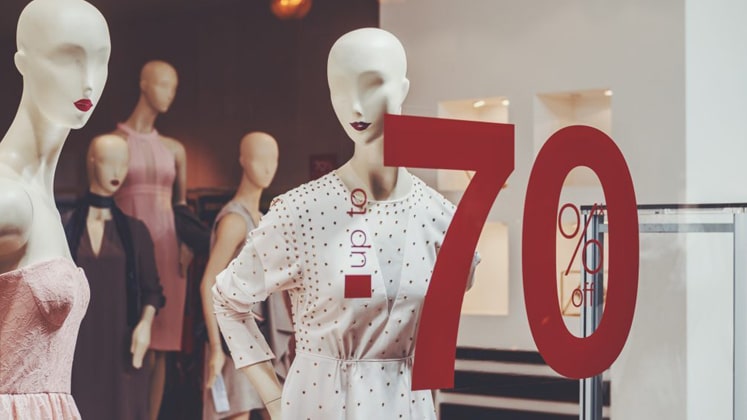
Amidst a global pandemic caused by the COVID-19 outbreak, businesses have been hit severely across industries, and apparel retail has been one of the worst hit. Sales at fashion brands fell by almost 70 per cent with fear of further decline post the lockdown period even as majority of retail brands are preparing to open physical stores in a structured manner with reduced shifts and restricted customer entry. While uncertainty is looming large on the retail businesses, one of the most damaging effects of the pandemic and subsequent lockdown is the unsold inventory at apparel retail brands.
Fashion industry has been running on seasonal basis and every collection is based on fabrics, colours and current trends and selling them during the season is critical for fast fashion industry. Once trendy styles quickly fall out of the shelf, they add to the unsold pile of merchandise and are sold in margin-killing discounts. Apparel retailers with shuttered stores are stuck with a season’s worth of inventory and to clear up the piled up inventory post the lockdown period, fashion brands are strategizing aggressively.
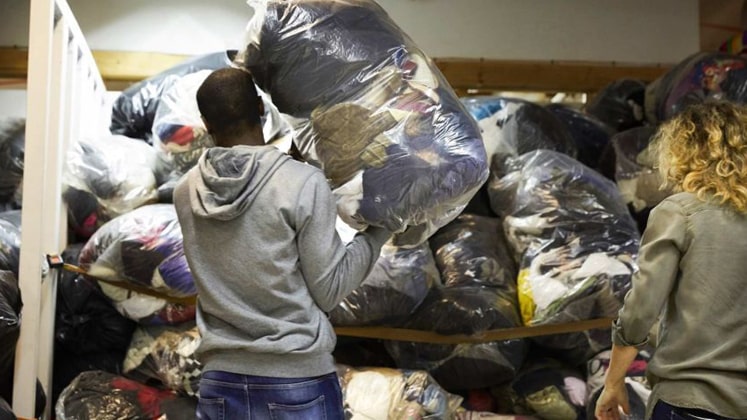
While retailers have reckoned that it would take 9-12 months for some kind of normalcy to return, they have, over the last few weeks, unanimously agreed on skipping pre-Fall collection completely, and instead, are planning the production of Autumn/Winter collection, besides offering discounts to lure consumers and also talking to e-commerce players to ramp up sales online. Since the Indian climate allows Spring/Summer wear to be used until winter sets in completely, fashion brands will go for roll-on of inventory from one season into the next. Furthermore, expansion plans too are on hold and retail leaders are trying to save cash in a situation where it is possible that shoppers may take months to start flocking the stores as earlier.
The survival strategies
Fashion brands like Tommy Hilfiger, Calvin Klein, Ritu Kumar, Arrow and Jack and Jones are planning to push their Spring/Summer collections till October or pre-Diwali to clear up inventory. In a webinar by Retailers Association of India (RAI), Shailesh Chaturvedi, CEO, Tommy Hilfiger India, said, “Fortunately, this time Diwali comes later in November giving us an extended summer. We will cut production of fall and holiday goods. We are avoiding deep discounting, as it spoils the brand and the market. The production, however, could stabilise only by February-March next year.”
Ritu Kumar’s Managing Director Amrish Kumar agreed as he asserted, “Being nimble on the supply front is a good idea in such uncertain times. Fortunately in India, season – in terms of fabric – changes only in October. So, we have a buffer time till October to push our Spring/Summer collection across bridal, high fashion and westernwear. We will also not be finalising any orders till October.”
Even as the third phase of the lockdown will be carried forward to further date, the retail leaders are hoping for more relaxations as are also waiting for the business operations to resume in staggered manner. The retail brands will have to undertake adequate precautions and measures to minimise the risk of exposure and to ensure safety of customers and retail staff, and relook at their business model and be ready for minimal footfall. Retailers are, in the meanwhile, looking at Diwali as a probable time for revival – for both business and spirits of consumers.
The pandemic has cracked the whip with force and one of the ways retailers are trying to cope with the jolt is by shifting whatever possible to online platforms which will help in better revenue generation and also selling the piled up inventory. Madame from the house of Jain Amar Clothing Pvt. Ltd. has cut down on its winter order, focusing instead on using its existing unsold spring-summer inventory for the upcoming autumn-winter season in August.
Talking to Apparel Resources, Akhil Duggar Jain, Executive Director, Madame (Jain Amar Clothing Pvt. Ltd.), avers, “We have acted steadily and a lot of products under WIP/sourcing have been modified to fit into Autumn ’20 collection accounting to 20 per cent replacement of the original plan. As we prepare for partial operations, the brand will sell the Summer ’20 collection at discounted prices to clear off as much inventory as possible and online commerce would scale up since brick-and-mortar outlets will not resume full operations as of yet. We have slashed down annual projections by 35 per cent. The sale loss is not going to be for just 2 months but with 50 per cent of our stores in malls which presumably would be the last to resume operations, we are looking at stability not before October 2020.”
The brand has also put on hold all expansion and renovation plans till 31 March 2021. Meanwhile, outdoor gear brand Woodland has said that it would halt fresh collections for markets in the south and west, and will use up stocks in the stores currently. “Even if the lockdown opens, whether consumers will walk into stores—there is uncertainty. So there’s no point making new merchandise. We will play with the existing stock, adding a few more for the winter line which is mostly north-India centric,” asserts Harkirat Singh, Managing Director, Woodland.
Few retail brands are also taking the unusual step to ‘pack and hold’ part of the inventory to next season, similar to what Gap Inc.’s CFO Katrina O’Connell told analysts on a conference call sponsored by Baird. The ‘pack and hold’ move in retail parlance is rarely used, as companies prefer to keep merchandise moving. But with most clothing retailers clobbered by the mandatory lockdown across India and outside and facing the same build-up of unsold inventory, ‘pack and hold’ right now looks like the logical step in comparison to trying to clear the merchandise by offering deep discounts, even if it means storage costs and waiting for revenues. PVH too is considering using this strategy even as its CEO Manny Chirico has expressed concerns around it.
However, Chirico allowed ‘pack and hold’ for items that are less seasonal. Brands with major percentage of their product basket in core category (the product merchandise that doesn’t change much from year to year) opine that this strategy can work for them in wake of the current situation. So, whatever collection or product range is unsold now can be held for a good while rather than being sold at a clearance price. So, among brands under Gap Inc., Old Navy and Athleta can go for ‘pack and hold’, while it would be riskier for the fashion-oriented ones like Gap and Banana Republic. Gap Inc. cancelled many existing orders in time last month. It also used its cloud with vendors and asked them to wait longer than usual to place orders for the fall season. Katrina O’Connell has maintained that the brand is working closely with its long-standing suppliers to best assess how it can work together through the crisis.
Also against deep discounting for clearing out inventory are other brands in the likes of Being Human, Monte Carlo, Celio, KKCL, etc. An insight from Kunal Mehta, Chief Operating Officer, Being Human Clothing, broadened on the brand’s plans for its inventory and sales losses. “We, at Being Human, have just reopened few of our stores, but it will take time for business to normalise. This is the time to ensure all the SOPs for safety are followed, assuring the consumers are absolutely safe. We have definitely lost fresh sale of nearly 2 months and have received zero revenue during this time. What needs to be noted is that the SS ‘20 merchandise hit the shelves in March and the lockdown was announced in the country by 20 March. Hence, the stock which is in the stores is totally fresh, as the consumers are yet to experience the new collection. Now when we slowly start to re-open, the SS ‘20 stock is already in place for the customer. We need a new business model and our endeavour at Being Human will be that there is no end-of-season-sale this time and the lost 2 months of sales during April and May will be compensated against the sales in the months of July and August, hence we will get back our 2 months of fresh sales. Furthermore, I reckon brands will skip Fall collection and directly concentrate on winter season post Diwali, as due to this pandemic, stocks are going to be scarce and all apparel factories are running at 25 per cent capacity due to scarcity of workers. Hence, we are actually looking at a scenario where inventory for the new season will be a challenge,” he informs.
Besides, opting for other creative solutions to bring back the consumers while offering decent discounts can also go a long way whilst taking cues from other countries already working on reopening the markets will help further.
During a webinar organised by DFU Publications in association with CMAI, Satyen Momaya, CEO, Celio, said, “While cash flow is important, we need to be careful not to give huge discounts on a wide spectrum of range. The current situation calls for creative solutions instead of deep discounting. At Celio, we have 3-4 options which could help us in coming in terms with the new situation. In France, where we have around 350 stores, the only difference between lockdown there and in India is that retail of non-essentials were also allowed there through e-commerce. But since consumers were not really spending on apparel, we saw a decline of 40-50 per cent in sales for March as compared to the last year. While in April, e-commerce business was back to 11-150 per cent of previous year and the last two weeks witnessed 350 per cent of the previous year. Meanwhile in India, we are leveraging our data to offer personalised service to consumers and are also taking cues from brands’ experiences and recovery strategies in China. Furthermore, we are also working on other creative solutions. Giving limited access to inventories that’s limited or trendy or which is launched only internationally, etc. will also help in balancing the discounts which we will have to offer on certain collections.”
While the COVID -19 pandemic continues to wreak havoc in the entire supply & demand chain, retail brands are looking for all kinds of options to overcome this situation. For Raymond Shirting Business (B2C), discounting is not the way out and the brand is shuffling and distributing its merchandise to its various locations according to the need and demand of the sales point ‘Right product, Right time and Right place’, with the help of its unique tech platform ‘MIDAS’. Last year, Raymond had rolled out MIDAS mobile app across 2,600+ of direct dealers – TRS, MBOs and WHS which gave them ready access to its NOS portfolio of products.
Depending on their requirement basis current demand in the market, the direct dealers place orders on the MIDAS app for the range of products that were readily available. The orders placed would then be executed from the firm’s central warehouse within 3 working days to ensure that the dealers have the right product at the right time. The MIDAS platform brings across a wide range of product choices across cotton and linen, developed to meet market demand and in line with customer/fashion trends.

Mohit Dhanjal, Business Head – Shirting (B2C), Raymond Limited, informs, “We retail our Raymond branded shirting fabric across 20,000 sales points in over 650 towns in India including our own exclusive outlets, The Raymond Shops (TRS: ~1100 outlets), Multi Brand Outlets (MBOs: ~1500 outlets) and our Wholesale network (WHS: ~200 dealers, who in-turn, supply goods to over 17,000 linked outlets). With regards to the current inventory, under these trying times, it is important that we have the right merchandise at the right time at the right location with MIDAS. We now plan to enable this tech platform with tactical and appropriate collections from our current inventory so that our dealers have access to the right stocks as and when demand picks up. This will also enable us to ensure that we do not have excess stocks in the channels thereby keeping the pipeline nimble and agile so that we may divert the right products to the right locations as and when consumer demand picks up.”
Additionally, the brand has also digitalised its complete inventory of fabrics which enables its dealers to visualise the fabric swatch at the touch of a button on the MIDAS app. “This enables us to serve our dealers in a contactless manner wherein fabric may be ordered and delivered without the traditional method of a physical sample card that is shown to multiple dealers. Now from the ease of their outlets or home, a dealer may access our swatch library and place orders for the fabrics they select through the digitalised fabric swatch without the need of a physical swatch card or the presence of a salesman/representative from the company,” he adds.
This is, however, not the first time that such a crisis will hit the fashion retailers; the 2008 recession too forced the retailers to cave in to the discounting strategy. This, in turn, created a bigger problem for them, in that, the consumers started expecting discounts and hesitated buying clothes at full price even years later. While the situation is bit similar, the industry is yet to see and test the best way out of the crisis in the times to come.
Also Read: Marketing a fashion brand successfully in times of COVID-19