
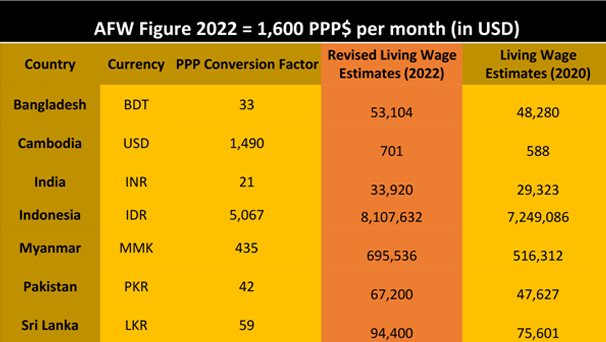
Asia Floor Wage Alliance (AFWA) has released 2022’s new and revised living wage figures for Asian garment-producing countries.
In a statement, AFWA said that nearly 20 trade unions across AFWA’s partnering countries in Asia were convened to study the findings and vote on the final living wage figure.
A total of 1,686 garment workers were interviewed between December 2021 and February 2022 with active support from trade union partners and allies.
Trade unions across Asia were consulted to design the study tool, study the findings and vote on the new living wage figure.
The pandemic has shown that there is an extremely urgent need to hold brands accountable for the poverty-level wages they pay workers, which pushed them to the brink of hunger in 2020-21.
This humanitarian crisis across Asia could have easily been avoided if they were earning a living wage.
The statement said that Sri Lanka and Pakistan have seen high inflation rates since the surveys were completed. The living wage figures may be an under-representation in these cases.
Workers in Asian garment factories produce most of the world’s clothing, and a majority of them are women. Yet, these women are paid such low wages that even after working for over a decade in the industry, they are unable to save money to tide over any crisis.
“All workers need a decent wage to be able to provide for them and their families’ basic needs – including housing, food, education and healthcare. AFWA’s campaign for living wages advocates for global fashion brands to pay garment workers in their supply chain the difference or the ‘gap’ between the national minimum wage and the Asia Floor Wage (AFW) of that country,” it says.
AFWA conducted the consumption survey with workers from seven countries: Bangladesh, Cambodia, India, Indonesia, Myanmar, Pakistan and Sri Lanka to calculate the average food and non-food costs of an Asian worker.
It was for the first time that workers’ non-food expenses were also surveyed along with food basket, confirming AFWA’s 2020 hypothesis that non-food expenses are gradually rising higher than food expenses.
Garment workers from Myanmar were surveyed for the first time.