Ministry of Textiles (MoT) is conceiving a National level Authority that can centrally look after the much-needed development and promotion of natural bast fibres like jute, flax, ramee, hemp, sisal, banana & bamboo, which can also become a hub for alternatives to plastic.
MoT has appealed to industry stalwarts to take forward the newly developed ideas and technologies to help set up new ventures for manufacturing such biodegradable and non-polluting bags and to help these new start-ups promote and market such innovative products.
In this regard, MoT is also promoting innovative ideas like organising the Textile Grand Challenge 2019 with the active support of the National Jute Board and the Start-up India Team of the Department for Promotion of Industry & Industrial Trade (DPIIT).
This event aimed to bring forward innovative ideas by start-ups/entrepreneurs for development of cost-effective and low-weight carry bags using jute bio-mass, jute plant-based bio-polymer and cotton fibre waste to phase out plastic bags.
It is also an initiative towards ‘Atmanirbhar Bharat’ and ‘Make in India’ under which innovative solutions were sought for (i) alternative to single-use plastic bags and (ii) alternative to multi-use plastic bags, using domestically grown natural fibres namely jute and cotton.
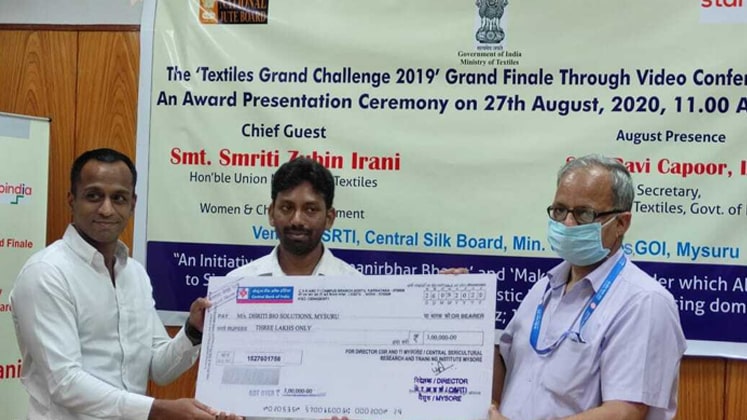
A total of 67 entries were received for the challenge out of which 3 participants – 2 for ideas on an alternative for single-use plastic bags and 1 for idea on the alternative for multi-use plastic bags –were selected and awarded by the Ministry with cash prizes.
The selected/winners start-ups are Awega Green Technologies, Pune; Dhriti BioSolutions, Mysuru and Sakthi NonWovens, Chennai.
The ideas so presented are unique and innovative using jute bio-mass, jute starch-based biopolymer and cotton waste fibres to manufacture non-woven carry bags that are cost-effective, low-weight and sturdy to carry grocery and shopping items.
Addressing the award ceremony event, Union Minister of Textiles Smriti Irani said that the innovative spirit of India needs to be institutionalised for developing eco-friendly and cost-friendly alternative ideas that can also be utilised to create job opportunities.