Across the globe, apparel industry – through various webinars – is discussing a lot about various topics like sourcing, the ‘new normal’ and survival post COVID-19, but workers – the base of apparel manufacturing – are almost neglected in all discussions. However, a recent webinar, conducted by the Association of NIFT Alumni (NIFTA), focused on that part, talking at length about workers’ conditions.
The webinar’s theme – ‘Keeping Workers Centre stage – managing the pandemic’s impact on the apparel and textile workers in India’ had well-versed panellists from all segments of the industry. Some of the speakers were loud and clear about the conditions of workers and they even raised issues very strongly. Brands have always done good business just because of these workers, so now it’s brands’ turn to show solidarity with workers. Conditions are unprecedented, and so should be actions. As per them, conditions are really worrisome, as many factories have not paid wages for the month of March, and to make matters worse, in some hostels, workers are getting food just once a day. There is an urgent need to take some necessary actions to help these workers. If the Government is working on any bailout package, it must keep workers (including home-based too) at the centre of this package.
“Majority of companies have not paid full wages to the workers. Workers have full right to live with dignity, so why are they depending on charity?” questioned Dev Nathan, Visiting Professor of the Institute for Human Development, and Research Director at GenDev Centre. He further added that companies have paid wages only to the skilled workers just because they don’t wish to lose them.
Rakesh Supkar, Business Head, Traidcraft India, insisted that workers in informal sectors are most affected. “Prior to the current pandemic, riots in various parts of Delhi also affected the livelihood of workers (mostly working with job-workers and engaged in apparel manufacturing), and now, this global challenge has impacted them heavily.”
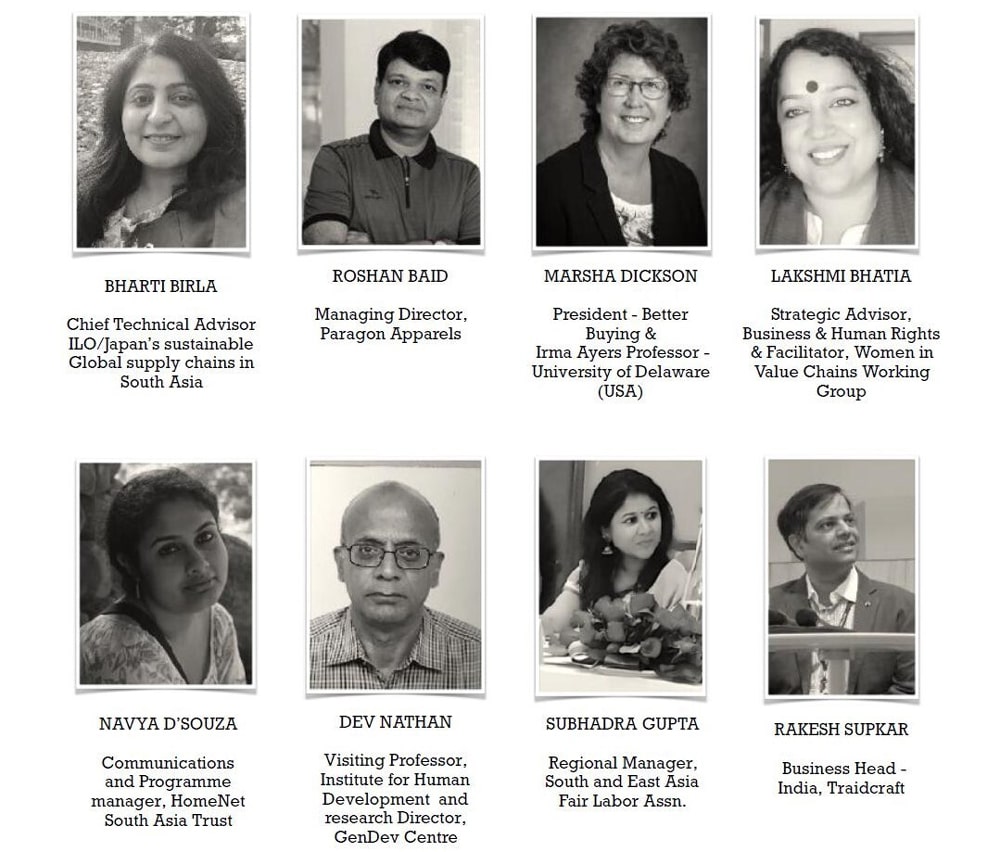
Subhadra Gupta, Regional Manager, South and East Asia, Fair Labor Association (FLA), Bengaluru, informed that particularly in South India, thousands of workers have lost their jobs and have not received their salaries. “Migrant workers can’t take benefit of local schemes, as they hardly have the required documents,” she said, further informing that FLA has asked its member brands not to cancel orders.
Navya D’Souza, Communication and Programme Manager, HomeNet South Asia Trust, shared that the home-based workers are the worst affected part of entire supply chain and they can’t event raise their voice.
Various experts unanimously agreed that it is time to win their faith and to support them. Many of them also need advance, and so, greater transparency is required now. Lakshmi Bhatia, Strategic Advisor, Business & Human Rights &Facilitator, Women in Value Chains Working Group, was of the strong opinion that workers’ onus should not only be on factories. “Brands should take care of both home-based workers and job-workers,” she said.
Bharti Birla, Chief Technical Advisor, ILO/Japan’s Sustainable Global Supply Chains in South Asia also shares similar views, underlining that during such a difficult phase, there are increased chances for discrimination against workers.
Marsha Dickson, President, Better Buying & Irma Ayers Professor, University of Delaware, US, gave a clear message that “there will definitely come a time in future when you will need your suppliers. But if you don’t support them today, they will also not be there for you in future.”
Mark Anner, an associate professor of labour and employment relations at Pennsylvania State University, shared how his study regarding Bangladesh worked tremendously and created a pressure on buyers to pay. Panellists and audiences strongly underlined that there should a similar kind of study with regard to Indian apparel industry. “We talk about complete supply chain, not for a particular country. But some brands and buyers have different stands for Bangladesh and India,” he added.
Also Read: True face of buyers: Not intending to pay!
Highlighting the manufacturers’ side, Roshan Baid, MD, Paragon Apparels, Noida, informed that due to the Holi festival in March, there were hardly 15 actual working days, but factories have paid for full month. “My salary bill is about Rs. 3.5 crore. I have more than 2,000 skilled women in my workforce and no apparel manufacturer wants to lose skilled workforce, but all are helpless,” he said.
In this crucial time when factories are not in a position to pay wages to their workers and are looking forward to the Government for support, it becomes highly important to take care of workers. The panellists rightly said that the workers’ faith needs to be restored and they must live with dignity. Moreover, it is the responsibility of all stakeholders of the industry.
Also Read: Post COVID-19 challenge: Industry to face labour shortage