
Moving beyond the discussions on terms like ‘new normal’ and ‘never normal’, life has finally started to move alongside COVID-19. A major chunk of the apparel industry is concerned as to how sustainability will take shape in this new phase post COVID-19. Stakeholders from the sustainability segment are brainstorming on this, trying to get answers to many questions that need clarity. In the current struggle for survival, the global textile and apparel industry is heavily impacted by factors like cancellation of orders and blocking of the rolling funds, leading to most of the sustainability professionals feeling that there is no definitive future forecast. So, the immediate need of the hour is to get the businesses back on track. Indian textile and apparel industry is not an exception, and it will be interesting to see how this sector is working on this important aspect.
Some directions that the Indian textile and clothing industry must follow include identifying and working on its strengths rather than just following overseas buyers and brands, focusing more on traceability and transparency, developing textile products with antibacterial and antiviral properties and taking sustainability as an investment and a profit-enhancing tool. As consolidation is also a major direction in the overall textile and apparel business, it is also significant to ensure that all the sustainable initiatives are more measurable and time-bound. Therefore, the first step is to consolidate whatever the industry has accomplished so far and then evaluate it, followed by taking the next step with collaborations. It is being insisted to raise the bar of supplier relationship and shift to equal partnerships.
Though the experts maintain that these things were already in practice, but given the current scenario, there will be more focus on these aspects now.
Currently, trends like slow fashion, responsible consumption and production have taken the centre stage. Having said that, we must highlight here that the Indian textile and apparel industry, which is buyer-driven, is hugely dependant on how the Western companies are functioning, be it about any major initiative, benchmark or standards to follow. Now, this trend needs to change. While there is nothing wrong in learning from various sources, sustainability has been a strong part of the Indian culture for centuries and has been practicing concepts like the use of vegetable dyes in apparels, etc.
Similarly, in South India, a large part of the textile industry has taken advantage of wind energy. The industry needs to identify more such areas and work upon them. One has to make it very clear that sustainability is not an expenditure; it is indeed an investment which will pay in forms of increased profitability (by reduced cost), with better environment and a better story to sell to the brands and buyers.
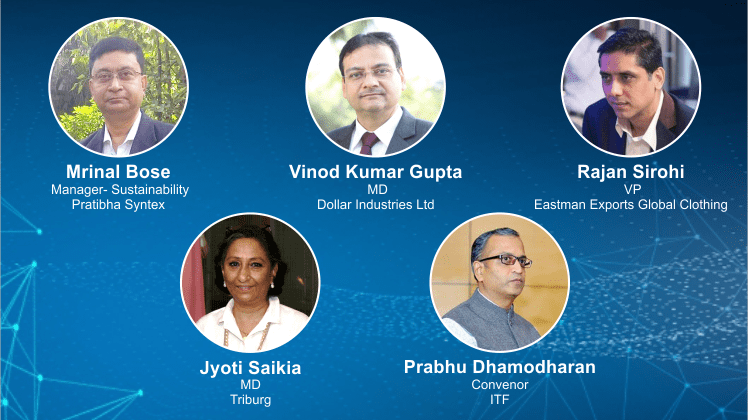
“While sustainability has always been there and it has nothing to do specifically with COVID-19, it will get a big push now. At the same time, innovative solutions are more required now, as people want sustainable clothing and no one is in a position to pay extra,” says Rajan Sirohi, VP, Eastman Exports Global Clothing, Tirupur. He further adds that every factory was previously practicing sustainability in some way or the other, but now they will increase their efforts.
Eastman Exports Global Clothing is one of the most sustainable companies with a lot of initiatives with sustainability aspects.
Few Indian companies that have taken some good sustainability initiatives have already explored how to lead in future, having developed quite a clear vision for future. Pratibha Syntex, Indore, is one of them.
“The two important pillars of sustainability are people and the planet. When we talk about the COVID-19 phase or even the post-coronavirus scenario, our primary focus has always been on people, and it will remain the same in future. Along with that, we will continue to focus our sustainable journey on all environmental parameters including clean energy, water and waste management,” says Mrinal Bose, Manager – Sustainability, Pratibha Syntex.
At the same time, he agrees with the thought that sustainability can go to the back-burner now that the priorities have changed. Financial implications are also involved in any sustainable initiative. In the past, brands and suppliers were working in isolation towards sustainability and sustainable development. But the time has come for partnerships and collaborations. And brands do realise that. So, Pratibha Syntex and many more companies are looking for collaboration opportunities with brands to work towards sustainability.
There have been a lot of discussions lately that consumer behaviour is now changing and they will be more cautious during the buying process. Majority of the industry strongly believes that consumers will be more interested to know who made their clothes and what are their clothes made of. This has shifted the focus on another growing aspect – traceability and transparency.
Companies like Welspun, Pratibha Syntex and a few others are already using various technical tools for traceability. With platforms like BeCREDIBLE, customers can see the entire journey of a garment from farmer to the end-product through a QR code. Already with the support of Sustainable Apparel Coalition (SAC)’s Higg Index, few Indian companies that are associated with the group are able to share with the customers all the relevant information including the sustainability practices used in the entire supply chain of a garment.
From thinking to execution, sustainability is now aggressively reflecting in the Indian companies’ product lines, also as they are moving beyond organic. Many big as well as medium level companies across India now have more trust in special finishes like antibacterial and antiviral, as such products are more in demand now.
Some industry leaders add one more interesting perspective in this regard – that is to take advantage of home workers and production in remote areas, as it attracts buyers and is a little cost-effective too. Jyoti Saikia, MD, Triburg, Gurgaon, comments “Honestly speaking, we should be more concerned about how we are going to revive the industry, and I am still waiting to figure out along with others as to what route sustainability is going to take. We have the final product, fabric that could be labelled as sustainable. Home-based work and production in villages need to increase. There is a change here that we need to take advantage of, figuring out the next steps to ascertain where we actually are.”
It is pertinent to mention here that the majority of apparel manufacturing players are MSME, and despite the younger generation being a part of many of these companies, sustainability is still not a major focus for them. This also needs to change.
The good thing is that many industry stakeholders are now active on the ground level, as few leading Indian brands are now equally concerned about sustainability. Similarly, trade associations have also started working towards this, so that their member companies can get the advantage of collective efforts.
“The COVID-19 pandemic has led to a societal and economical downfall globally and made it imperative for brands to focus on sustainability initiatives that have proved to be an effective tool to accelerate progress in this hour of crisis,” says Vinod Kumar Gupta, MD, Dollar Industries Ltd., Kolkata.
He further adds that several factors have pushed the growth of consolidation across various sectors, including aggressive competition growth/market share, sluggish sales growth via bricks-and-mortar stores, and constant industry pressure, etc. But his company is moving forward continuously.
So far as the efforts by trade bodies are concerned, the Coimbatore-based Indian Texpreneurs Federation (ITF) has come forward to develop a sustainability blueprint for Tamil Nadu textile sector. It has initiated a project ‘India for SURE’ with the concept of India as a stable, sustainable, reliable and ethical partner for sourcing fashion foods with Tamil Nadu textile sector as the base. Prabhu Dhamodharan, Convenor, ITF, believes that post-COVID-19, sustainability will gain momentum and this is also one of the reasons for their new project.
There may be few more directions in the coming months, as there will be more clarity in the market dynamics, but sustainability must become an integral part of apparel business, be it organised or semi-organised.