 Even as the international buying community stood up for the Bangladesh garment industry after one of the worst human tragedies to hit the industry – the Rana Plaza collapse in April created uproar on the way business was being conducted in the country, the last three months of the year could not sustain the business momentum, mostly because of internal upheaval related to general elections. According to the Bangladesh Garment Manufacturers & Exporters Association (BGMEA), the period from October-December saw orders cut nearly in half, the worst drop in two decades, as unlimited strikes, bandhs and recurring violence took substantial toll, restricting buyer’s visitation and order placement.
Bangladesh’s US $ 19 billion garment industry accounts for 80 per cent of the country’s exports and is so important to the economy that it has traditionally been spared from the political unrest that periodically racks the South Asian nation. The country is known to give privileged treatment to trucks plying export goods even during riots and curfews, but with the unrest accompanied by roadblocks transport costs has escalated by 10 to 20 per cent, creating a worry for an industry that operates on wafer-thin margins and needs to keep costs low to be competitive.
[bleft] Ironically, the situation got out of hand even though many textile tycoons are politically active with several factory owners being members of parliament. More than 100 people were killed in clashes ahead of the election, and as the international community waits for the situation to be controlled, the unrest has not shown a sign of abating even after the polls. [/bleft]
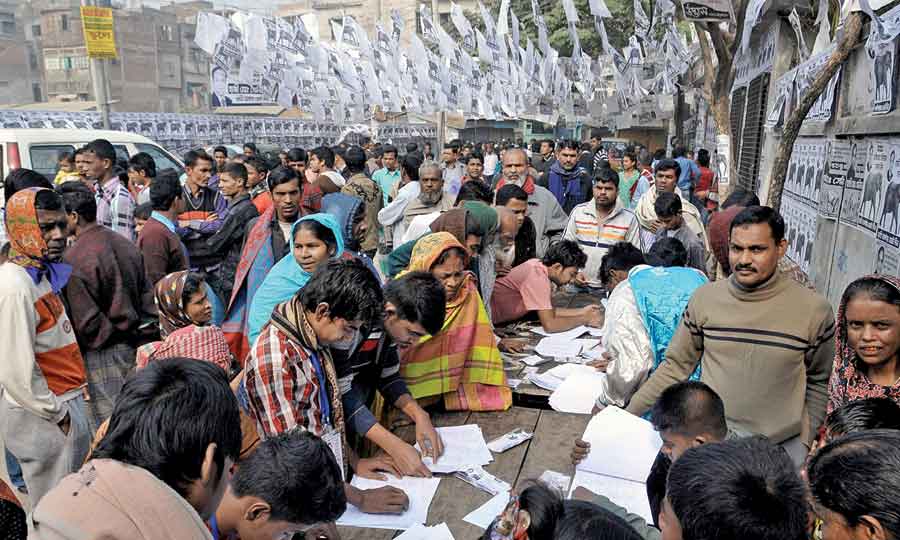
Ironically, the situation got out of hand even though many textile tycoons are politically active with several factory owners being members of parliament, representing either the ruling Awami League or the opposition Bangladesh Nationalist Party (BNP), which boycotted the poll in protest to Prime Minister Sheikh Hasina’s refusal to hand power to a neutral caretaker Government to oversee the election process.
More than 100 people were killed in clashes ahead of the election, and as the international community waits for the situation to be controlled, the unrest has not shown a sign of abating even after the polls, as opposition continues to protest.
Impact to remain till June this year
Apparel Online knows for a fact that many companies in India have picked up orders that were initially meant for Bangladesh, while many other orders have gone to Pakistan and China. “The impact of these shifting orders won’t be immediately felt by the customers, but the delay in shipping of finished orders will hurt the global retail market around June 2014,” predicts Shahidullah Azim, Vice President of BGMEA, who also claims that up to US $ 1 billion in orders are at risk in the coming weeks if the situation does not improve.
Many garment export houses have altered their work hours to avoid mishaps. Babylon Garments shortened its work shifts to eight hours from the usual 10 and closed production lines as months of election-related violence disrupted transport and prompted global retailers to curb orders. The company which supplies shirts, trousers and other apparel to global retailers including Walmart, is one of the biggest players in Bangladesh. “December is usually a season when we are packed with orders to a point where we can’t take any more but look at this year – it was a completely different story this time,” says Muhammad Saiful Hoque, Assistant General Manager of Babylon Garments. Babylon’s production of shirts fell to 7,50,000 pieces in December from 8,50,000 in the same period last year, and was expected to fall below 7,00,000 by February due to the lack of demand. Out of the 12 large retailers to whom Babylon supplies, only 7 or 8 were placing orders and that too in reduced quantities, while the rest have completely stopped.
AKH Group, a large supplier that produces for H&M, M&S and Fast Retailing’s Uniqlo, said it was becoming nearly impossible to meet delivery commitments. “Trucks are stuck on the roads for days and there is very little you can do about it other than somehow pay through the roof to get them going,” averred AKH Group’s Deputy Managing Director Abul Kashem. Some shipments are costing the company as much as 1 million Taka (US $ 13,000), compared with the 20,000-30,000 Taka it usually takes to send the same truckloads, as transport costs surged due to roadblocks across the country.
While Marks & Spencer is closely watching the situation in Bangladesh and Cambodia, it claims that it has not reduced orders and at this stage did not anticipate any effect on supplies; a Uniqlo spokesman said the company had not reduced production or orders from Bangladesh. According to industry watcher Michael J. Silverstein, a senior partner with the Boston Consulting Group based in Chicago, Bangladesh is a critical supplier of clothing for world markets and too large to replace. “The majority of the customers believe Bangladesh will not go dark, however, there will be delays and a need has arisen for alternative suppliers,” he concluded.