
Eight months of 2021 have gone and market sentiments across the globe are picking up. Speedy vaccination drive, growing outing of people for official and personal reasons, upcoming festival season, strong quarter results of Indian and overseas companies, expansion plan announced by various companies are some of the reasons giving hope for a better future. Top global brands to unorganised segment of India, majority of players are bullish about market presently. At the same time, Indian Government’s support to Indian textile industry is also continuing. There are many reasons to believe that Market is Gaining Momentum… Better Future Ahead!
Positive signs from US, Europe
According to Mastercard SpendingPulseTM, which measures in-store and online retail sales across all forms of payment, retail sales in the US grew for the 11th consecutive month in July. It is being also reported that the first of six-monthly Child Tax Credit payments provided parents with an infusion of cash during the peak back-to-school shopping season, with apparel (+80 per cent Y-o-Y) and Department Store (+44.8 per cent Y-o-Y) sectors seeing an uptick in sales for the month. This was concentrated in the days immediately following the first distribution on 15 July.
India is also gaining from the US’ improved conditions as India’s exports to the US increased by 22 per cent during January-May 2021 as compared to the same period of previous year.
According to a report by the European Outdoor Group (EOG), outerwear sales in Europe are on the rise after a rocky year. Current data collected for 2021 shows the recovery of the outdoor sector in the Outdoor Retail Benchmark Report. EOG results reveal that the sector is also beginning to outperform other retail categories. At present, the report states that German online and in-store retail in the outdoor sector grew by 18.6 per cent, as of June 2021, in comparison to 2020.
“Apparel exports to major markets such as the US, Europe, UK, Saudi Arabia, Canada, Japan and Australia are recording healthy growth,” said A. Sakthivel, Chairman, Apparel Export Promotion Council (AEPC).
Global brands, retailers’ strong performance
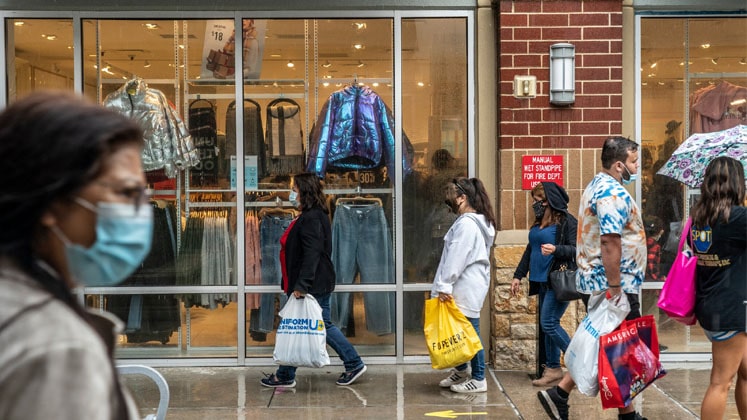
Across the globe, global brands and retailers have shown strong performance during Q2 and many of them have raised annual outlook. The companies’ revenue soared due to strong digital performance.
Further they are pursuing their existing strategies like trying to become more appealing to younger consumers.
Just a few days back, PVH Corp. has announced income and revenue gains as it is benefiting from robust international operations. The company’s outlook for the fiscal year 2021 anticipates higher freight and other logistics costs in the second half, attempting to mitigate delays of approximately four to six weeks for certain orders. However, no greater supply chain disruptions have been predicted afterwards.

While the revenue levels for the international businesses have exceeded and continue to exceed 2019 pre-pandemic values for the remainder of 2021, the businesses in North America are expected to remain challenged, as international tourism – a significant contributor of the regional revenue – is not predicted to significantly bounce back this year. Primarily driven by Europe, the company incurred strong performance gains within its international businesses in 2021, despite extensive temporary store closures in the prior-year period which resulted in significantly reduced capacities for the remainder quarters.
Prior to this, US denim bigwig Kontoor Brands, which owns Wrangler and Lee, has raised its annual outlook after a robust second quarter. The company saw its Q2 revenue surge to US $ 491 million – that’s a rise of 41 per cent on a reported basis and 37 per cent in constant currency. Increasing its outlook for rest of the year, Kontoor Brands has said that the revenue is expected to increase in the mid-teens range, over 2020, between US $ 2.39 billion and US $ 2.42 billion.
German fashion house Hugo Boss also aims to double sales to US $ 4.75 billion by 2025 as its new CEO Daniel Grieder set an ambitious target to double sales to € 4 billion (US $ 4.75 billion) and improve the operating profit margin to 12 per cent of sales by 2025. The company’s marketing spending is set to be more than € 100 million between now and 2025.
Under Armour too has cashed in on the demand, sharpening its focus on full-price sales at its bricks-and-mortar and online stores and is planning to pull out of 2,000 to 3,000 discount-heavy wholesale outlets to increase its profit margins.
It boosts forecasts as athletic apparel revenue more than doubles. “When we come out of this pandemic, we’re going to be ready for growth,” Chief Executive Patrik Frisk of the company told analysts.
The company’s second-quarter net revenue rose 91 per cent to US $ 1.35 billion compared to the estimates of US $ 1.21 billion. Excluding items, Under Armour earned 24 cents per share, crushing Refinitiv IBES estimate of six cents.
Similarly, Ralph Lauren also boosts annual revenue outlook as luxury demand rebounds. Its net revenue rose nearly threefold to US $ 1.38 billion in the quarter ended 26 June. The company expects fiscal 2022 revenue to rise from 25 per cent to 30 per cent on a 53-week reported basis, having previously estimated a 20 per cent to 25 per cent increase on a 52-week comparable basis.
Patrice Louvet, CEO of the company said the company’s brand and products were resonating well with shoppers ‘against the backdrop of stronger than expected re-openings across North America and Europe’.
Good sentiments are also being received from second-hand clothing platform ThredUp as it saw its revenue touch US $ 59.96 in the quarter that ended 30 June 2021, which was much more than US $ 47.34 million it posted a year back.
Apart from these enthusiastic results, few of the companies are bullish about future. British online fashion retailer Boohoo has announced to create 5,000 jobs by 2026. The Group added that the investment programme worth £ 500 million reflects the need to meet the growing demand.
Domestic-focused companies’ aggressive growth
Expansion continues
Just a month ago, Apparel Resources (AR) did a detailed article about how many companies are expanding, or have announced to invest. The same spirit seems to continue by many more companies.
India’s largest private sector company Reliance Industries Limited (RIL) is doubling its PET recycling capacity by setting up a recycled polyester staple fibre (PSF) manufacturing facility in Andhra Pradesh. RIL’s initiative to more than double its recycling capacity to 5 billion post-consumer PET bottles will ensure India maintains over 90 per cent recycling rate. As of now, RIL converts more than 2 billion post-consumer PET bottles into fibres annually.
Welspun India, India’s number one home textile company, has earmarked capital expenditure of Rs. 600 crore in the ongoing fiscal for completing expansion projects across its three business verticals.
BK Goenka, Chairman Welspun Group said, “To cater to the demand, our plants at Vapi and Anjar operated at peak capacity in FY ’21. With demand continuing to rise, we are expanding capacity through debottlenecking and rebalancing at both the plants, which will lead to increased capacity for towels, bed linen, rugs and carpets.”
The company expects its top line to grow by over 15 per cent in FY ’22 on the back of expanded capacities and with customer demand remaining buoyant.
Bengaluru’s leading apparel exporter Gokaldas Exports’ board approved fund raising up to Rs. 300 crore. The board also increase in authorised share capital from Rs 27.50 crore to Rs 32.50 crore.
Another leading apparel manufacturer Zedex Clothing bets on automation to set benchmark in apparel manufacturing post-pandemic. The company has come up with a new unit having collective area of around 200,000 square feet.
One of the India’s leading undergarment brands Dollar is targeting turnover of Rs. 2,000 crore by end of March ’24. And to achieve this target, the company is working on various fronts like it is building up an integrated warehouse in Kolkata with around 3.5 lakh square feet. That integrated warehouse will of course allow the company to have 1-2 per cent better margins.
With an investment of around Rs. 65 crore, it also has plans for further installation of 20,000 spindle spinning mills. It is also actively pursuing digital marketing for promoting its products directly to the consumers.
Medium and small-scale players are also expanding as Pioneer Embroideries, a Mumbai-based leading manufacturer of speciality polyester filament yarn, has plans to invest Rs. 58 crore to enhance its capacity to 26,000 tonnes per annum by adding 8,000 tonnes. The company will manage Rs. 18 crore from internal accruals and the rest through bank borrowings. The capacity expansion follows a post-COVID increase in demand for these yarns in newer segments such as home textiles and technical textiles.
Kolkata-based entrepreneur Ashok Prasad Khajni, having apparel manufacturing units in Kolkata as well as Odisha, is now setting up a shirt factory in Gorakhpur. The facility is expected to create jobs for 500 people. Notably, the unit will cater to overseas buyers mainly. It is important to mention here that Gorakhpur Industrial Development Authority (GIDA) is developing 101 plots in Readymade Garment Park, with land being available from 500 square metres to 5,239 square metres. There will be flatted factories also for the MSMEs.
The festive season is just around the corner which is the biggest season for Indian domestic market. Going forward, speedy vaccination drive and opening up of the market are sure to boost the confidence of industry.
Improved performance during Q1 of FY ’22
To mention a few such companies at various levels of supply chain, Grasim Industries Ltd., part of Aditya Birla Group, reported around fourfold jump in its consolidated net profit at Rs. 2,447.97 crore for the first quarter ended June 2021.
Its revenue from viscose-pulp, viscose staple fibre (VSF) and filament yarn segment was up over threefold to Rs. 2,102.76 crore in Q1 of FY 2021-22 as against Rs. 557.68 crore a year ago. However, sequentially the segment has witnessed a degrowth of 17.9 per cent as it was at Rs. 2,583.40 crore in the January-March quarter.
“India observed selective restrictions in the business activities during most of Q1 of FY ’22, which impacted the sale of textile products, leading to an accumulation of inventory in the value chain. Consequently, the VSF sale volume registered sequential degrowth in Q1 of FY ’22,” Grasim Industries Ltd. stated.
Ludhiana-based vertical integrated company Sportking India’s net profit jumped multiple-fold to Rs. 78.99 crore for April-June quarter of the financial year 2021-22,as against Rs. 0.36 crore in the year-ago quarter.
Undergarment and casualwear giant Rupa & Company’s revenues grew by 4 per cent, EBITDA by 16 per cent and profit after tax (PAT) by 32 per cent. The company claims that it was possible due to improved operating efficiencies and cost reduction strategies.
“We faced certain disruptions in distribution of our products since many outlets were shut in May 2021. Normalcy resumed in June 2021, and we are witnessing increased demand for our products across all categories,” said Dinesh Kumar Lodha, CEO of the company.
Strong retail front
Online or bricks-and-mortar, organised retailers did well in previous months. Some of the product category really did well and they are geared up to grow further. Snapdeal, a leading e-commerce company, has said that its sales of fashion category have grown by 210 per cent in the first six months of 2021. ‘Value-buying’ has emerged as a common theme cutting across buyers and categories in the apparel sector. Similarly, the retailer notices kids’ apparel sales growth of 493 per cent in 7 months of 2021
World’s number one online retailer Amazon is also aggressively growing and it has announced that it will create 2 million jobs in India by 2025.
As of now, Amazon is hiring for more than 8,000 direct job openings across 35 cities in the India and these job opportunities are spread across corporate, technology, customer service and operations roles.
Arvind Fashions, a leading casualwear and denim manufacturer, raised Rs. 439 crore from various marquee investors which will ‘significantly strengthen’ the balance sheet and allow the business to pursue its growth strategy while insulating it from any COVID related uncertainties. The retail giant will focus on 6 marquee brands and plans 500 new stores in 3 years.
Indian Terrain Fashions also plans to expand its portfolio of exclusive brand stores to 400 from the present 200 by FY ’24.
Shoppers Stop Limited posted 272.9 per cent revenue growth to Rs. 201.0 crore in Q1 FY ’22 against revenue of Rs. 53.9 crore in the same period, last year. The company’s expansion plan of stores is on track as it is further intending to open more than 20 stores across large and small formats in FY ’22 besides modernising 10-15 stores.
Few other retailers have also done well.
Brands entering and focusing on India
Various national, international brands are geared up to catch the growth expected in future.
Cult Gaia, one of the US brands, has made its India debut with multi-brand luxury e-commerce store Ajio Luxe.
Saundh, an Indian fashion brand for women owned by the Gujarat-based textile gaint Sahiba Ltd., is expanding its retail presence with stores in Delhi, and plans to open 15 new stores this fiscal.
International brand Guess has relaunched its retail presence at the DLF Mall of India. The company is planning to further open up at prime locations in Mumbai and Pune in the coming months. The aim is to launch more than 10 stores by the end of this financial year.
Manoj Kumar Nair, CEO of Gaurik Lifestyle which has brought Guess to India said, “The first plan is to expand the base to the Tier-1 metropolitan cities and slowly penetrate into Tier-2 metros, touching the top grossing malls for the ease of our consumers. Then, we will gradually look at approaching the micro markets and launching accessory stores in smaller cities that will carry our key categories like handbags, watches, etc.”
US-based Poshmark, a social shopping marketplace specialising in second-hand clothes, is also entering the Indian domestic market.
Manish Chandra, Founder & CEO at Poshmark, said, “When we started off 11 years ago in the US, there was a lot of scepticism, but our platform currently witnesses a gross merchandise value (GMV) of US $ 1.4 billion. But as we enter the Indian market, it’s natural to have that scepticism. However, we feel the consumer in India has always been focused on sustainability more so than any other markets. A marketplace such as ours provides both value and a sustainable lifestyle.”
Founded in 2009 by Imran and Emma Hassan in the UK, kidswear sustainable brand Lilly + Sid recently announced its entry in India. “With a robust digital presence, we wish to offer Indian consumers a product line that is sustainable, conscious and does not compromise on the quality of clothing for children,” said GS Periwal, CEO of the company.
Growing funding for start-ups
Not only established companies, even apparel start-ups are also performing well from few months. GOAT Brand Labs, The Souled Store, Fashinza have raised funding and are geared up for future now.
In its first-ever funding round, Bengaluru-based GOAT (Greatest of All Time) Brand Labs has raised US $ 36 million from Tiger Global Management, Flipkart Ventures and Mayfield. The company plans to utilise the funds in the acquisition of online sellers in fashion, beauty, personal care, home and kitchen spaces.
“Through this venture, we are bringing together passionate entrepreneurs, their (direct-to-consumer) D2C brands, marquee investors, industry experts and a dynamic team, who believe in the philosophy of partnering and nurturing. We want these brands to have access to the best resources so that they scale rapidly to become GOATs,” said Rishi Vasudev, Co-founder of GOAT Brand Labs.

The Souled Store, a Mumbai-based youth casualwear brand, has raised Rs. 75 crore in Series B funding led by Elevation Capital. This funding will be used for expanding its product portfolio of both licensed merchandise and casualwear. The funding would help it in building better brand awareness and offline retail presence pan-India, expanding its manufacturing capabilities and focusing on recruiting activities.
Vedang Patel, Co-founder and CEO, The Souled Store said, “The focus going forward will be to introduce a variety of new product categories, enhance our customer reach and expand our offline presence pan-India to fulfil our aim of crossing Rs. 1,000 crore GMV by 2025.”
Similarly Fashinza, a B2B start-up, has raised US $ 20 million in a mix of equity and debt as part of series A funding. The funds will be utilised to invest in supply-chain technology and expand the company’s presence and manufacturers’ base globally, especially in the US and the Middle East.
Commenting on the fresh funding, Pawan Gupta, CEO & Co-founder, Fashinza, said, “Fashinza has grown over 20x in the last 12 months. Covid has ceased travel and complicated the global apparel supply chain. Our AI-led technology platform automates everything from finding the right supplier to managing production across stakeholders. We started Fashinza because we wanted to help small and medium ethical factories employing millions of workers, connect with global demand and eliminate environmentally unsustainable practices of this industry like overproduction. By 2030, we want to build an environmentally net positive supply chain at a scale that doesn’t even cost extra.”
Home textile segment’s growth continues
Growth of home textile segment continues as it used to be early. The giant in this segment Indo Count Industries performed well in Q1 of FY ’22 as with 111 per cent growth, the company’s normalised total income stood at Rs. 709 crore, while the profit after tax (PAT) stood at Rs. 117 crore, at a growth of 563 per cent. Anil Kumar Jain, Executive Chairman said, “We are witnessing a demand momentum in our end markets. We continue to remain laser focused on increasing our share in the global and domestic market.”
Few more companies in home textile segment have good results and are enthusiastic about future.
Globally changing scenario
Because of fear over the lack of COVID-19 protection for workers, Bestseller, leading Danish retailer has halted on new orders from Myanmar’s apparel factories
The retail giant said that it would not be placing any new orders in Myanmar until an impact assessment had been conducted and it had spoken with experts, NGOs, trade unions and other relevant stakeholders ‘with a clear focus on the well-being of garment workers in Myanmar’.
Unorganised segment also showing strength
In discussion with AR, apparel manufacturers of unorganised and semi-organised market were of the opinion that now they are having positive feedback from their dealers, wholesalers and retail clients. Nearly all of them agreed that the coming festival season will be prove fruitful for them.
Amongst all the above-mentioned positive development of last few months and good signs about coming season, we can hope that soon the market will be in full swing. No doubt, challenges were always there and will be there in future also but the zeal of entrepreneurs to survive will work again. And Indian Government’s supportive initiatives should also prove to be beneficial.
Ready for IPOs
Go Fashion (India), owner of womenswear brand ‘Go Colors’, is geared up for its initial public offer (IPO). The IPO comprises fresh issue of equity shares worth up to Rs. 125 crore and an offer-for-sale (OFS) of up to 12,878,389 equity shares by promoter and existing shareholders, as per the draft red herring prospectus. Proceeds from the fresh issue will be used for fund rollout of 120 new exclusive brand outlets (EBOs), supporting working capital requirements and general corporate purposes. As of May 2021, the company had 450 EBOs located across 115 cities.
Nykaa, an initiative of veteran investment banker-turned-entrepreneur Falguni Nayar, is poised to launch its IPO. Nykaa has 73 stores across 38 cities in India and distributes 1,350 brands. It also has its own private label range with everything from fragrances to fashion apparel.