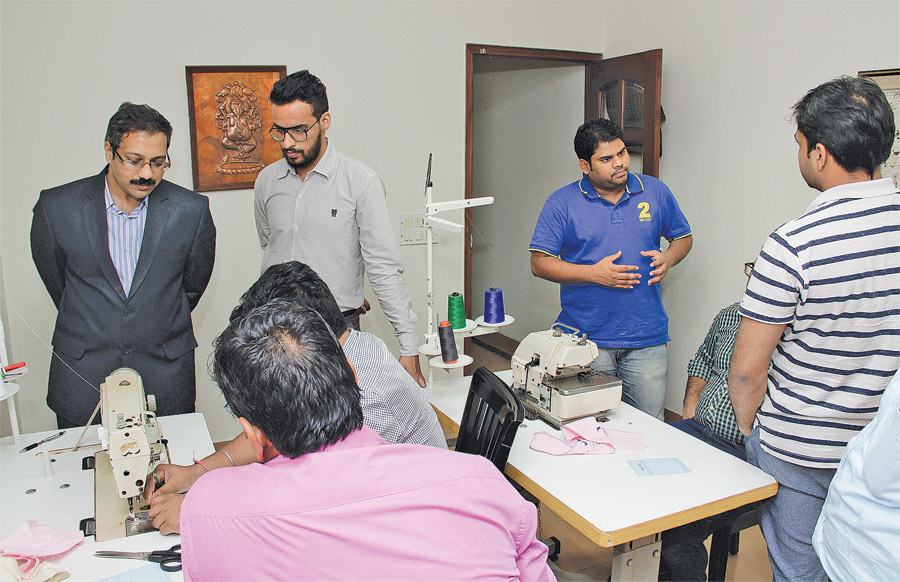
In today’s manufacturing scenario, as cost of production increases, it is becoming very important to cut down on wastages and time lost on unproductive activities. Lean, a manufacturing process management tool handed down from the automobile industry in Japan, has found application in the garment industry, and many of the companies that have gone in for the Lean tool have registered noteworthy results, making them more profitable. One of the important steps towards Lean is Total Productive Maintenance or TPM as it is popularly called. Sadly, not many in the Indian garment industry understand or for that matter know what is TPM and how major benefits in quality, productivity and availability of machine time can be achieved by putting ‘maintenance’ related systems in place, positively affecting the bottomlines. Today, maintenance is not a part of the KRA of a production manager and companies do not give enough importance to the setback or losses that occur because of machine downtime. Through TPM, factories can effectively distribute maintenance responsibilities between the operator, maintenance staff and the production manager to reduce time, money and resources spent on machine downtime and save the same for more productive activities. Keeping these critical facts in mind, the most recent workshop from the ‘Technology Forum 2015’ by Apparel Resources, successfully took up this time Total Productive Maintenance (TPM) – a relatively less explored topic for the apparel manufacturing fraternity. The workshop hosted representatives from KAS Business Consulting, Tynor Orthotics, and Marubeni. The 2-day workshop, designed to be a one-of-a-kind experience, elucidated how TPM can be implemented in apparel business by giving the attendees a hands-on experience of the concept. Important fundamentals of maintenance, like workplace management, and preventive and predictive maintenance were discussed at length. To give a better insight into the causes of breakdowns the concept of forced and natural deterioration of machines was also explained to the core. The participants were involved in Do It Yourself (DIY) exercises with sewing machines like SNLS and overlock, to help them understand concepts like Failure Mode Effects Analysis (FMEA), Autonomous Maintenance, Poka-Yoke, and Kaizen. The main emphasis of the activity was on discovering and analyzing the probable failure modes of machines, making the operator responsible for his/her machine’s maintenance, making error-proof processes, and bringing continuous improvements in processes. The participants were also given a practical experience of using the Red and the Blue Tags, which form the initial steps to implementing TPM. Team work, a very important concept required to implement TPM, was explained to them through simple and interesting games which also kept the participants pepped up. With stories from his own experience of implementing TPM in apparel manufacturing factories, Chandrark Karekatti, Head Projects and Training – Apparel Resources, gave a presentation on the topic and urged the participants to interact and resolve maintenance-related issues and reservations faced by them. The discussion was further supplemented by case studies and videos. Although TPM is a niche concept, the participants came prepared with their interests and stakes for the workshop as most of them are looking at adopting new methods to attract international buyers and reduce machine downtime. Marubeni, a Japanese buying and sourcing company, already has plans of TPM implementation at the premises of their suppliers. Attending the workshop for such dedicated requirements, the participants appreciated the avenue of learning and applications now open to them post-workshop. “TPM is essential to becoming a system-oriented manufacturer. The workshop was a great top-up to my knowledge,” shared Sumit Sisodiya from Marubeni. As the participants were quite engrossed with the curriculum, which provided an in-depth understanding on TPM (from Alpha to Omega of it), their exuberance and countenance was a token of proof of how enriching the workshop was. The ‘Technology Forum 2015’ is a part of the workshop series initiated by Apparel Resources that addresses key challenges for the apparel industry. Moving from the ‘I know it all’ stance to learning with experts through knowledge sharing, especially on Saturdays and Sundays, speaks volumes about the positive transition underway in the attitude of the industry.