Sewing thread is no longer just about holding garments together. From enabling easier disassembly and recycling to improving visibility, durability and processing, it is becoming an increasingly important part of apparel innovation. AMANN is giving momentum to this shift with five new product innovations designed to address the changing needs of the industry.
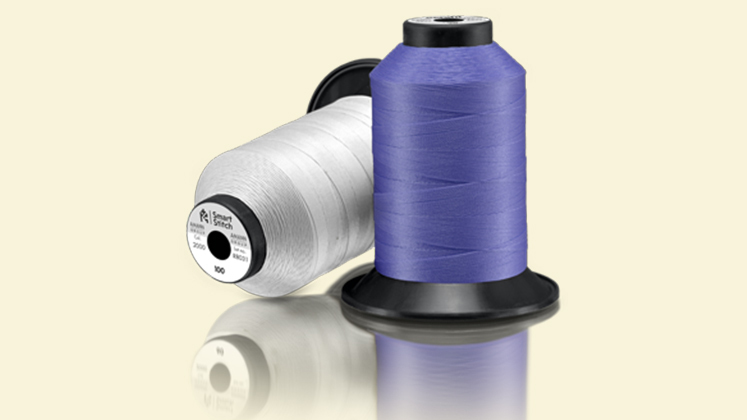
Among these is Smart Stitch, developed in partnership with Belgian circular technology company Resortecs. The heat-dissolvable sewing thread allows garments to be more easily disassembled, enabling fabrics, trims and other components to be separated for repair, reuse or recycling.
Apparel Resources spoke to Sanjeev Grewal, Regional Business Director – Asia, Middle East & Pacific, AMANN Group, and Cedric Vanhoeck, Co-Founder & CEO, Resortecs, about Smart Stitch, AMANN’s latest innovations and how thread is becoming a more strategic part of apparel design and manufacturing.
What challenge was Smart Stitch developed to solve, and how does it work?
Cedric Vanhoeck: Smart Stitch™ is part of our broader design-for-disassembly solution. It combines our heat-dissolvable sewing thread, produced by AMANN Group, with Smart Disassembly™, our thermal system for separating garments into different components for repair, reuse or recycling.
Brands and manufacturers can source Smart Stitch™ through AMANN, an established global sewing thread supplier, while Resortecs provides its expertise in ecodesign, engineering and garment disassembly where required.
Smart Stitch™ is designed to perform like a conventional sewing thread throughout a garment’s intended use phase, maintaining the required durability and quality. At the same time, it enables controlled disassembly when a product needs to be transformed or prepared for recycling.
When activated under the appropriate thermal conditions in a special oven, Smart Stitch™ enables specific parts or components to be separated from the garment. This makes it possible, for example, to remove trims, labels, logos, elastic bands or other components that may otherwise hinder repair, reuse or textile-to-textile recycling.
For industrial-scale processing, Smart Disassembly™ works together with Smart Stitch™ to automatically separate garments and remove components that can interfere with recycling. The process enables high levels of material recovery while preserving the quality of the textile material for subsequent recycling.

Every new technology has to prove its value in the real world. Where has Smart Stitch already been adopted, and what impact has it delivered for brands and manufacturers?
Cedric Vanhoeck: We’ve already seen the technology deliver results in several real-world applications. One example is our collaboration with Decathlon.
Although Decathlon had already developed swimwear using elastane-free fabric to improve recyclability, the garments still required elastic bands, which prevented the entire product from being recycled efficiently. By using Smart Stitch and our thermal disassembly system, the garment panels and elastic bands can be separated automatically, allowing each material stream to be recovered and recycled correctly.
So far, around 350,000 garments have been produced for Decathlon using this technology, while approximately 50,000 denim products have been manufactured for Inditex’s Bershka. It has also been used in the production of ski jackets in Asia for the European market.
Another promising application is workwear. Reflective tapes often wear out long before the garment itself, forcing companies to replace the entire product. By stitching only the reflective tape with Smart Stitch, it can be removed and replaced quickly, extending the garment’s service life while reducing replacement costs and waste.

Beyond Smart Stitch, what other innovations is AMANN bringing to the market?
Sanjeev Grewal: Across these innovations, our focus is not simply on developing new threads, but on solving specific challenges in textile manufacturing and throughout the product lifecycle. One innovation I’m particularly excited about is AeoniQ™ Fil, a high-performing biodegradable sewing and embroidery thread made from renewable cellulose fibres. What makes the innovation particularly remarkable is the combination of performance and biodegradability: AeoniQ™ Fil offers significantly improved sewing and embroidery performance compared with conventional cellulosic threads, while the underlying AeoniQ™ fibre is engineered to deliver the strength and durability typically associated with synthetic materials.
At the end of its lifecycle, however, the material can biodegrade within just 12 weeks, with biodegradability validated under industrial composting conditions. This is an important distinction: biodegradability does not come at the expense of the strength and performance required during the product’s use phase. As a 100% cellulosic thread, AeoniQ™ Fil is ideally suited for cellulose-based textiles and supports monomaterial designs by eliminating the need for synthetic seams. This can simplify recycling and end-of-life processes – an increasingly important consideration for circular textile concepts. AeoniQ™ Fil has also received the Texprocess Innovation Award 2026 in the “Ecological Quality” category.
We are also introducing Waterfil, a water-soluble sewing thread designed for temporary seams and the attachment of joker tags. The thread holds securely during sewing but can subsequently be removed with water, dissolving completely and leaving no residue. It addresses a step in the process that often takes time in practice and can put strain on fabrics due to the manual removal of temporary stitches.
With Sera Reflect and Isa Reflect, we are introducing two retroreflective sewing and embroidery threads that make textile products more visible in low light or in the dark. Seams and embroidery created with these threads can reflect artificial light directly back to the light source, thereby helping to improve visibility in low-light conditions. The key benefit is that visibility is not added to the product as a separate feature; it is integrated directly via the thread, seam and embroidery.
Last but not least, we are showcasing Isacord Recycled UV, a new embroidery thread developed for applications exposed to high levels of UV radiation. The machine embroidery thread is designed for durable, lightfast embroidery and is particularly suitable for products exposed to intense or constant sunlight. It addresses a specific practical problem: embroidery should retain its colour, durability and quality even under demanding outdoor conditions. Made from 100% recycled polyester and available with GRS certification, the thread combines resource-efficient material use with high UV resistance, abrasion resistance and colour fastness.
Together, these innovations underline AMANN’s commitment to combining technological excellence, the highest standards of processing quality and responsible product development.
How important is the Indian market for AMANN?
Sanjeev Grewal: India is an important market for AMANN and one where we see strong potential for further growth. The country’s investments in manufacturing, technology and sustainability are creating new opportunities for companies that can bring technical expertise and innovative solutions to the industry. For AMANN, it is about staying close to our customers, understanding their requirements and supporting them as their needs evolve.
This thinking is also reflected in our new brand campaign, “AMANN. Beyond Threads.” It captures what AMANN delivers beyond the thread itself: Peace of Mind, Partnership and Proven Solutions – built on reliable performance, technical expertise and close collaboration with our customers in India and around the world.