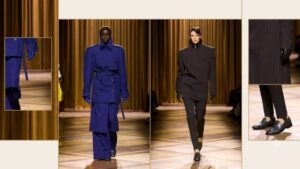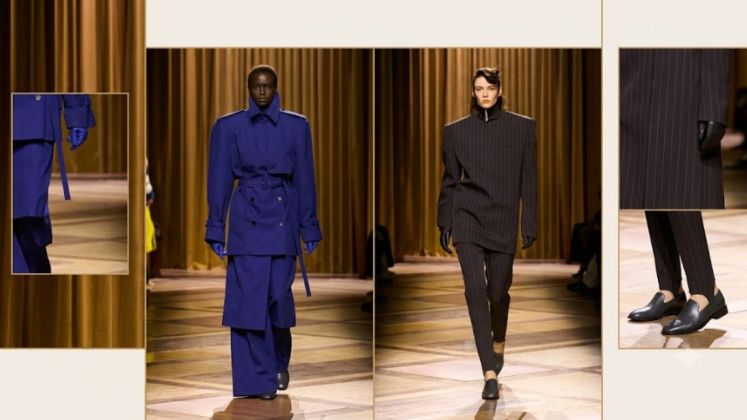
Tailoring is a fixture of every autumn season, but the mood driving it into A/W 2026 has shifted register. Where last season’s “high society” trend leaned into a softer, ladylike take on suiting skirt suits at Ralph Lauren and Jacquemus, Jonathan Anderson’s loosened styling of Dior’s Bar jacket, the new suiting story is harder-edged, closer to corporate-core as filtered through ’80s and ’90s thriller aesthetics. Pinstripes read as costume rather than uniform, silhouettes are body-conscious rather than boxy, and the overall effect is deliberately intimidating: power dressing recast as psychological armour.
The industry has tied the look with a pair of weapon-sharp heels and oxblood accents, the latter visible in the styling at Gucci’s recent collections. Farrell frames the trend as sitting somewhere between social commentary on capitalism and a natural, darker evolution of autumnal power dressing. On the runway, the throughline is precise: undone shirts and slouchy trousers are explicitly out of step with the look, in favour of sharply cut, fitted tailoring.
Internationally, Givenchy’s pinstripe wool blazers and striped wool midi skirts, alongside Gucci’s embellished pumps, are being positioned as key pieces for the trend at retail, alongside the ladylike suiting carried over from Ralph Lauren and Jacquemus.
Indian design houses have been working in parallel territory, even if the framing differs. Rajesh Pratap Singh’s structured, tailored silhouettes and Amit Aggarwal’s sculptural approach to formalwear both draw on a similarly precise, architectural vocabulary, while Rimzim Dadu’s metallic and wire-thread textile work has repeatedly been styled into body-conscious, corporate-adjacent shapes. Payal Singhal and Rohit Gandhi + Rahul Khanna have both built out sharply cut pantsuit and blazer lines aimed at India’s occasionwear-meets-formalwear customer, while Huemn and Dhruv Kapoor have leaned into a more androgynous, exaggerated version of the same tailored severity. On the menswear side, Kunal Rawal’s sharply cut bandhgalas and jackets echo the same appetite for heightened formality.
At the high-street, bridge and D2C level, the trend has a more direct commercial read. Van Heusen Woman and AND have both built out tailored separates, blazers, pencil skirts, pinstripe sets, aimed at India’s expanding workwear segment, while newer D2C players such as Fablestreet have built their entire proposition around structured, office-ready tailoring for women, making them a natural fit for this cycle’s sharper suiting story.
Formal and semi-formal womenswear is one of the faster-growing categories in Indian retail as more women enter white-collar and hybrid workplaces across metros and Tier-2 cities. A global trend cycle built around sharp, structured tailoring gives domestic brands a hook to expand tailored ranges beyond basic office-wear staples, and gives designer labels already working in structured silhouettes a clear runway-to-retail narrative to lean into for the season.