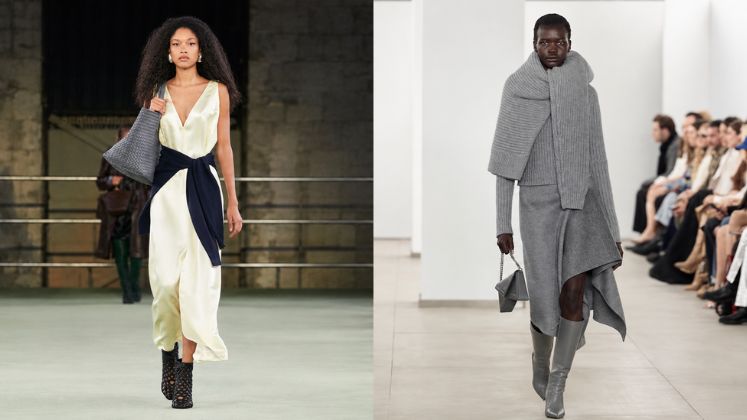
Outerwear tied around the waist or hips has emerged as one of the more functional-turned-fashion moves of the season, with designers pushing what was once an off-duty gesture into considered runway styling.
At Coach’s spring show, knitwear and outerwear were repeatedly wrapped at the waist and hip rather than worn conventionally, in keeping with the label’s habit of formalising practical, off-duty styling tricks into runway signatures. LoveShackFancy leaned into a similar spirit across its spring 2026 and pre-fall collections, where cable-knit sweaters, matching knit sets and cardigans were tied and layered over dresses and shorts as part of designer Rebecca Hessel Cohen’s Americana-inflected, road-trip-through-the-country narrative.
The move itself isn’t new, Matthieu Blazy notably tied sweaters over satin slip dresses for his Bottega Veneta debut, and Lemaire and Louis Vuitton have both worked variations into recent collections, but this season’s iteration leans dressier: sweaters and cardigans knotted over slips, tailoring and even bare shoulders, rather than sportswear. Off the runway, the look has carried into celebrity styling too, with a cardigan tied at the shoulders replacing the top altogether at a recent Paris Fashion Week front row.
Cardigans in particular are doing double duty this season, worn buttoned, layered open, or tied at the waist to add shape and structure over slimmer pieces, a versatility that stylists cite as the reason knitwear is outperforming other categories in current trend coverage.
The instinct to knot a layer at the waist already has a place in Indian dressing, from stoles and Kashmiri pashmina shawls draped and tied over kurtas to dupattas cinched at the waist for a more structured silhouette. For domestic knitwear and resort-wear labels, particularly those serving hill-station and destination-wedding markets, the runway version of this trick offers a low-cost styling update that leans on existing craft strengths in pashmina and wool, rather than requiring new product development.