If we look at the textile value chain, the majority of small and mid-level players are still dependent on manual operations and automation hasn’t gained much space there. While the kind of capacities big-level factories do have, manual handling of processes and materials isn’t possible for such factories and the use of technology is the only way for them to be profitable. Especially when big factories in home textiles, technical textiles and high-end garment sectors are considered where spreading of different types of technical and premium fabrics takes place in huge quantities, the role of high-end spreading and cutting system becomes even more crucial and significant. There are technology companies eyeing these big players in the market as they believe they might not be affordable to those factories that are small in scale and one such company is LIDEM which is a European leader in textile and apparel technology.
LIDEM has held supremacy in the niche technology segment for nearly 30 years now. The company has various textile technologies such as roll slitter cutters, spreaders with cutters, shredders, recycling machines and filling machines under its basket that are developed by its very own engineering team and manufactured in its state-of-art unit located in Valencia, Spain. Traditionally, as India holds superiority in textile industry, it has always been a go-to location for technology companies andis seen as a potential market.
With the aim to find better opportunities in India, LIDEM has partnered with Magnum Resources for the country’s vibrant market and is seeing whopping response for its ‘Roll Cutters’ and ‘Extendor –spreaders, cutters, and stackers’ –that is designed to work simultaneously with several fabric rolls or pallets in apparel and particularly for home textile segment, so as to be called a high production system. It is a system adaptable to any type of fabric, ensuring high cutting precision.
LIDEM’s cutting-edge technology and its mechanism…
All the major Indian home textile factories – in knit, woven, and non-woven –are reportedly expanding in recent times and the capacities are seeing multi-fold increase. For that to happen at large-scale successfully, automation is required and Extendor is said to be a machine which, in roll form, directly gives the factories a perfectly layered and spread sheet that, later on, can be used for cutting patterns with an automated cutting machine. Currently, LIDEM, in association with Magnum Resources, has brought solution with Extendors and Cutters namely – for woven elastic and non-elastic, knits as well as non-woven and technical fabrics.
“LIDEM extender spreads fabric differently than traditional spreader where fabric roll travels the length of lay. In LIDEM extender, the fabric roll remains stationery and a set of grippers catches the fabric and travels the length of lay. While the grippers pull the fabric, the roll unwinds to release the fabric either by negative drive or by positive drive. For lighter rolls and non-stretch fabrics, fabric unwinds by negative drive, whereas for heavier rolls and stretchable fabrics, positive drive is required for unwinding fabric from roll. The lay prepared can be cut using any CNC or manual cutting system,” commented Dr. Prabir Jana, Professor, NIFT (Delhi).
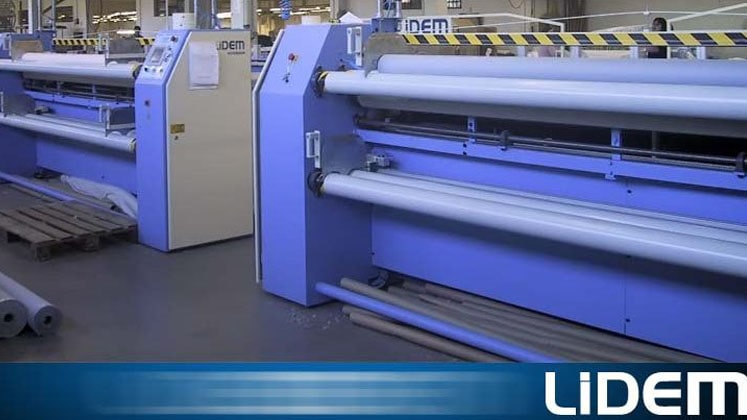
LIDEM provides several versions of the Extendor…models for inelastic fabrics incorporate an unwinding unit through metal shafts that are introduced into the interior of the rolls, while in other versions, the rolls are placed directly on two rollers. The traction for unwinding occurs by the pull of the spreader cart assembly. (See Image 1)
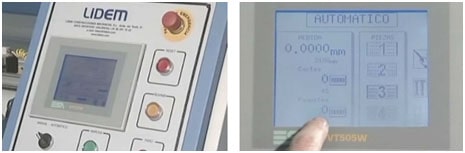
In the high-end models, all machine parameters such as number of cuts, cutting length, cuts package, number of packages, extended trolley speed, voltage, travel speed of the blade, speed of descent of the elevator table, etc.,are controlled from the centre console via the touch screen display (See Image 2).
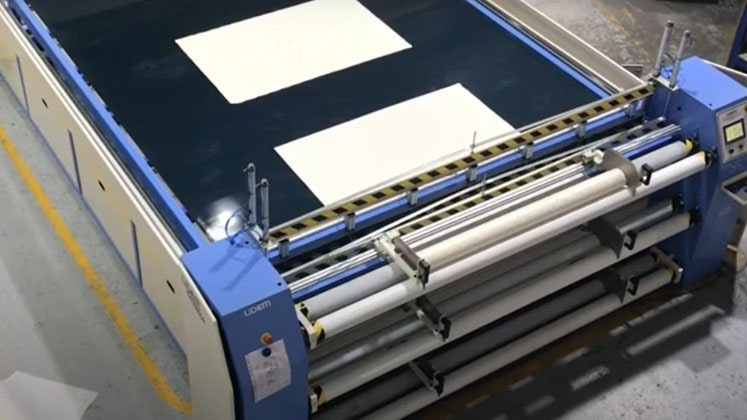
Further, the lift table allows stacking height of up to 260 mm thick fabric layers. This table consists of two separate work areas – one for cutting where the machine performs the spread and the other is handling where the operator can handle the material simultaneously to the spreader. The transport of stacked layers between areas is done with the help of PVC belts. This machine is ready to work also from external feed systems such as creels or simple trestles, increasing the initial capacity of 3 or 4 rolls of the machine. (See Image 3)
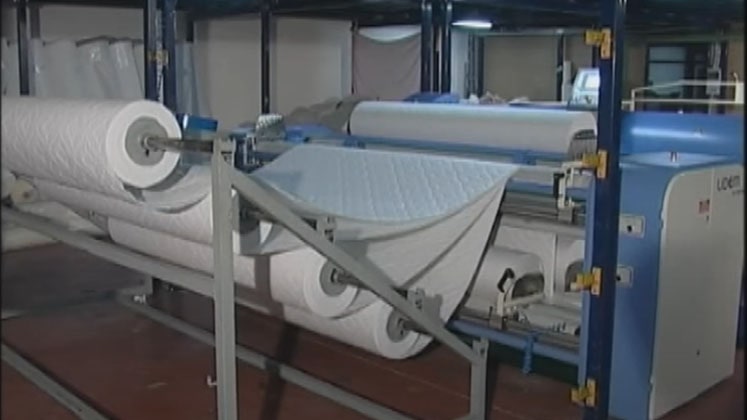
On the other hand, the GDB models incorporate one or more units that allow work from rolls or batches with diameters of up to 1,800mm, which prevents frequent roll changes, permits continuous production and eliminates downtime. This machine is said to be ready to work also from external feeding systems such as feeder deployed to the back or doubled and feeder to work from double folded material. The fabric is fed, aligned and placed in the machine for spreading, end cutting and stacking.
Technical specifications for all three models of Extendors
| Model No. | Description | Dimensions |
| Extendor DC3 | Full automatic spreading, cutting and stacking machine for fabrics and non-elastic materials
Designed to work simultaneously with multiple fabric rolls |
Width – up to 3.20 metres Length – up to 15 metres |
| Extendor GDB2 | Full automatic spreading, cutting and stacking machine for all kind of fabrics and materials
Designed to work simultaneously with multiple A-Frames or with zigzag folded materials |
Width – up to 3.20 metres Length – up to 15 metres Diameter – up to 1.80 metres |
| Extendor GDT4 | Full automatic spreading, cutting and stacking machine for all kind of fabrics and elastic materials
Designed to work simultaneously with multiple rolls |
Width – up to 3.20 metres Length – up to 15 metres |
Controlling cost to increase profitability is what a technology should do and that’s where LIDEM’s Extendors have an edge…
Just bringing a high-end machine to the flourishing market is not the measure of superiority and endorsing the same, Bijoy Bhattacharjee, General Manager (Home Textiles and Technical Textiles), Magnum Resources, told Team Apparel Resources that the Extendor series holds dominance when it comes to controlling the production and maintenance costs…He explained that these machines can lay 90 metres of fabrics per minute and 5,400 metres of fabrics every working hour.
“If a factory is having a capacity of laying 50,000 metres of fabrics per day, that’s just under 10-hours job for this machine, with no manual intervention. And, this productivity is impossible if manual operation is opted! If you look at ROI, it depends on the productivity…If the capacity is just 3,000 metres of fabrics per day, ROI will be around 8 years. While the big factories (with a capacity of over 40,000 metres of fabrics per day) can see ROI in less than 2 years,” shared Bijoy.
Dr. Jana added, “As multiple rolls (3 to 5 rolls) can be used simultaneously in this spreading system, the effective spreading speed can be three to five times higher than traditional spreaders. Although currently this system of spreading is primarily used by home textile players, some of the Jeans and trouser manufacturers may consider exploring it. Denim and trouser fabric comes in wider width and comparatively higher roll length. Denim fabric may not have any dimensional stability problem and layer-wise ticketing system is anyway being followed, so spreading multiple rolls together will not have any problem. Most importantly traditional spreader capacity is generally half than any CNC cutter for a given fabric type. Higher spreading speed may act as a boon for Jeans and trouser manufacturers.”
Akshay Sharma, CEO & ED, Magnum Resources,added “There is only one other technology that is similar in the kind of Extendors we are doing…But our solution is the best in the industry and gives higher return on investments with better precision and quality. We are looking forward to more and more customers reaping the benefits of these machines.”
In terms of maintenance, the machines come with a complete scheduled maintenance guide. There are fixed maintenance activities that take place at a certain frequency in a factory and the same needs to be fed through the machine display system. The moment a memo of the scheduled activity arrives in the machine, its system displays the scheduled activities to the maintenance team well in advance so that they get prepared with their maintenance plan.
Bijoy further explained, “When roll to roll cutting happens, the Roll Slitters can cut edges as sharp as it can be, though it also depends upon the compactness of the roll. More compact the roll, better cutting accuracies it will have! We can achieve up to 0.10 mm variation from top to bottom for a roll of 500 mm diameter. That’s the kind of accuracy we have worked upon for Roll Slitters. Similarly, as we stack layers of fabrics on Extendor one after another up to 260 mm of height, there has to be some variation at the fabric edges on all four sides and a mismatch of edges will certainly be there while laying fabrics. Our machine gives exact alignment of fabrics on all 4 edges. More the fabrics are aligned, less the wastage is. And that’s where we save material cost for factories.”