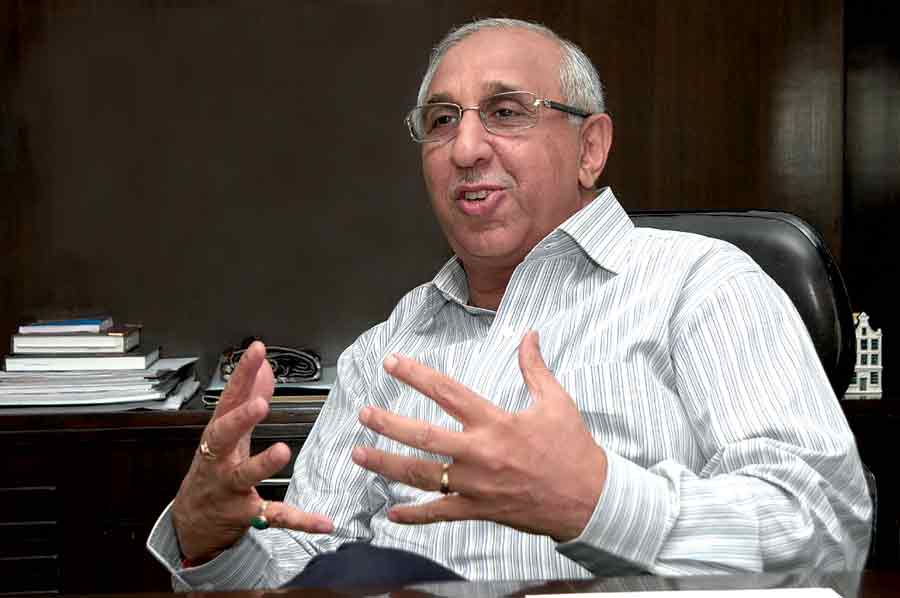
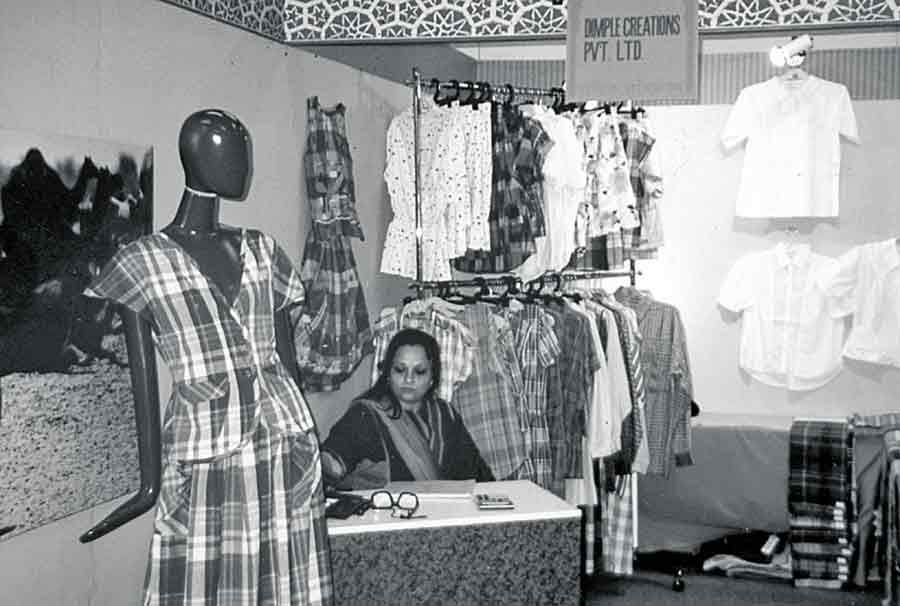
While most exporters, who form the group of early entrants into the apparel industry, are those that saw a business opportunity soon after their graduation in the late 60s or early 70s and plunged head on into it, Dimple Creations is in a different league because not only was it started by a woman but also Praveen Nayyar, the husband of the enterprising lady, was a well known Chartered Accountant whose association with the industry started off as a professional auditor of leading textile and export houses like Intercraft. In fact, it was his wife Vandana who ran the show for many years, while Nayyar dedicated himself to his profession and joined the export house full-fledged only in 1987, when not only his wife but also the industry needed his expertise to manage the expanding scope of business.
Coming from the Mahajan family, considered to be the pioneers of the Panipat home furnishing industry, textile was in Vandana’s blood even before she formally joined hands with Ameeta Batra to start an apparel export venture in 1977. Ameeta’s company, Design Connections, had gone bankrupt when it was working with German buyers. Together, both the ladies started production at Nayyar’s East of Kailash home in New Delhi, with 4 local machines catering to the orders from very small customers. “I took the venture casually without much thought, until one cold wintry night in Feb 1978, when I woke up at 2 o’clock in the morning to find my wife stitching buttons onto 400 shirts that needed to be shipped out the next day. I realized how much hard work and devotion was required,” recalls Nayyar.
Seeing the intensity of the efforts, Nayyar, during his visit to the US in September 1979 as Alternate Director of a US based company, invited Buyers ‘Pinkie Originals’ to India. This turned out to be the biggest break for the company as Pinkie placed an order for 12,000 pieces in schiffli (hemla) embroidery, that during those days, was available only in Amritsar. “It was very difficult to get fabric as there were very few suppliers; HP Singh had just set up a small shop in1980. What was mostly available, was fabric from nearby looms or Madras-checks from the South,” remembers Nayyar. However, they managed to execute the order, and as they say, the company never looked back thereafter. As business expanded and began to flourish, they rented a factory at Okhla, Delhi in 1982 for Rs. 7,000 a month.
“In that era, the type of manufacturing facilities, that exporters had, was not important; what mattered was the marketing abilities and the skill to make samples on time,” says Nayyar. That was the reason why Vandana opted to join the first pilot batch of NIFT in 1981-82 when FIT, New York, came to India and set up classes at Hotel Samrat to determine whether the country was ready for a fashion institute. Vandana, along with the wife of Vinod Kapoor of Radnik Exports, underwent a one-year programme in pattern-making and marketing. Among her classmates, were Rohit Bal, Rina Dhaka and many other known designers of today. Export business was the prime business in those days, as an exporter doing Rs. 20 crore of business, earned Rs. 15 crore as incentives! Price was not an issue and buyers were more friends than business associates,” says Nayyar.
“In 1984, when Ameeta decided to part ways, the second and most exciting phase of growth for the company began, when business opportunities in Russia presented huge growth potential. Jawaharlal Oswal of Ludhiana was exporting sweaters to Russia in a big way. One of its buyers requested for woven garments. The order was passed on to us. Initially it was for 400 pieces per style but within a month the demand multiplied to 4,000 pieces per style,” recalls Nayyar. However, the Russian business was not assured and with growing political turmoil in that country, the orders eventually dried up 1988-89. In 1990, C&A American business came their way, which eventually accounted for 80% of their total turnover.
“If you evade taxes, you are a criminal; but, if you can avoid taxation by legal interpretation of regulations, there is no harm done”
It was indeed a fascinating era, as the dynamics of business revolved around ‘Quota regulations’. The simple accounting philosophy that Nayyar swore by was ‘if you evade taxes, you are a criminal; but, if you can avoid taxation by legal interpretation of regulations, there is no harm done’ and this was exactly what was happening. “It was like a maze; one wasn’t sure what goods to deal in, because every year, there were quota problems on different products, which made it difficult to plan production,” says Nayyar. In one year, skirts were in premium, and in the ensuing year, blouses would be the hot-product category.
So, exporters invented ways and means to work around the problem “circumventing the provisions of the act without violating the regulations” as Nayyar puts it. When ‘India items’ were not within the preview of quotas, exporters conveniently attached small ghoongroos to the skirt tops and passed them off under ‘India items’, till the authorities caught on. Similarly, blouses and dresses, which had quota at premiums, were packed along with underwear/shorts and tagged as ‘sets’, because ‘sets’ were not under quota. Another ploy that created a ruckus was when, to avoid quota, consignments of dresses were shipped as nightwear. They were cleared as nightwear at the port but during debittance they were entered as dresses and the US placed an embargo, making it difficult for other exporters, since the quota on dresses was under-utilized, as per records with the AEPC.
Nayyar remembers another interesting episode that added a new category to quotas. “The person who brought in quotas on rayon to the country was Atul Gulati of Atex Overseas. He is no longer in the trade but he made his money because of his foresight. When 100% cotton blouses/shirts were in the premium category, Atul went to Selam and developed a fabric using 51% viscose and 49% cotton and shipped them in tonnes to Santa Cruz, the biggest buyer in California, till the US customs realized what was happening; and when quotas were slapped on, he became the biggest quota holder in the category,” recalls Nayyar. In fact, quota policy remained the same, but what changed regularly were the regulations to rein in manipulations.
Another reason, why the period of 90s was exciting, was that with the new technology coming in, exporters, buyers and operators were all learning how to work better and more efficiently. “The biggest changes came in the finishing and washing section,” says Nayyar. He narrated the difficulty in working with embroidery when there were no computerised machines. “We had to oil the tread for smooth operations. This action left stain marks on the garment for which dry cleaning was a must, but in the conventional dry-cleaning method a strong smell of petrol would remain, which was a constant irritant for the buyer. So we started sun-drying the pieces after dry-cleaning and then washing them to get rid of the smell. Later the MTO chemical came into the picture, which was added to the washing machine to remove stains while washing. However, it led to a new problem. The workers would open the tumbler without adhering to the proper instructions and add the chemical to the washing machine. This led to the evaporation of gas inside the tumbler and many times it would catch fire,” recalls Nayyar.
In fact, fires in factories were quite common in those days when people were learning to cope with new technology. The advent of ‘jet fuel’ for removing stains instantly, without the need to wash and without any smell, was also the source for many fires in factories as the chemical was highly inflammable and even the smallest of negligence could lead to a blazing inferno. “It was one reason why, when boilers for steam presses came in, no one was ready to work on the system for fear of an explosion,” recollects Nayyar. Using the old coal press, was creating quality issues, for example, when pressing a black garment, it would leave a shiny mark. Hence, it became essential to convert to padding and steam systems. Nayyar claims to be the first user of Ramsons steam presses in Delhi and his first set of 6 presses bought in 1986 are still a prime possession of the company.
Getting people to work on any new technology was difficult, whether it was high-speed Juki machines, Pegasus overlook machines, blind stitch machines or sharp blade cutting machines. “One of the biggest challenges was to convince people to work with them and most of the times after working for a few days the labour would reject the machine saying that it was of no real help and went back to old systems,” recalls Nayyar.
As the industry struggled to increase its production levels and standards, the expectation of the buyers also grew and many compliance and testing norms were introduced from mid-90s onwards. “Japan was one of the first countries to ask for testing. In 1988, we exported one shipment to the country. It had to pass through many of the stringent controls that came much later in the US,” says Nayyar. As regulations became complicated, the role of Associations and the AEPC also began to grow. In 1987 when the Open Tender System (OTS) was introduced, Nayyar provided leadership and fought the system aggressively; and finally succeeded in getting the regulation scrapped. “Since then, I have been a constant member of various associations and also of the AEPC at all levels, and have been trying to convince the authorities that all exporters are not crooks but are hard working industrialists who need their support,” says Nayyar.
Today, his wife has taken a back seat, while his second daughter Mona, a graduate from FIT, New York, has become actively involved in the business. His youngest daughter is a lawyer and it is with her help that Nayyar has recently fought for and succeeded in abolishing ESI requirements for out-sourced workers. He strongly feels that the next generation should be actively involved in the industry and he is leading by example.