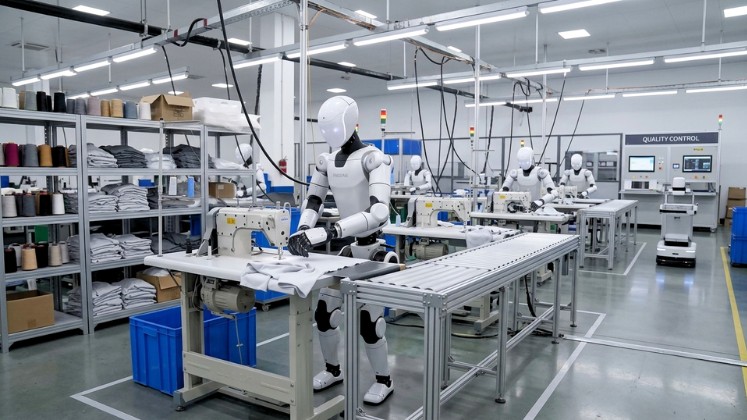
The technology landscape is changing fast; so fast that before one could reach its peak the next one is replacing it. Social media is also asymmetrically fueling interest and awareness about any technology resulting in unnecessary discussion. Indian textile and apparel manufacturers are ever-curious, always updating their knowledge and showing their “thinking ahead” mentality.
The recent viral video of shopfloor sewing operators in garment factories sporting head mounted cameras fueled the debate of will humanoid robots learn and do the sewing operation in future? Dr. Prabir Jana analyses.
Sewing is a crucial value add operation in apparel manufacturing, contributing nearly 80% of manufacturing value add in terms of time. Simultaneously sewing operators also constitute 80% of the production workforce in a typical apparel manufacturing enterprise, quite obviously the biggest pain-point of any manufacturer.
Going by the science of sewing, a pair of eyes, a brain and a pair of hands are all that are required to sew. Now the ability of a vision-based system to look (capture image replacing human eye), process the captured image at a split second (much like the neurons in our brain) and direct mechanical actions through robotic hand and tactile end effector, is a reality.
Vision Systems Integration in the sewing process showed promise almost a decade ago with Brother’s BAS 311G and Vetron’s Autoseam. But, why were those not popularised? Not even in Western Market? Two reasons may be attributed for the same; first, limited production (exclusivity) and prohibitive cost. One report in 2017 mentioned that the Autoseam model was pre-booked for two years in Europe! The second reason could be the change of tech from arithmetic logic to AI based training. Vetron’s autoseam did not use any AI, it is a pure algorithm. It used only X-Y axis manipulation of fabric plies, which worked for stiff, dimensionally stable fabrics.
If we analyse any manufacturing workplace, the majority of the functions that require hand manipulations only with limited or stationery lower body. Apparel manufacturing is no different either; sewing, ironing, checking, folding, etc. all require only upper body movements. A six-axis cobot has 6 DoF; six is the minimum DoF needed to position and orient a tool arbitrarily in 3D space — 3 DoF for position (x, y, z) and 3 DoF for orientation (roll, pitch, yaw). This is why 6-axis is the standard for general-purpose cobots (from Universal Robots, FANUC, KUKA, ABB, etc.) across industries. Each axis is a rotary joint, and each rotary joint contributes exactly 1 DoF. So the six joints are:
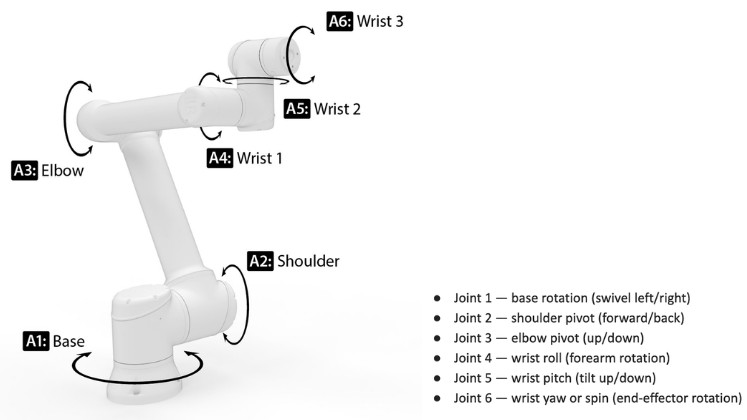
If we see carefully, cobots are mimicking the upper human body, but up to the wrist only; palms and fingers missing! Vacuum, electrostatic, magnetic, mechanical end effectors (grippers) are used for primarily pick and place job till now and not for dextrous work. That is precisely the gap that humanoid hands are trying to close. The human hand (palm at wrist level) has 27 degrees of freedom (DoF) and most of the humanoid robots today offer anywhere between 11 to 22 DoF making these robotic hands capable of “near-human” manipulation of material. Sewing operation specifically uses only dextrous hand movement of fingers and hand movement from elbow. Pedal start-stop function is a no-brainer and most of the commercial sewing automats already run without pedal start-stop.
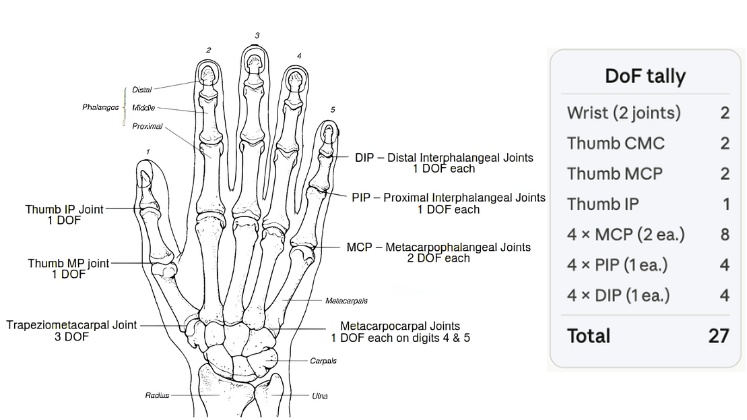
That raises the question: how appropriate are humanoid robots for sewing operations? While a six axis cobot fitted with a 27 DoF dextrous end effector (gripper) may do the sewing operation, do we need the lower body?

The lower body of a humanoid robot is comparatively expensive due to load bearing structure, torque demand and special actuators at the knee, which can be avoided or compromised (for sewing job!). According to a Mckinsey report if we split a humanoid robot, the cost of the upper body, lower body and the shared platform comes to approximately 42%, 47% and 11% respectively. So, an upper body with dextrous hands may do the sewing operations at approximately 50% of the cost of a humanoid robot!
“Why is it that I always get a whole person, when all I want is a pair of hands?” — Henry Ford