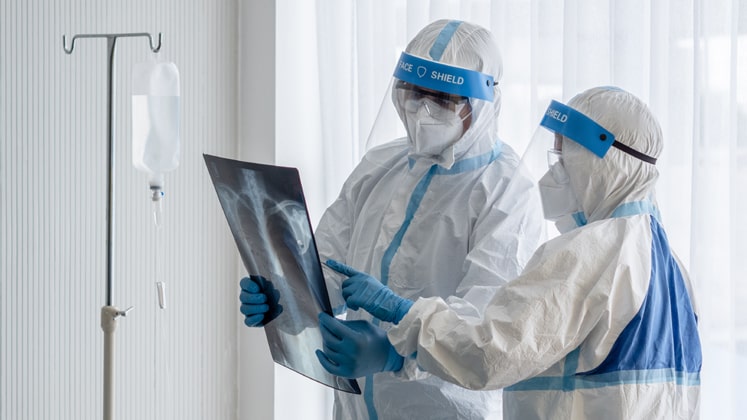
The entire PPE coverall industry felt the shock when HLL Lifecare – the Government procurement organisation for coveralls – sent an email on 2nd June to notify the authorised vendors about the hold on coverall supplies, citing quality issues.
In its statement, HLL said it is reviewing the quality of coveralls supplied by all manufacturers at its own warehouses, and the inspection would be done at manufacturers’ end as well. Just a day after the notice (3 June), HLL again notified all manufacturers that it has rolled out inspection protocols which are considered too strict to follow by the manufacturers across India. There may be quality issues from a number of vendors, but it’s hard to digest that all the manufacturers are not following quality standards.
Now, the industry – which has been raised from almost zero to 4.50 lakh coveralls on a daily basis in just two odd months and has been giving survival hopes to manufacturers – has seen a sudden halt due to this whole mechanism that has created a huge chaos. The unforeseen scanner put by HLL now raises certain questions which need to be answered.
Why no quality audit system was in place in the last two and half months?
On 18 March this year, the Union Textiles Secretary, Ravi Capoor, hosted a joint meeting of officials and industry representatives to assess the availability of coveralls and masks to further supply them to medical professionals fighting the COVID-19 pandemic. Then, the Ministry of Textiles, India, and PMO appealed to the apparel manufacturing industry to step up and produce PPE kits including body coveralls and face masks which was accepted by the industry wholeheartedly.
Initially, the fabric and coverall samples were checked on synthetic blood penetration test standards – ASTM F 1670 and ISO 16603 – set by the Ministry of Health and Family Welfare, India, and after the manufacturers got an approval from authorised testing laboratories SITRA, DRDE and Ordnance Factory Board, they were given green signal to continue with production. Now, the major issue is that no inspection process was involved from the Government’s side for the produced lot of coveralls all across India.
As per the manufacturers of coveralls, they are not at fault if – the process is the same as was adopted to make samples, materials are the same as were adopted to make test samples, and no complaint was made by the appointed nodal officer while procuring PPE coveralls with them.
Also Read: What goes into making a body coverall?
Even after following all test methods and protocols released by the MoHFW, if the coveralls are seeing quality deterioration, is it justified putting the blame on the entire manufacturing fraternity all at once? What was the role of nodal officer and HLL then which were procuring the coveralls?
Moreover, what has stood as a barrier for the manufacturers now is the new quality testing protocols of HLL supporting zero tolerance in coveralls which is not possible for bulk quantity orders. The protocols state that five samples out of a lot of 10,000 coveralls will be taken out and checked on synthetic blood penetration test, and failure of even one sample will reject the whole lot and the manufacturers would be blacklisted. This seems to be an arbitrary introduction of new protocols by HLL, as it’s a known fact that the apparel manufacturing industry works on AQL and is habitual to follow AQL as decided mutually with buyers. Following zero tolerance would put them in an insurmountable situation.
Another issue that raises the bar is the coverall testing process post 3 June. ISO 16603 has six classes (1-6) and most of the manufacturers got their samples approved on class 3 which was enough to pass synthetic blood penetration test, as directed by HLL. Whereas, now some OFB and other labs are checking the samples on class 5 or even 6 which will result in huge failures and the manufacturers would be forced to take back their rejected lots at their own cost. The whole matrix seems to be going in a complete different direction.
Why has no Viral Penetration Test been conducted yet?
No viral resistance claims can be made based on the synthetic blood penetration ASTM F1670 or ISO 16603 standards. Medical fabrics can pass these tests and yet fail bacterial/viral penetration test. Frontline warriors have put their lives in danger, as they are coming in touch with COVID-19 patients and are vulnerable to the virus attack. BIS, MoT, MoHFW and HLL have got it all wrong, in the first place.
It can be safely claimed that HLL Lifecare did not understand the quality demands in fabrics to be made for a highly challenging product like coverall nor had they contacted the right people or agencies having expertise in the subject matter that could standardise these PPE coveralls for them.
This has led to unspeakable quality issues as the whole procurement, replenishment and distribution process was managed by a team that did not understand how to check and how to do quality control. HLL just kept on buying and procuring based on demand received by MoHFW without evaluating the supply chain and the risk it may contain. Even today, there is no mandatory guideline from the Government stating the need for conducting ASTM F 1671 test in fabrics.
Crores of amounts are now stuck at Government’s end
HLL is procuring a coverall at Rs. 635 from approved manufacturers. There are around 95 (as per HLL) manufacturers currently entitled to supply coveralls to this organisation. Prior to 3 June when HLL halted to take coverall supply, the manufacturers were supplying around 4.50 lakh coveralls to HLL on a daily basis which means the coverall was supposed to be a Rs. 857 crores industry on a monthly basis.
Considering 250 lakh coveralls have already been procured by the Government since March, the total amount of procurement stands at Rs. 1,587 crore. Alongside, around 32 lakh pieces are already stuck in WIP at manufacturing facilities in the country and the amount of which values at Rs. 200 crore. The total purchase order made by the Government till June is around Rs. 1,787 crore and that’s a staggering amount. Though the Government has released some of the payments, the manufacturing industry claims a large amount of payments are still due to be paid and that’s a pressing issue for them in these tough financial times.
Why has MoT distanced itself from the whole scenario?
Setting up base for PPE coverall manufacturing was a need during the initial stage of coronavirus spread in India, and the Government wanted to ensure the supply comes to them regularly. Time was short, so no tender was put across. The Ministry of Textiles (MoT) infused the need, PMO steered it for national cause, purchasing was done by HLL under the guidance of MoHFW and MoT is nowhere in the scene now.
Textile Ministry was the go-to communication channel for the apparel manufacturing industry, and the sudden regulations thrown by HLL, under the guidance of MoHFW, do not make any sense as no communication can be done now on mutual understanding. It seems like MoT has taken a back seat in a time when the industry needs its guidance and support the most. It is only the 6th of June when an extensive discussion happened between MoT, BIS, MoHFW and the industry stakeholders. Though the manufacturers – which consisted right from representatives of top companies to MSMEs – expressed their issues and concerns of the infeasibility of the new protocols, the meeting did not become satisfactory for them.
Simply put, the new testing protocols might have been rolled out with good intent by HLL and MoHFW in order to ensure no defective coverall goes to medical professionals, but the poor and untimely implementation of the same is enough to oppress manufacturers across India.
Also Read: Venturing into coverall manufacturing? Here’s what you need to know!






 Bharat Tex Special Report 2026