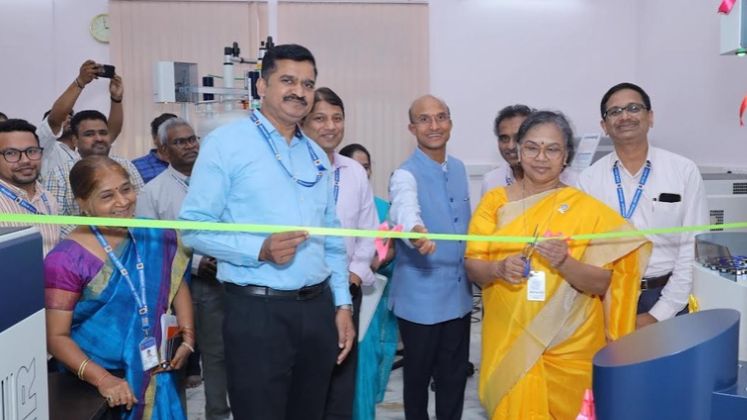
The CSIR-Central Leather Research Institute (CSIR-CLRI), Chennai, has inaugurated a Technical Textile Pilot Plant and unveiled a High Resolution 600 MHz Nuclear Magnetic Resonance (NMR) Spectrometer to strengthen its research and development capabilities. The institute also transferred two indigenous technologies to industry, focusing on carbon footprint assessment and sustainable leather finishing.
The developments took place during the visit of Dr N Kalaiselvi, Secretary, Department of Scientific and Industrial Research (DSIR), and Director General, Council of Scientific and Industrial Research (CSIR), to CSIR-CLRI.
The pilot plant houses six specialised machines, including a Miniature Carding Machine, Miniature Rotor Spinning Machine, Needle Punching Nonwoven Machine, Fibre Extracting/Grinding Machine, Leather Scraps Shredder and Yarn Coating Machine.
The facility is designed to support the leather, footwear, textile and allied sectors in material development, product prototyping and process validation. It will also serve as an industry-support platform to reduce product development risks, improve resource efficiency, promote sustainable manufacturing and enhance industrial competitiveness.
In addition to the pilot plant, CSIR-CLRI inaugurated a High Resolution 600 MHz NMR Spectrometer to strengthen its research and development activities. The advanced analytical instrument has been established to support the institute’s research mandate across several areas, including sustainability, footwear, apparel and components, collagen-based biological products, biomaterials and therapeutics.
The spectrometer will also support ongoing research projects under initiatives such as CSIR-FIRST, FBR, GAP, MLP and OLP. Its advanced analytical capabilities are expected to facilitate innovation, collaborative research, high-quality scientific publications and technology development.
In another significant development, CSIR-CLRI transferred its indigenously developed CLI-Mate Carbon Footprint Assessment Digital Platform for the Leather Industry to four leather manufacturing companies. The recipients are Sai Chamois Inc., Dindigul; KAR Leathers Pvt. Ltd., Dindigul; Vaigai Leathers, Dindigul; and VRS Leathers, Chennai.
CLI-Mate is a sector-specific digital platform developed to assess greenhouse gas emissions across leather manufacturing processes and associated waste treatment systems. Designed for global applicability, the platform enables manufacturers to quantify their carbon footprints, identify major emission hotspots and develop targeted carbon-reduction strategies.
The technology transfer is expected to support the leather industry’s efforts towards sustainable industrial development and contribute to India’s Net-Zero 2070 vision.
Further strengthening its sustainable technology portfolio, CSIR-CLRI transferred its water-based, bio-based polyurethane–silica leather coating technology to Hyderabad-based Kshetragna Agronym Pvt. Ltd. The institute exchanged a licensing agreement with the company to facilitate the commercialisation of the technology.
Developed under the CSIR Specialty Chemicals Mission Mode project, the technology offers an environmentally responsible solution for leather finishing. It provides leather with a clear, smooth and non-tacky finish, along with resistance to water, oil and common household stains, including tea and coffee.