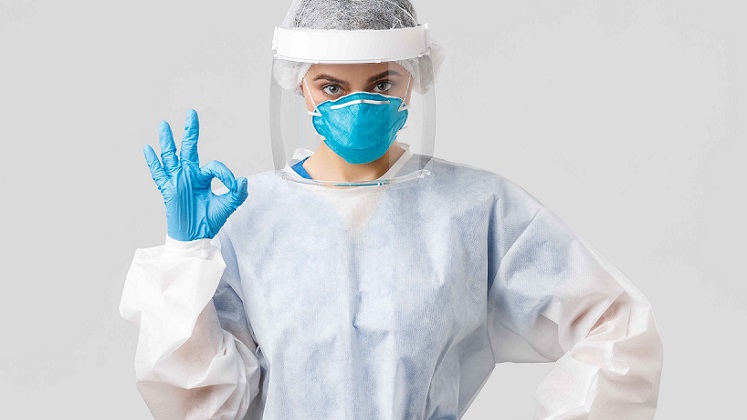
At the beginning of August last year, Shahi Exports and few other leading apparel exporters stopped manufacturing of PPE (coverall) as their regular business resumed. Now when vaccination has started across the globe and Covid cases are considerably down, many apparel manufacturers who explored PPE as a major product category are not producing the same at all.
On the other side, various stakeholders of the industry believe that there will be good demand for PPE in future, especially in overseas markets. The data of Get Us PPE says that in US, PPE requests in October 2020 increased for the first time since April. During January-October ’20 period, the US has seen a whopping surge of 311.60 per cent in value terms of its PPE imports. The total PPE imported by the US, according to OTEXA, valued US $ 16.58 billion in January-October ’20 as against US $ 4.03 billion in the same period of 2019. Experts believe that at least for the next year, even as the vaccination drive picks up momentum, the demand for PPE will continue.
Positive outlook
Ethical Sourcing, Gurgaon is doing good business in this product category and even further has a positive outlook in this regard. Sanjay Thakur, Sourcing Director of the company says, “PPE demand is definitely on the uptick; being an industrial product, the demand is not affected by the short uptrends or downtrends of Covid cases. Its stocks are professionally managed by brands/agencies involved as per their long-term strategies.”
He further adds that PPE components are mostly professional categories and countries/private brands will have to maintain war stocks due to which there will be a continuous demand at least until 2022-23.
Vandeep Ratra, Director, GBKC Fashions, Dehradun (the leading manufacturer of PPE) also foresees a continuous demand of PPEs for both domestic and export market. He states, “With the given situation of the second wave of lockdown and apprehension in many developed and developing countries in Europe, I think this will continue to be a growing product in the textile market. Also, based on the huge order quantities in tenders across countries, we can see a huge demand for protective apparels going forward.”
This leads to an important question as to if there is a correlation between the growing or reducing cases of Covid and demand of PPE. Jasdeep S Sahota, CEO, Gravity House, Gurgaon is of the view that on both fronts, there is a clear trend and hence direct correlation in demand. “While some countries have brought about a sharp decrease in Covid, they will now need more PPE for the roll-out of the vaccine,” he says. Gravity House, a supply chain expert firm, is also doing well in PPE business.
Regular product category
Professionals of buying community dealing with this product category are of the view that it is a regular product category while people have upgraded facilities and also invested in product testing, compliances etc., which is mostly a one-time affair.
Competition
Though India has developed strong strength in the manufacturing of PPE, but countries like China, Bangladesh and a few others are also strong in this category. They also have ‘First mover advantage’ as far as export of PPE is concerned. And now as in India, prices have spiked up from fabric to boxes, will it not have a negative impact on India’s PPE export?
Sandeep agrees with this and adds that labour cost also makes India not so competitive currently and a lot needs to be done where exporters/supply chain need to get out of the opportunistic mindset in which they are currently. They are quoting obnoxious prices keeping 20 per cent and more as profit margins, however, a rational approach is to keep 5-7 per cent on the higher side.
Vandeep believes that from export perspective per se, only a few manufacturers in India have in-depth technical knowledge of this product and if you look at the developed countries, the demand is for compliant products meeting all the required test parameters as per the applicable regulation. I think, for India, it’s a huge opportunity to become one of the most authenticated and prominent suppliers of healthcare apparels in the world.
He suggests that MSME shall invest in gaining know-how of the product and continue to supply these products in the export market.
Jasdeep also feels that it is still early days to say that India would be a long-term supplier for exports, especially to the US, EU markets. “China was and is an established supplier with years of execution and the requisite certifications in medical-grade sterile products while India is a late entrant with the potential,” he says.
Level one to level four
It is pertinent to mention here that currently India is majorly focused on level one product of PPE; however, to compete for level 3-4 product categories in this domain, India needs to invest a lot in fabric manufacturing capability/clean rooms etc., apart from worker training to handle such high-value product and quality expectations.
“As AAMI PB 70 Compliance as per US FDA or EN Standard compliance as per EU directives and the scope and opportunity to supply authentic products is huge in India, so there is no question of competition as of now,” says Vandeep.
Buyers’ expectation from Indian manufacturers
Supply chain needs to understand that this is a commodity business and they should leave their opportunistic attitude and work on sustainable margins to make product competitive out of India.
Maintain prices in short-term (six months to one year) and hike as minimum as possible later.
Be proactive on certification and compliances.
Expectation from buyers
The buyer should be clear as to what exactly is their requirement for these products. Especially in the domestic market, all the major orders are coming through GeM Portal and what we have seen is that almost all the tender documents are being prepared without complete knowledge and requirement. For example, It says the product should pass ISO 16603 test from a recognised lab with UCC Code but now, almost all the UCC codes have been expired as it was issued during the start of the pandemic, and now UCC has been replaced with the ISI mark and all these coveralls have to be BIS Certified.
Another example is in terms of the fabric requirement. In many tender documents, it is mentioned that the fabric should be SMS and it should pass the Blood Synthetic Penetration test, but technically it is highly unlikely that the SMS fabric will pass this test unless it is laminated with a PE coating on top or in between. It is important that the buyer should be completely aware of their requirements.
Many feel that India is at a nascent stage for manufacturing PPEs and is moving towards becoming one of the biggest sourcing hubs for healthcare technical textiles in times to come. Healthcare textiles is a vast sector with a variety of products involved made up of varied fabrics so focusing only on body coveralls, we will not be utilising the full capabilities. With respect to global quality standards, I think India is in the process of accepting global quality standards and design. In the long run, one will see a huge difference in product quality and design.
It is also pertinent to mention here that lockdown has proved that traditional supply chain infrastructure leaves organisations vulnerable during a pandemic. So, keeping stock of PPE seems a viable option.
Sandeep Makkar, MD, Johnson & Johnson Medical India is of the view that stockpile of PPE will not cost much and we should not wait for any other crisis, but remain prepared.
As India has had proved itself and created a revolution in PPE manufacturing, there is no reason that with some above-mentioned steps and looking at the overall scenario, it can be a strong hub for global supply.
Jasdeep concludes well, “When India first moved into PPE, it was driven by Government support and demand for coveralls. Over time, industry expertise developed with more comfortable, breathable fabrics of higher value. We have the raw materials, the basic skill sets and entrepreneurs and with the right policy framework, India can grow in the global PPE business.”






 Bharat Tex Special Report 2026