India’s denim industry has been on a roll for the last few years. According to various studies, it will skyrocket to US $ 9.15 billion by 2026, up from US $ 6.15 billion in FY 2023. Whether it’s global denim giants like Levi Strauss, Pepe Jeans or domestic players like Arvind Fashions Limited, Killer Jeans or Spykar, each one of them is witnessing impressive growth in India with a drastic shift in consumer behaviour and preferences influenced by factors like comfort, versatility in formalwear, focus on women denimwear, rising urbanisation and a tilt towards eco-friendly innovations. To gain further insights into this thriving sector, we conducted an extensive survey amongst denim mills in India, aiming to understand the industry’s current status and its future trajectory. Our survey has revealed quite interesting findings.
Production Capacity
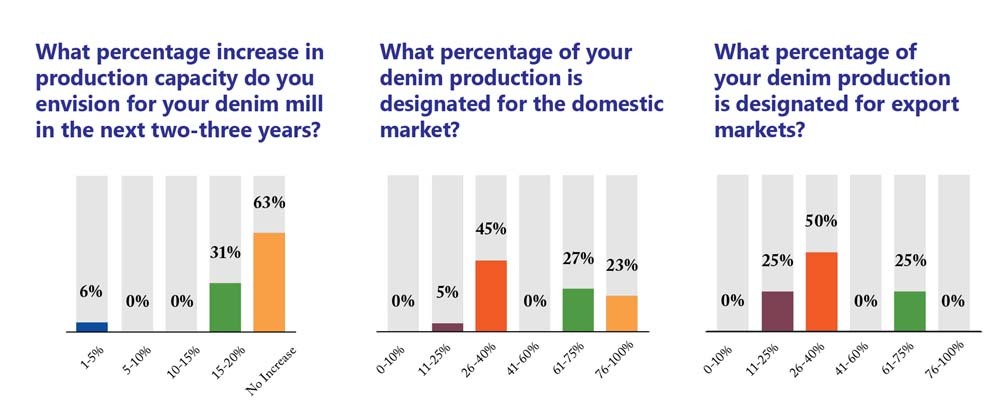
Though the denim industry is growing but surprisingly a majority of denim mills, comprising 63 per cent, express a conservative stance with no planned increase in production capacity over the next two-three years. However, a notable 31 per cent hold a bullish perspective, eyeing a significant 15 per cent – 20 per cent expansion. It’s worth noting that many of these mills are small to mid-sized and are primed for growth.
Market Focus
India’s denim production is over 1600 million metres per annum, making it the second-largest producer of denim fabric globally, right after China. According to the survey, nearly 65 per cent of this fabric is used within the country itself, including for making jeans that are exported abroad. The remaining 35 per cent fabric is sent to countries like Bangladesh, Colombia, Venezuela, Egypt, Sri Lanka and the UAE, amongst others. This distribution highlights the denim mills’ ability to effectively meet both local and global demands.

Export Destinations
In 2021, denim fabric exports reached US $ 354.54 million, followed by a decline to US $ 291.84 million in 2022, marking a 17.68 per cent decrease year-on-year. From January to November 2023, exports further decreased to US $ 154.45 million, representing a significant 44 per cent decline compared to the same period in 2022. Among the destinations for denim exports, Bangladesh continues to remain a prominent hub, capturing 35 per cent of the market share, closely followed by Latin American markets commanding 26 per cent. There was a consensus among the respondents to look for newer markets especially considering the declining trend in exports over recent years.
Colour trends and sustainability
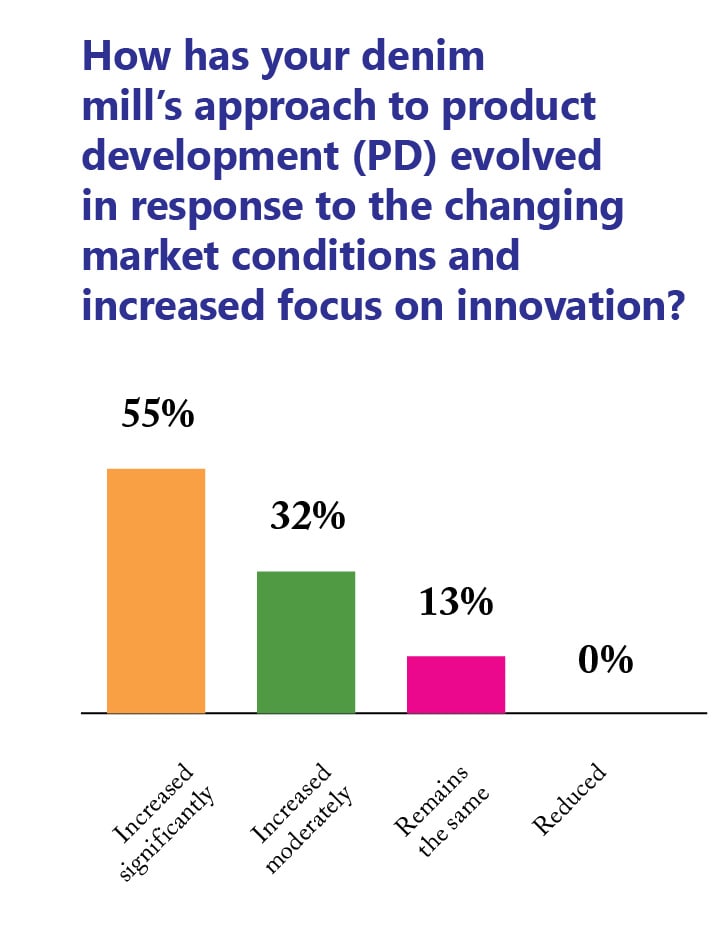
In response to shifting consumer preferences, denim mills are attuned to emerging colour trends. Apart from indigo or blue which dominates the market, black (43 per cent) emerged as the next hot hue in demand, followed by grey (20 per cent). Moreover, the survey underscores a rising demand for sustainable denim fabrics, with a significant 46 per cent acknowledging either a significant or moderate increase in demand. Responding to market dynamics, denim mills are also embracing innovation and product development, with 55 per cent reporting a significant increase in their approach to product development.

Future Growth Areas
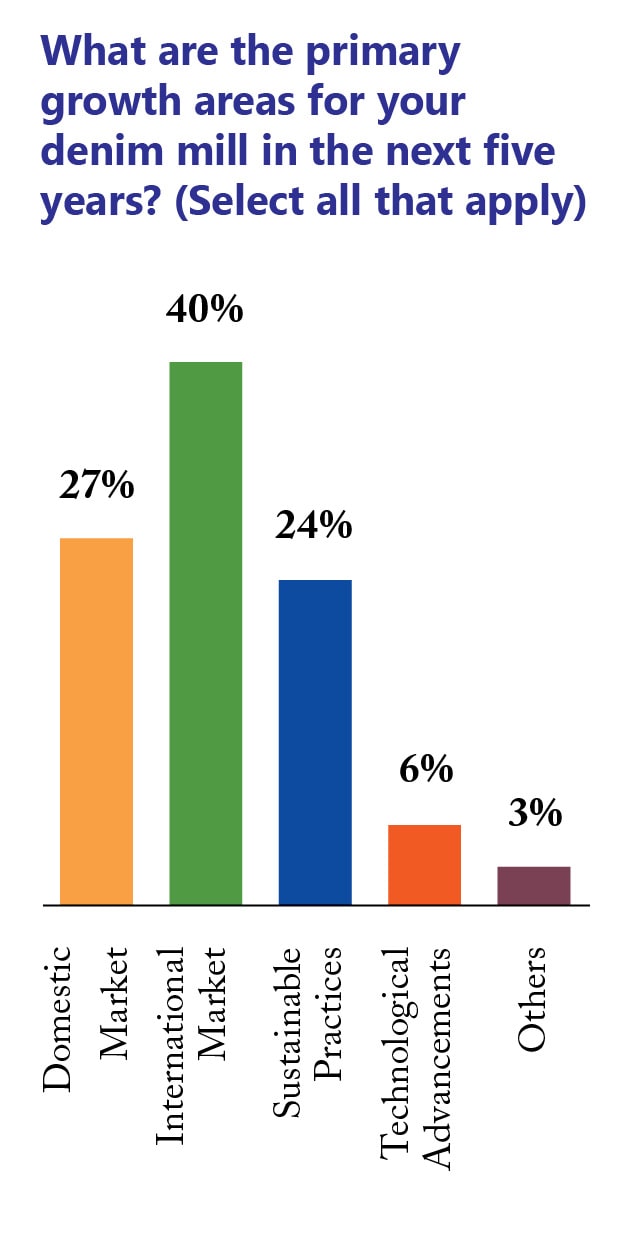
Though global economy is on track but it’s not yet out of the woods. The World Bank’s latest report predicts that global growth will slow to 2.4 per cent in 2024 before edging up to 2.7 per cent in 2025 and going from strength to strength in the years to come. This sentiment is echoed by denim mills in India as well. Looking ahead, the survey respondents identify international markets (40 per cent) as the primary growth area, trailed by domestic markets (27 per cent). Remember, Indian economy is expected to grow close to 7 per cent in FY ’25 and will hold the momentum going forward.