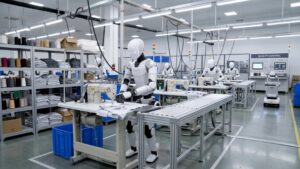
The most crucial requisite to convert a conventional factory into smart factory is data… Since everything has been changing dramatically in fashion business, the manufacturing industry has to realise the power of transitioning from 3.0 to 4.0 using ‘data’ which is something the factories are now opting for, but it’s yet to see maturity. So, how to achieve maturity? The step begins with the strong understanding of a garment making process on sewing floor and then comes collaboration between data, automation and existing manufacturing processes. Once this happens, the road to smart factory initiative becomes smoother and easier that further leads to eliminating the inefficiencies and errors from the shopfloor, improving quality of the finished garment products, and shortening the lead times in a rapidly changing global business.
On similar lines, Nimish Dave, Founder, The Idea Smith – a business consulting firm, talks to Team Apparel Resources where he puts strong emphasis on the smart factory initiatives that need to work alongside existing process improvement tools such as lean manufacturing, Six Sigma etc. rather than replacing them. Having worked with the apparel manufacturing industry extensively in India, Bangladesh and other Asian countries, Nimish brings that kind of expertise which can play a vital role to uplift apparel manufacturing business using amalgamation of 4.0 tools, lean manufacturing tools and quality control methods. Nimish has recently integrated another vertical – iSmart Factory – to his company that works in close conjunction with factories to digitise processes and to reduce manual dependency using the exhaustively collected data. Following are the excerpts of our interaction with Nimish…
AR: What, according to you, are the core shopfloor problems in today’s time that are hampering the profitability which anyway industry is not earning much? And, how can smart factory be a solution for that?
Nimish: Garment industry is all about tailoring outfits where you bring in fabric, cut it, stitch it, finish it, pack it and dispatch it. To be efficient and profitable, factories need to be supremely productive and qualitatively driven. There is no room for error as error costs you money and takes away small margins of profits.
If I talk about the main problem with India’s apparel shopfloor, I can vouch for the fact that the whole structure of giving a supervisor the power to take care of a variety of jobs on sewing lines is senseless. Even if factories change supervisors in case they fail in their performance, they won’t be able to see drastic changes by changing people. Digital dashboards are now able to do these jobs such as maintain hourly numbers, keep track of efficiencies, and ensure defect/rework/rejection level is below the set parameters in much more efficient ways that a human can do! Factories working using digital tools have seen their efficiencies go up to 65 per cent with a lot of scope of improvement still there!
Lack of accountability on quality is another issue that the garment industry is facing. If you are manufacturing millions of garments a year and you depend only on end-line QC for quality control, you probably aren’t going to please your buyers and build a culture where quality is given priority. How would a quality inspector know that the produced garments ascribe to accepted quality standards or not before they are fully stitched? And, if there is a defect in an item, how is it addressed at the point of cause so that quality at right first time produced and cut-to-ship ratio can be improved? This is a really difficult task if handled manually at big level.
The smart factories address all these issues head-on with data collection at each step on floor. As a result, the factories actually know what their DHU (Defects per Hundred Unit) rate was before they became ‘smart’ and how much time, energy and hidden costs were being wasted in the rework process. The DHU rate in most of the Indian factories is somewhere between 14-22 per cent and that’s the money the factories lose if quality is compromised due to lack of data-driven approach. Smart factories can help bring this DHU rate to below 2 per cent.
In order to bring positive changes, I would say work on a method called DMAIC – Define, Measure, Analyse, Improve and Control which is a six-sigma methodology. Factories are encouraged to define their goals, measure them and do an in-depth analysis on it. When 3 core parameters out of 5 get desired attention, rest two will always be effective. Now, at this phase, comes digitisation, IIoT, 4.0, smart factory that become game changer.
AR: So, what are the key requisites for implementing digital tools in order to step closer to become a smart factory?
Nimish: I would like to bring in the mention of ‘Manufacturing Execution System’ (MES) here which is an information system that monitors and tracks the process of producing manufactured goods on the factory floor. I strongly believe MES is the stepping stone to the SMART FACTORY initiative. The overall goal of MES is to make certain that manufacturing operations are effectively executed to improve production output. MES helps in real-time quality data checks, yield monitoring, automatic enforcement of specifications and business rules, and as-manufactured lot, batch, device or unit traceability – all resulting in improved product and process quality, and higher productivity.
The goal is achieved by tracking and gathering real-time and accurate data about a complete production lifecycle. MES is helping millions of factories in various sectors across the world and improving their key parameters such as quality, productivity, efficiency, cost, maintenance, lead time and hence competitiveness.
Another advantage of MES is paperless manufacturing as it helps to reduce scrap and eliminates paperwork errors and redundant checks. It also tracks product and order details on the plant floor, collects transactions for reporting to financial and planning systems, and electronically dispatches orders and manufacturing instructions to shopfloor personnel.
I have always thought that the industry’s problems can holistically, sustainably be solved only if human intervention is reduced because a human doesn’t have the required set of talent pool to bring transformation through manual efforts. Transforming factories from analogue to digital helps companies achieve multiple objectives with the use of IoT, tablets, cloud computing, real time data etc. This assists them in taking data-driven decisions on productivity, efficiency, bottleneck analysis and operator issues.
Not just that, the quality can also be digitised. Having said that, not just in factories that work on salary model, digitisation can also help improve quality level superlatively even in piece rate system, though I do not advocate the piece rate system. Factories are advised to make a cell and assign some qualified QCs that report concerned person directly. Now they require to put digitisation at the in-line QC and include all 40-50 quality parameters in digital mode in tablets. A QC inspector, with the help of digital quality tool, will do inspections on all the set/fed parameters. That means a garment will undergo all quality defect parameters. So this gives the decision makers of the factory the real time information – it can be seen on LEDs, it can be brought to them via email box, or it can be sent on WhatsApp.
All this can be of great help in piece rate model – not just in quality department but in cost-calculation as well. Pay-out system has been made easier because most of the piece rate factories do work on 15-day pay-out model. Currently, there is a huge mismatch between what an operator actually earns and what he is paid at the end of 15 days cycle. These all issues can be eliminated through digitisation.
AR: How is MES different from ERP then? Can both work together to solve some of the most pressed shopfloor issues for operational excellence?
Nimish: MES provides a number of long and short-term benefits as well as strategic and tactical advantages, including more rapid time to volume, improved yields, lower operating costs, increased compliance.
So, the question here is how do MES and ERP work together? I believe – “ERP knows why decisions need to be made, while MES know how to make those decisions.”
Both MES and ERP have the ability to work together. Since both software bring different capabilities to the forefront, using them together can help bring apparel manufacturing business more well-rounded results. Both software can be integrated, which can increase operational clarity and equip organisations with the ability to monitor and adjust performance against business plans.
Another important question to ask here is why can’t one just build the order schedules from ERP?
Today’s shopfloor is a complex, continually varying environment. The scheduling needs to account for a level of variations that are typically beyond the scope of the planning systems – MRP, Master Scheduling and the like. MES automation considers and controls the highly critical details of a typical plant shopfloor and helps tackle the Causes of Variation on the shopfloor as follows:
- Machine breakdowns
- Labour absenteeism
- Changing set-up times
- Cleaning and maintenance times
- Changing delivery dates
- Quality problems
- Alternative work plans
- Alternative parts list
- Availability of transport
- Availability of quality resources
- Changes to minimise process times, set-ups and many more
I would say – “It (MES) is virtually the heartbeat for all things happening on the shopfloor.”
With an MES in place, KPIs, performance data and future intelligent planning begin to become available. To that end, the MES is best-positioned as a ‘first step’ action in any factory’s digital transformation. The MES will grow in scope and complexity as a factory’s systems and automated processes mature and will serve as the foundation for most every other step in the digital transformation journey.
Visuals for Avanti Overseas (Noida) Smart Factory
(All images are captured by Apparel Resources)
iSmith/STITCH commenced its digitalisation journey in Noida-based Avanti Overseas, owned by a dynamic young entrepreneur Raghav Modi, by converting the factory into smart factory and transforming processes from Analogue to Digital.
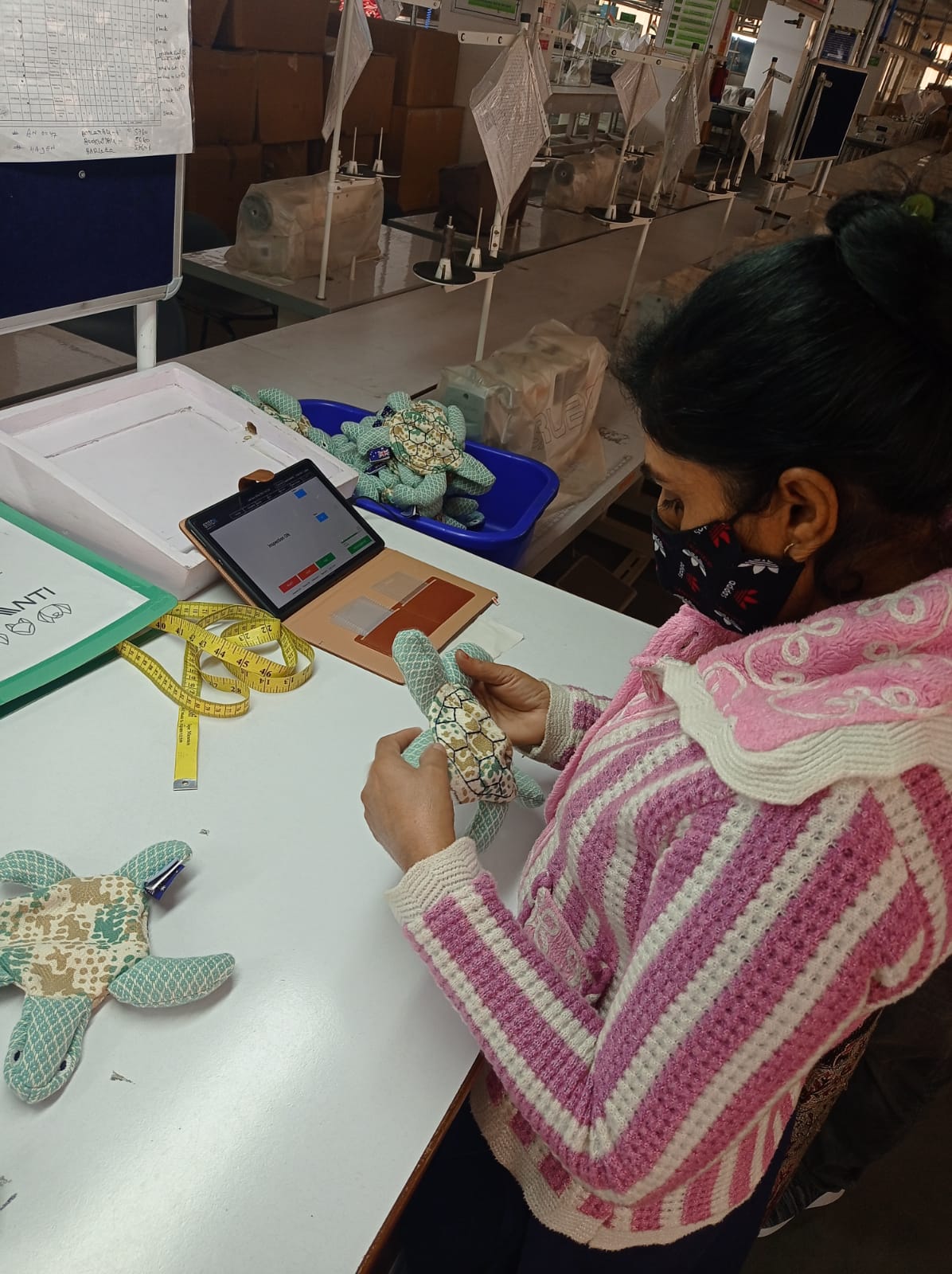
Digital quality inspection ongoing in textile toy product before it goes for fibre filling so that DHU of final product can be brought drastically down. In Avanti, DHU rate has reduced to below 3 per cent using digital solution from over 15 per cent in manual inspection…

The tablet, installed and maintained by STITCH, gives real time information of approved, rejected and altered products…
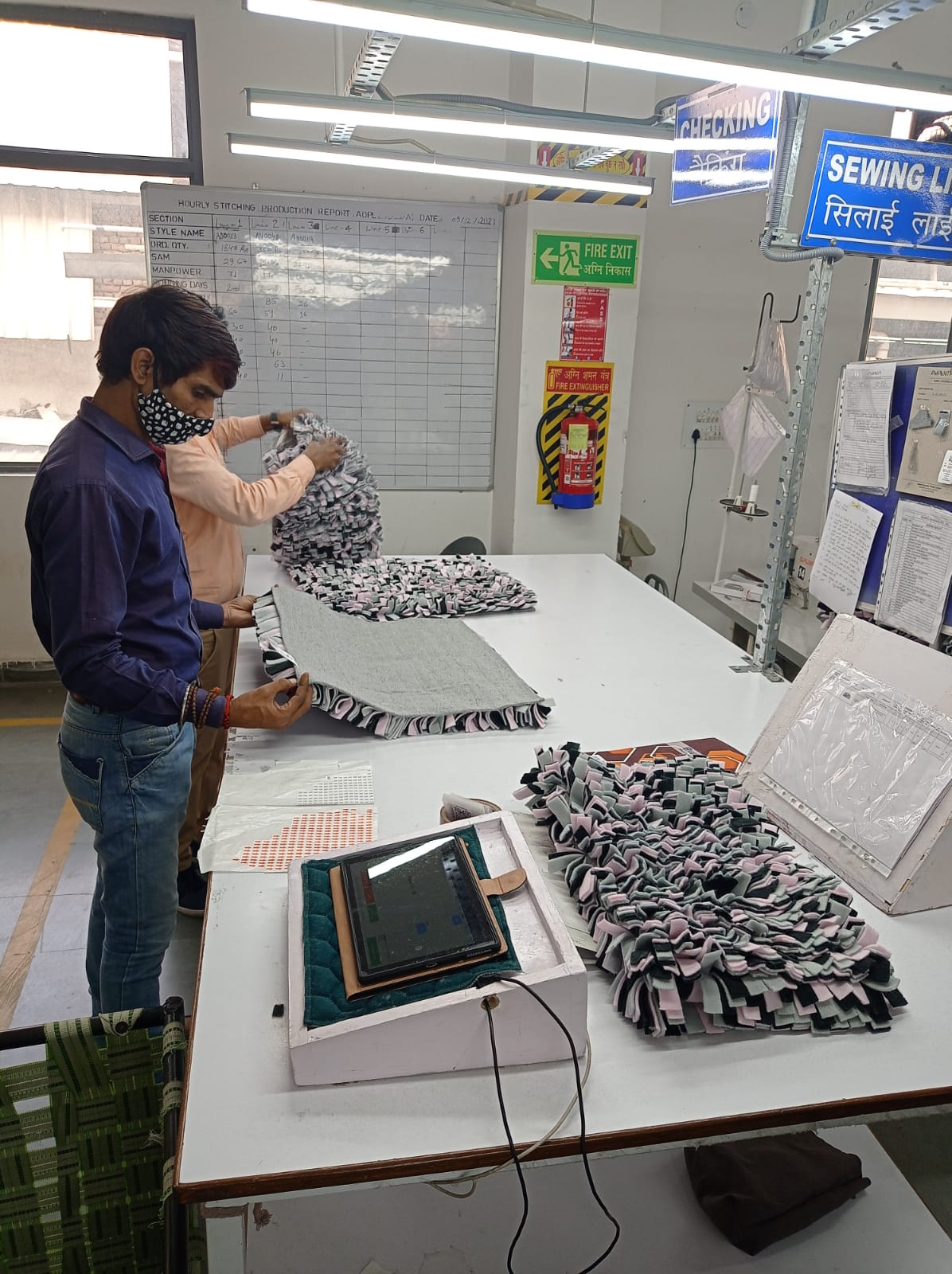
On-line digital inspection happening in pet bedding before final piece is assembled…
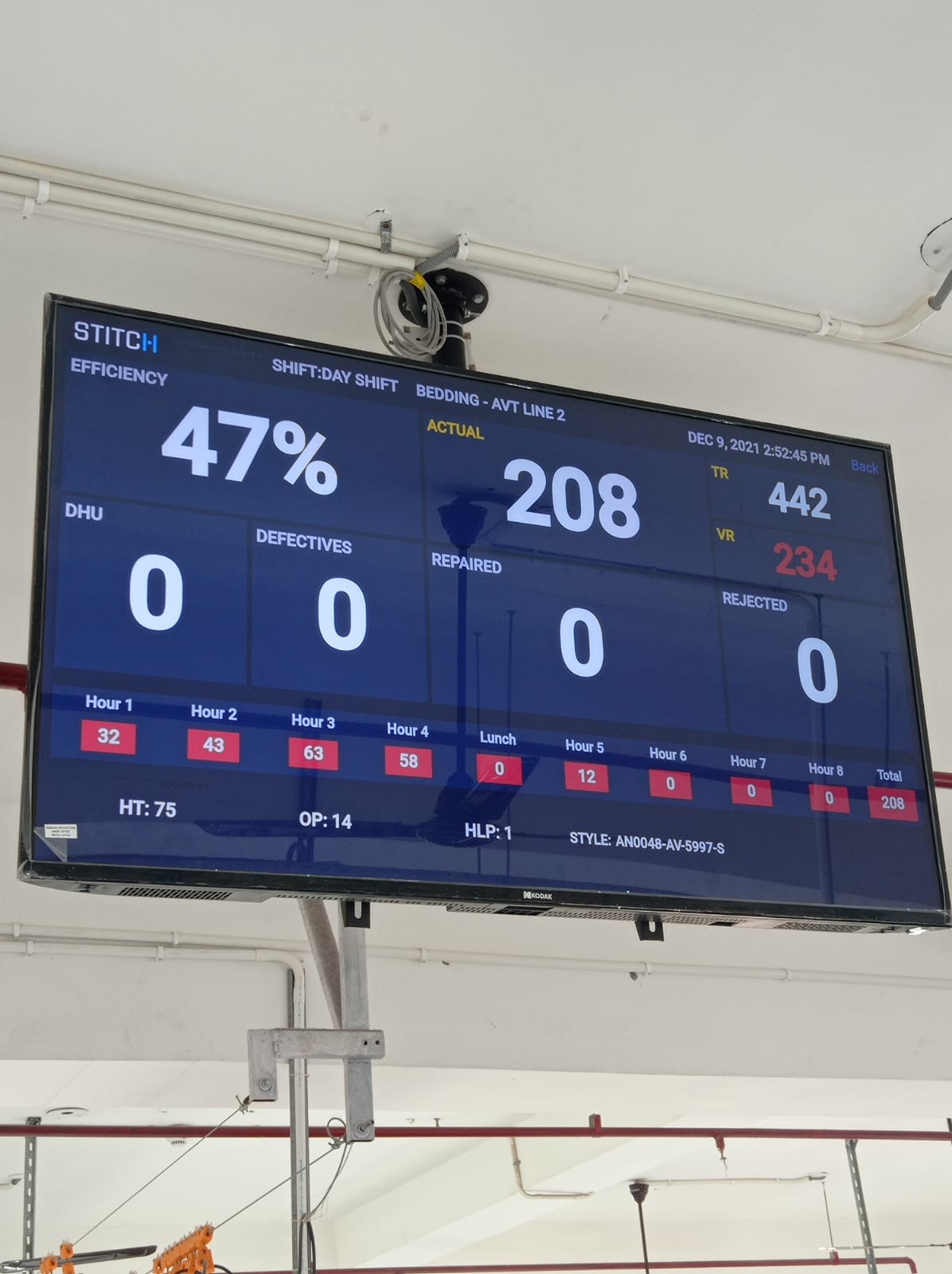
A digital display, powered by STITCH, on the shopfloor gives real time information of production as well as quality inspection inside Avanti Overseas…
AR: What, according to you, is the future of smart factories in the Indian apparel manufacturing industry? Is the investment coming up from factories of all level or is there still a reluctance?
Nimish: The way I view it – smart factory is the only way ahead. Consultants and the people who are aware of the changes that are happening in the world’s apparel manufacturing space are helping, teaching, guiding and mentoring factories…And, the good part is that the apparel manufacturing fraternity is now opening up and seeing the value in becoming smart. Factories in pan-India are deploying such digital tools that help them collect real time data, eliminate redundant human intervention and take quick, correct decisions. Factories such as Zedex Clothing (Ahmedabad), R.K. Industries (Chennai), Penguin Apparels (Chennai), and LNJ Bhilwara Group have joined the bandwagon recently; while, as per my knowledge, Vitamins in Mumbai is also deploying the same and the installation process is underway there. A number of small and mid-level enterprises are also showing their interest in these digitisation tools and MES solutions because they know the smaller groups can get the value out of it as much as the bigger and established ones are getting.