The Phase 1 infrastructure blueprint and administrative guidelines for the development of ‘PM-Mitra Textile Park’ in Kalaburagi, Karnataka has been finalised, and groundwork for the project will commence shortly, according to Karnataka’s Minister for Home, Information Technology, Biotechnology and District In-charge Minister of Kalaburagi, Priyank Kharge.
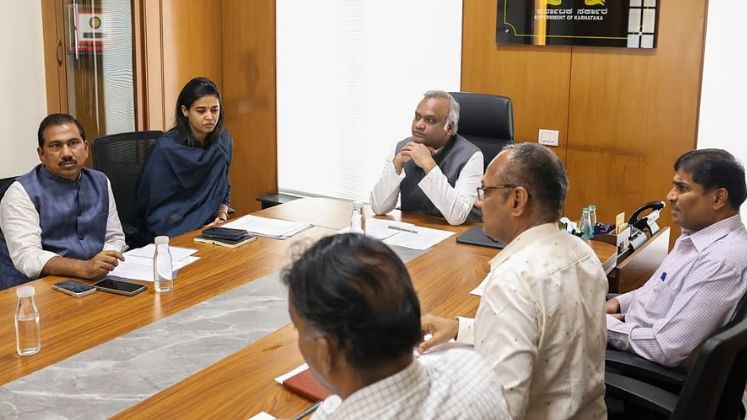
Kharge chaired a review meeting at Vikas Soudha in Bengaluru to assess the progress of the textile park, which is being developed over 1,000 acres during the first phase near Kalaburagi.
The minister stated that the project would feature a world-class “plug-and-play”ecosystem, enabling investors and textile units to commence production with minimal delay.
He added that the entire park will also be covered with underground (UG) high-tension/low-tension (HT/LT) power distribution lines, along with the installation of eco-friendly solar street lights.
According to officials, the first phase will focus on the development of core infrastructure,including land development works,internal road networks and a modern reinforced cement concrete (RCC) drainage system to ensure efficient stormwater management across the industrial park.
To meet industrial water requirements,a 5 lakh-litre Ground Level Service Reservoir (GLSR) will be constructed,along with a 10 lakh-litre Elevated Level Service Reservoir (ELSR) for the supply of treated water.
Highlighting the project’s environmental sustainability measures, Kharge further stated that the establishment of 2.5 MLD capacity common sewage treatment plant (CETP) with zero liquid discharge (ZLD) technology and its supporting pipeline network will be started to ensure environment protection.
Memorandums of Understanding (MoUs) were signed with nine private companies in the cotton processing and textile business, with an expected investment of Rs 1,900 crore when the project was formally inaugurated during the tenure of former CM Basavaraj Bommai.
The decision to establish a textile park in Kalaburagi was taken in 2003 by the central government, considering the significant cotton grown in Yadgir, Vijayapura, Raichur, Bidar and other parts of Kalyana Karnataka region.