Most businesses in Asia accept that they are a long way from achieving the highest levels of productivity that have been consistently achieved in the world’s best factories. Many businesses have been buying faster high-tech machinery or have introduced operator incentives to encourage the workers to sew faster. However they have still not seen the improvements in output they had hoped for. Why is this? Simon Gibson, MD, FastReact explains the reasons through various live examples released from time to time.
Have you confused SPEED with EFFICIENCY? Which of these is faster? Which is more efficient? The sports car or the motorbike? Taxi or the sports car? The sports car IS FASTER… but… the motorbike taxi is MORE EFFICIENT! Why, because the motorbike, even though it is slower, spends less time waiting and more time in moving.
Let us not forget that Production = Speed X Time on Work
How much sewing time do your sewing operators lose every day? Walk out on to your own factory floor today and surely you will find the following:
- Delays due to missing fabric, trims and accessories,
- Delays due to style approvals,
- Delays due to machine shortages or capacity problems,
- Poor workflow due to work in progress (WIP) problems,
- Fire fighting leads to unnecessary style and colour changes.
Delays Due to Missing Fabric, Trims and Accessories
The reality is that many companies struggle to clearly prioritize and communicate what they need from their suppliers and when. To improve the situation clear targets for each order/material item, based on ‘how much and when required’ in time for production is provided through a good software solution. These targets are calculated on Just in Time (JIT)/Lean principles, so clear priorities are set directly from the latest production plan. Through a good solution such as FastReact one can tell all suppliers exactly what is the need and when. A good solution can then receive feedback on expected availability of material for quick and easy reference during the planning process.
Delays Due to Style Approvals
The line has to change from style ‘A’ to style ‘B’ because the planned style ‘A’ is not ready for production. Later the output drops again because style ‘A’ once it is ready has to be spread over to more sewing lines to make sure that the delivery is met; …unnecessary style change is directly responsible for lower efficiency. These problems can all be traced back to problems in planning, communication and coordination. And due to the day-to-day pressure you just don’t always see the next problem soon enough! Targets are NOT based simply on the delivery date minus a standard production lead time as this does not reflect priorities. If we have 30 orders all for the same delivery date, only the latest production plan can reflect our true priorities.
Delays Due to Machine Shortages or Capacity Problems
Many factories fail to see far enough in advance that they will have an overload or bottlenecks on some operations or processes. This will be due to the style mix at a particular time leading to machine shortages on certain machines in sewing, or capacity problems either before or after sewing on operations such as embroidery, washing or sandblasting, etc. With an ever-changing plan, it can be difficult to keep track of the style mix and loading on key machines or processes. With manual and spreadsheet based systems, this can be an almost impossible task.
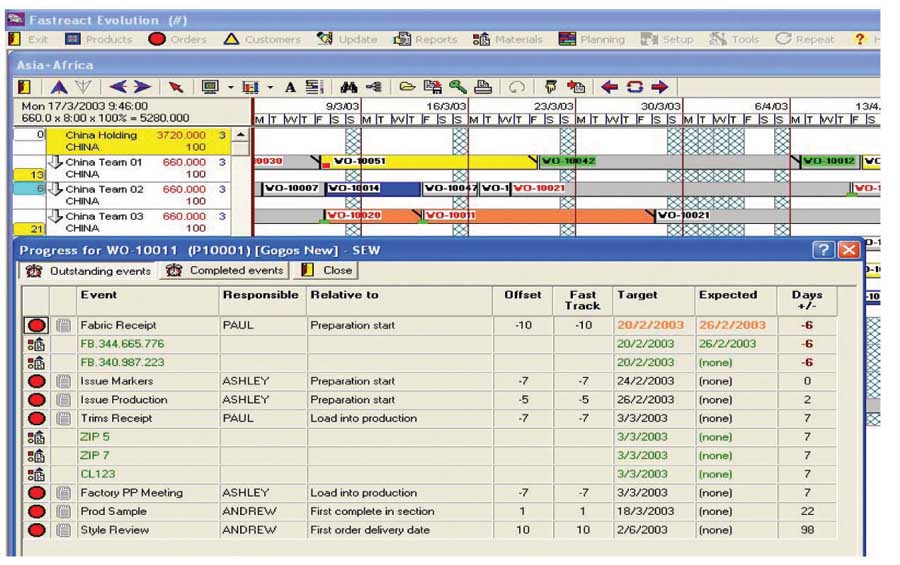
A good software solution such as FastReact allows the user to define which operations and machines they wish to monitor. As soon as the main sewing plan is created, the operation bar-charts provide an easy-to-read monitor of the loading on key machines or process areas. Potential overloads and problems are highlighted well in advance (by operation and by day/by week/by month), to take corrective action. Full drill down and ‘modelling’ of capacity and working hours etc. allow for rapid ‘what/if’ problem solving.
Poor Workflow Due to Work In Progress (WIP) Problems
For many factories, day-to-day production problems result in insufficient work for certain production lines. Many factories lose output due to not having cut/embroidered/printed the correct orders or the correct quantities to feed the production lines. This is often the result of numerous, necessary changes to the production plan and not being able to quickly communicate the latest requirements/priorities to each department.
In order to facilitate the process it is important to generate a work schedule for all departments and subcontractors from the master production plan (for e.g. sew). This ensures that the latest priorities are always clearly communicated. Daily production updates are also fed into the solution to highlight any WIP problems, such as insufficient cut work coming through for sewing which are immediately highlighted with a colour code.
Fire Fighting Leads to Unnecessary Style and Colour Changes
All of the above problems cause further productivity losses due to fire fighting and the changes cause disruption on the factory floor. These problems often result in unnecessary style and colour changes. For example due to delays and urgency, a style which was originally planned on one sewing line now has to be re-planned on to two or three sewing lines to catch the delivery date. This means more style change losses and lower overall production efficiency.
Plan and communicate better – If you can plan better to start with, there will be fewer surprises, and both management and suppliers will receive clearer priorities. Potential problems will be seen in advance and there is more time to fix them. In the inevitable cases where things do go wrong, a good software like FastReact allows for quick ‘what/if’ planning to find and evaluate different solutions.
Manual planning methods inevitably result in low efficiency and high overheads. Indirect staff used to manually enter data into numerous spreadsheets, reports, data summary and analysis sheets, etc. Lack of visibility results in management time wasted in trying to identify priorities. Problems are often not visible until it is too late to avoid excess costs or late delivery. Staff is unable to quickly test out different “what/if” scenarios when planning. Poor decisions result from not being able to consider alternatives. Much time is typically wasted in numerous meetings, emails and phone calls to communicate the frequent changes in the plan.
In summary, with manual systems far too much time and effort is spent in simply identifying the problems in the first place, leaving far too little time to solve them. Management time lost on managing and planning all these symptoms could be better spent on analyzing and implementing business improvement solutions, such as SAM to provide better information for planning. FastReact makes both the planning team and management more productive, allowing them to concentrate on problem solving. Highly visual and easy to use, the FastReact solution sits on the local PC network and provides a central point of reference for all departments and ‘a single version of the truth’. To plan effectively, there are many variables to consider including capacity, lead times, material availability and current production progress against the plan… if one of these variables changes on a single order it may also have a knock-on effect on other styles and orders. FastReact allows the immediate effect to be seen, not just on the order involved, but also on all other orders.
Conclusion
How do you plan, communicate and coordinate will decide how quickly you can expect improved efficiency. If you carry on with the same old system of using spreadsheets, emails and endless meetings, you may end up with lower efficiency. The easiest and most effective way to improve factory productivity is NOT to focus on sewing faster BUT to make sure your operators spend more of their time sewing. Make the best possible plan for line efficiency and then make sure that all departments achieve that plan so start cut can happen as planned.