Embracing ‘verify to rectify’ method at every stage all across the shopfloor, Tharun Garments has chosen a way that will not only enable them to sustain in the chaotic apparel market but also lead them to the path of long-term escalation. Since knitwear manufacturing possesses a greater amount of challenge than woven segment, Tharun has clipped check points at every step right from material sourcing to dispatch. “If there are problems, there are solutions too. We supervise every process closely as continuous supervision is the only solution to reduce rejections and improve productivity,” says Mahesh.
Despite being a small-scale unit, Tharun Garments has a practice of not bypassing even a single check point. Raw materials, trims and accessories such as buttons, labels, fabric, yarns, thread, needles, zippers that enter the factory premises are not qualified for further processes until these are thoroughly inspected both on quality and quantity ends. “We believe if we fail in verification, it will spoil the final products,” shares Mahesh.
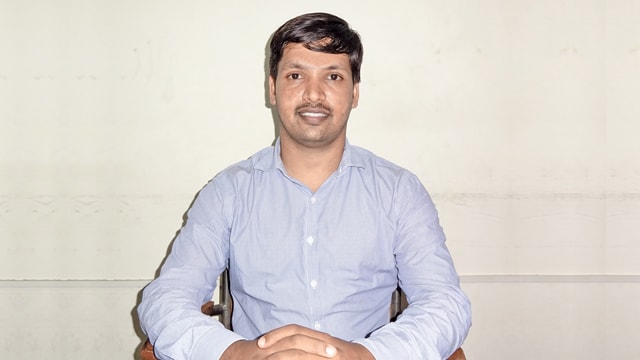
Tharun Garments is currently a Rs. 12 crore company with three production units having 25,000 pieces production capacity each. Being five years old in the business, Mahesh believes that the habit of using technology should be the topmost priority for any start-up in the garment sector. “This habit will surely enable the companies to challenge the rising costs just like we groomed ourselves in last five years,” comments Mahesh.
More than 80 per cent of the garment manufacturing units in Tirupur can be categorized as MSMEs and a general perspective is that there is a huge scope for improving the operational efficiency in these units. Many of these units are not generally keen to take a professional approach because of their size, knowledge level and capacity to absorb costs but Tharun Garments is surely an exception. “Although we are not that big a name in the apparel industry, we want to fly high to achieve heights in the coming years. To achieve what we foresee, it is necessary to keep enhancing the factory processes on a regular basis and that’s the only key to become competitive,” – E. Mahesh Kumar, Managing Partner, Tharun Garments.
The company is studded with 120 UBT SNLS machines of Juki and Siruba. The technical team of Tharun sets the stitch type on sewing machines according to the need of running production order to sew the garments having GSM 100 to GSM 300 fabrics. Stitch length, thread tension, seam width, number of threads, panel pass by guides and folding clips are adjusted according to the required seam operation. “With this adjustment process, we ensure that no stretch problem occurs in the sewn garments,” claims Mahesh.
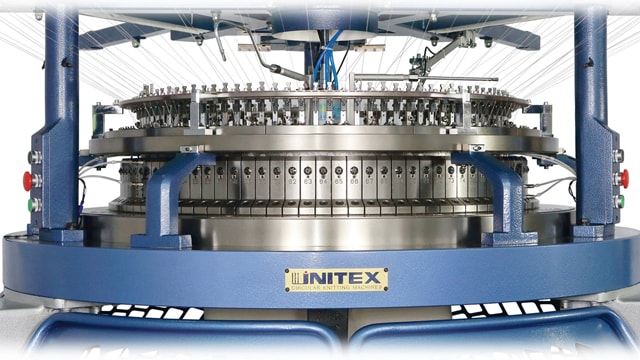
Tharun Garments has also set up an in-house knitting facility with five circular knitting machines of Unitex (Singapore) to take care of fabric knitting. The company buys yarns and knits fabric under the close inspection of a foreman appointed for the operation. The operators’ responsibility is to operate the machine at the particular shift, as set by the foreman. The operator also keeps a check on every fabric roll he produces and submits the inspection report to the foreman. “He makes a mark with non-removable marker pen and notes down the details like the yarn count used, the stitch length and diameter with his signatures,” adds Mahesh.
In case of any problem identified in the fabric, the machine is stopped and the foreman corrects it. If the problems are big and uncontrollable by the foreman, a service call is made to appoint a service engineer. “This way we follow our ‘verify and rectify’ process from the very beginning of the knitting operation,” avers Mahesh.
Mahesh further adds that a machine will take care of the production if it is properly maintained. To ensure that high-quality knitted fabrics are obtained, Tharun uses only Groz Beckert needles in its machines. These needles are replaced after knitting every 50,000 kg of fabric. Additionally, 100% water soluble lubricant is used to make the fabric free from oil stain. “We use oil purchased from Siruba only, as we know the cost of poor quality and never want to experience that in our unit,” underlines Mahesh. The knitting machines are inspected and cleaned on daily basis and the service is done after the machines knit 3,000 kg of fabric.
“Self-learned operators are more important than professionally trained ones as for changing product categories, self-groomed operators keep sharing their ideas to increase productivity,” opines Mahesh.
Once the fabric is knitted and cut according to the design, the production team of the factory comes to play its role. According to the factory needs, bundle production system is followed in the production area as it’s the best method for the low quantity orders. “We have deployed specific machine operators for some defined sewing operations and there are clear instructions that no operator will involve in the lines other than the line he/she is working in. This way we keep their concentration on their work,” discloses Mahesh. Tharun Garments has an impressive production floor efficiency of around 80% and during the lean phases, it reduces to 60%.
Furthermore, to avoid final garment rejection, the company maximizes the cutting efficiency through panel rejection in fabric cutting department itself. “It is mandatory for every manufacturer to keep record of the base process so that processes in the pipeline do not suffer,” opines Mahesh.
Additionally, Tharun follows small production practices to make workers habitual of the standardization. “Cross checking one garment per bundle, cleaning the machines and factory premises, placing waste clothes in the needle bar at the end of the day and keeping stitch-ready garments for the next day production, are some of the practices that we have adopted to be followed daily,” tells Mahesh.
The company has recently started the 5S tools to organize its shopfloor. The mid-management is providing training of 5S to the workforce as it believes pacing up with the trend is necessary to upscale the factory status. “We just have 5% rejection rate and with 5S and other lean tools, we are trying to reduce it by 2% till the beginning of the next fiscal,” shares Mahesh.
However, Tharun Garments is not yet a direct exporter to the buyers it is working for and this is the only target of the company to achieve in coming months. Until now, the manufacturer was getting orders from the buying houses but after the imposition of the GST, the existence of the buying houses might vanish in Tirupur gradually. “We have been working with Denmark’s brand such as Bonprix, Siehan and Witt Weiden. But it’s irony that we are sharing our margins with the buying houses. Therefore, we are just trying to get direct orders by the end of this year and for this purpose, we are in talk with the Tirupur Exporters Association (TEA) to be a part of them,” concludes Mahesh.





 Bharat Tex Special Report 2026