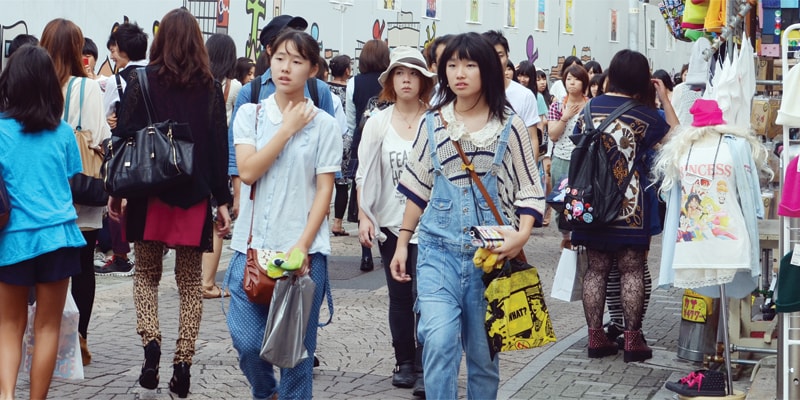
Japan – the world’s second-largest developed economy, the third-biggest economy by nominal GDP, and the fourth-largest by purchasing power parity – has once again shown its economic growth as positive – to just over 0.5% in 2016, though it has been forecast to stay well below 1% for the next six years. However, the majority of Indian exporters are not working with some of the markets like Japan which still have enough scope for Indian made apparels. Some of the exporters have individual reasons while most others have common reasons. But one can’t ignore that Japan imports apparel products worth almost US $ 40 billion a year while its overall market is about US $ 110 billion and it is supposed to expand to US $ 150 billion in the next 8 years. Bangladesh’s apparel shipment to Japan might cross US $ 1 billion mark soon after the relaxation of the Rules of Origin (RoO). Hence, from all these facts/figures, it is evident that Japan’s name undoubtedly comes on priority whenever someone talks about emerging/non-traditional markets. Apparel Online discussed with the Indian exporters about the changing paradigms of both the markets.
Japan is a mid-size high unit value market with focus on quality, consistency and repeatability. As price is now the biggest challenge irrespective of buyer/country, the same is applicable for Japan as a majority of exporters feel that Japanese prices are very sharp now. Still some players believe that there is some relief from Japan on the price front. “Unit value attractiveness is to be viewed in line with volumes, quality demands, product standardization, consistency and achievable efficiencies. From this perspective, Japan unit values are average than good,” says Jay, CEO, Fedmac India, Tirupur, who earlier worked with Japanese retail on menswear and kidswear. As Japan is also sourcing value-added garments from India, reasonable margins are kept in such orders and repeat orders from Japan are motivating enough for the exporters to work on lesser margins.
Experts feel that India has a fair amount of success in textiles working with Japan, but the same is not applicable in case of apparel. Vardhman Nisshinbo Garments Company Limited is a perfect example in this regard. Some of the Jaipur-based exporters are also working aggressively but at a small level. Indian giants can explore more opportunities together.
As far as products are concerned, both value-added garments and basic garments are working well in Japan. But exporters feel that after Comprehensive Economic Partnership Agreement (CEPA), demand of basic garments has increased compared to value-added garments. The same has been observed by Pradeep Nahata, MD, Karni Exports, Jaipur having 10% of its business in Japan (mostly boutique buyers for small quantity). Almost similar experience is that of Pawan Arya, VP, Orient Craft, Noida who informed that out of the entire quantity that Orient Craft is exporting to Japan, 95% consists of basic garments. The company is not working with Japanese customers and is shipping to Japan franchise stores through US customers. Jay says, “Japan looks at India for cotton apparel – both basic and fashion. India loses out big time on MMF due to its weak supply chain and this restricts India’s ability for Japan as a major user of MMF apparel.”
It takes two days for goods to reach Japan from China while it takes 18 days from India. What could be a plausible solution or how can India improve on this point? Jay believes that direct sailing of master vessels from Tuticorin and Chennai is possibly one of the options to cut sailing timeline. Pradeep is of the opinion that Japan is not very far from India, but internal services take a lot of time to move the cargo to the Indian port or to move it to any airport. Also, the custom department takes a longer time to give clearance and the rush on ports further delay the stuffing of goods on ship. “We need direct cargo flights for Japan at a very economical fair which can give a boost to Indian exporters, so that the buyer can find it very fast like China and can work easily without tension of delivering on time,” he added. Some other exporters also expressed their concern that only better design inputs, quality and advanced planning can tackle this issue. “Not 18, but it can actually take 40 days to reach a Japanese store from our factory here; but for us it is not a big issue as buyers who want to get their deliveries done soon, pay air charges themselves, shared Satish Chand, President, Spring Overseas, Delhi. The company is known for working mainly with Japan.
Is 100% inspection or strict quality parameters one of the reasons that Indian exporters are not able to book big Japanese orders? “Yes, it could be one of the reasons,” says Pawan but some exporters don’t see this as a problem as they know very well that in small order, it is a good way to work with 100% quality parameters. Jay adds that Japan quality demands with 100% audit are for the most part tangent with the established quality systems (4 points system, AQL) of mainstream factories with major exposure to EU and US making it difficult to sync Japanese production with mainstream.
Exporters feel that even China’s exit from apparel manufacturing has not pushed Japanese orders to India in a significant way as only some orders are coming to India. They stress that those importers who really need Indian taste and quality workmanship will buy from India. The rest will go to Bangladesh, Indonesia, Thailand and other Asian countries. “It is likely to have less impact given the fact that China has nurtured a good set of satellite nations around the region (Vietnam, Cambodia, Mongolia, Indonesia, etc.) to convert its textiles at a lower cost and stay miles ahead of India,” shares Jay.
More than 5 years have passed since the CEPA between Japan and India went into effect. Even this has not proved much fruitful as sharp prices, shorter lead times and strict quality parameters are the major factors slowing the growth of business with Japan and most of the Indian exporters are lacking at least on one of the above mentioned three points. Exporters are aware that supply exceeds demand and with China and its satellites next door, the need for Japan to outreach beyond them is not necessary.
So, for India to increase its apparel export to Japan, the significant point that would help is of course the improvement of Japanese economy but at the level of Indian exporters and the Indian Government, more support to the exporters for participation in Japan-based sourcing fair and other such fairs in Japan to sell the Indian products can be an immediate step. “Yes, many exporters are participating in such fairs but it costs a lot; so those exporters who are willing to expand in this market or are just entering, should be given some extra benefits to attend such fairs,” Pradeep suggests.