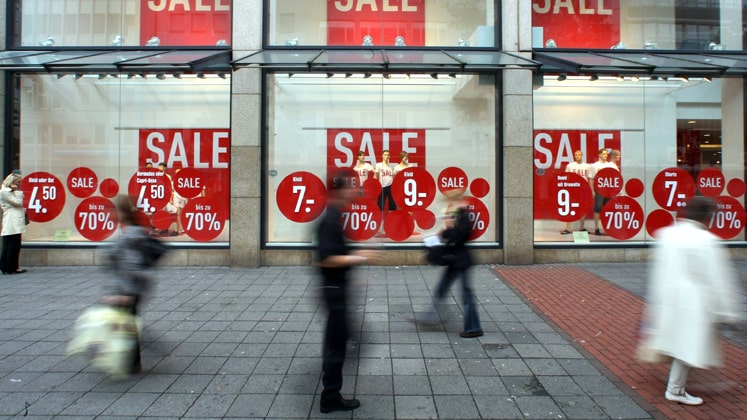
Amidst the global pandemic caused by COVID-19, businesses have been hit severely across industries, and apparel retail has been one of the worst hit. Sales at fashion brands fell by almost 70 per cent with fear of further decline post the lockdown period even as majority of retail brands are preparing to open physical stores in a structured manner with reduced shifts and restricted customer entry. While uncertainty is looming large on the retail businesses, one of the most damaging effects of the pandemic and subsequent lockdown is the unsold inventory at apparel retail brands.
Fashion industry has been running on seasonal basis and every collection is based on fabrics, colours and current trends, and selling them during the season is critical for fast fashion industry. Once trendy styles quickly fall out of the shelf, they add to the unsold pile of merchandise and are sold in margin-killing discounts. To clear up the piled up inventory post the lockdown period, fashion brands are strategising aggressively. While retailers have reckoned that it would take 9-12 months for some kind of normalcy to return, they have over the last few weeks unanimously agreed on skipping pre-Fall collection completely, and instead, are planning the production of Autumn/Winter collection, besides offering discounts to lure consumers. Since the Indian climate allows Spring/Summer wear to be used until winter sets in completely, fashion brands will go for roll-on of inventory from one season into the next.
The survival strategies

Fashion brands like Tommy Hilfiger, Calvin Klein, Ritu Kumar, Arrow and Jack and Jones are planning to push their Spring/Summer collection till October or pre-Diwali to clear up inventory. In a webinar by Retailers Association of India (RAI), Shailesh Chaturvedi, CEO, Tommy Hilfiger India, said “Fortunately, this time Diwali comes later in November giving us an extended summer. We will cut production of fall and holiday goods. We are avoiding deep discounting, as it spoils the brand and the market. The production, however, could stabilise only by February-March next year.” Ritu Kumar’s Managing Director Amrish Kumar agreed as he asserted, “Being nimble on the supply front is a good idea in such uncertain times. Fortunately in India, season – in terms of fabric – changes only in October. So, we have a buffer time till October to push our Spring/Summer collection across bridal, high fashion and westernwear. We will also not be finalising any orders till October.”
Also Read: Fashion in the time of COVID-19: Indian designers share their strategies to stay afloat
Even as the overall industry is waiting for the lockdown to be lifted on 3 May, the retail leaders are aware of the chances of it being extended as also the business operations which will resume in staggered manner. The retail brands will have to undertake adequate precautions and measures to minimise risk of exposure and to ensure safety of customers and retail staff, and relook at their business model and be ready for minimal footfall. Retailers are, in the meanwhile, looking at Diwali as a probable time for revival – for both business and spirits of consumers.
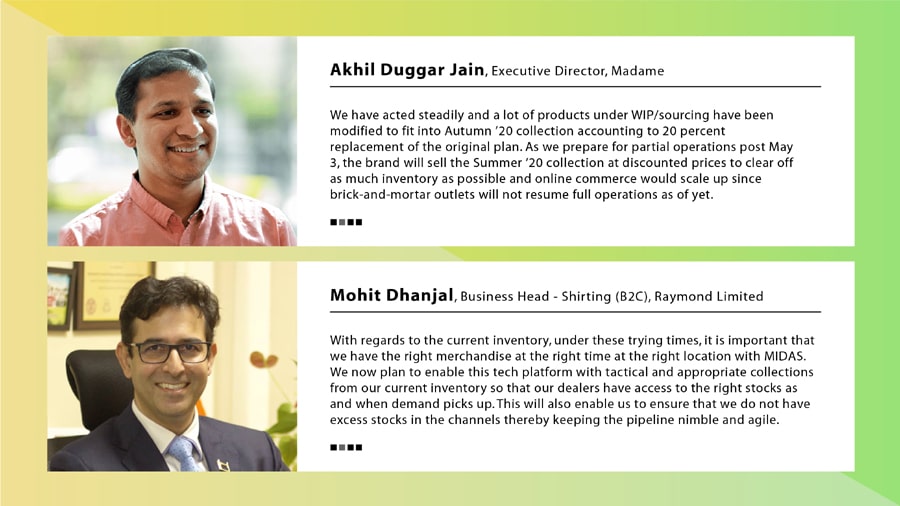
Online sales will also help retail brands in better revenue generation and also selling the piled up inventory. Talking to Apparel Resources, Akhil Duggar Jain, Executive Director, Madame (Jain Amar Clothing Pvt Ltd), averred, “We have acted steadily and a lot of products under WIP/sourcing have been modified to fit into Autumn ’20 collection accounting to 20 percent replacement of the original plan. As we prepare for partial operations post 3 May, the brand will sell the Summer ’20 collection at discounted prices to clear off as much inventory as possible and online commerce would scale up since bricks-and-mortar outlets will not resume full operations as of yet. We have slashed down annual projections by 35 per cent. The sale loss is not going to be for just 2 months, but with 50 per cent of our stores in malls which presumably would be the last to resume operations, we are looking at stability not before October 2020.” Few retail brands are also taking the unusual step to ‘pack and hold’ part of the inventory to next season, similar to what Gap Inc CFO Katrina O’Connell told analysts on a conference call sponsored by Baird.
While the COVID-19 pandemic continues to wreak havoc in the entire supply and demand chain, retail brands are looking for all kinds of options to overcome this situation. For Raymond Shirting Business (B2C), discounting is not the way out and the brand is shuffling and distributing its merchandise to its various locations according to the need and demand of the sales point –‘Right product, Right time and Right place’, with the help of its unique tech platform ‘MIDAS’. Last year, Raymond had rolled out MIDAS mobile app across 2,600+ direct dealers – TRS, MBOs and WHS which gave them ready access to its NOS portfolio of products. Depending on their requirement based on current demand in the market, the direct dealers place orders on the MIDAS app for the range of products that were readily available. The orders placed would then be executed from the firm’s central warehouse within three working days to ensure that the dealers have the right product at the right time. The MIDAS platform brings across a wide range of product choices across cotton & linen, developed to meet market demand and in line with customer/fashion trends.
Mohit Dhanjal, Business Head – Shirting (B2C), Raymond Limited, informed, “We retail our Raymond branded shirting fabric across 20,000 sales points in over 650 towns in India including our own exclusive outlets: The Raymond Shops (TRS: ~1,100 outlets), Multi Brand Outlets (MBOs: ~1,500 outlets) and our Wholesale network (WHS: ~200 dealers who, in turn, supply goods to over 17,000 linked outlets). With regard to the current inventory, under these trying times, it is important that we have the right merchandise at the right time at the right location with MIDAS. We now plan to enable this tech platform with tactical and appropriate collections from our current inventory, so that our dealers have access to the right stocks as and when demand picks up. This will also enable us to ensure that we do not have excess stocks in the channels, thereby keeping the pipeline nimble and agile, so that we may divert the right products to the right locations as and when consumer demand picks up.”

Additionally, the brand has also digitised its complete inventory of fabrics which enables its dealers to visualise the fabric swatch at the touch of a button on the MIDAS app. “This enables us to serve our dealers in a contactless manner wherein fabric may be ordered and delivered without the traditional method of a physical sample card that is shown to multiple dealers. Now from the ease of their outlets or homes, dealers may access our swatch library and place orders for the fabrics they select through the digitised fabric swatch without the need of a physical swatch card or the presence of a salesman/representative from the company,” he added.
This is, however, not the first time that such a crisis will hit the fashion retailers; the 2008 recession too forced the retailers to cave in to the discounting strategy. This, in turn, created a bigger problem for them, in that, the consumers started expecting discounts and hesitated buying clothes at full price even years later. While the situation is a bit similar, the industry is yet to see and test the best way out of the crisis in the times to come.
Also Read: Can omnichannel retailing be a potential solution to combat COVID-19 crisis?






 Bharat Tex Special Report 2026