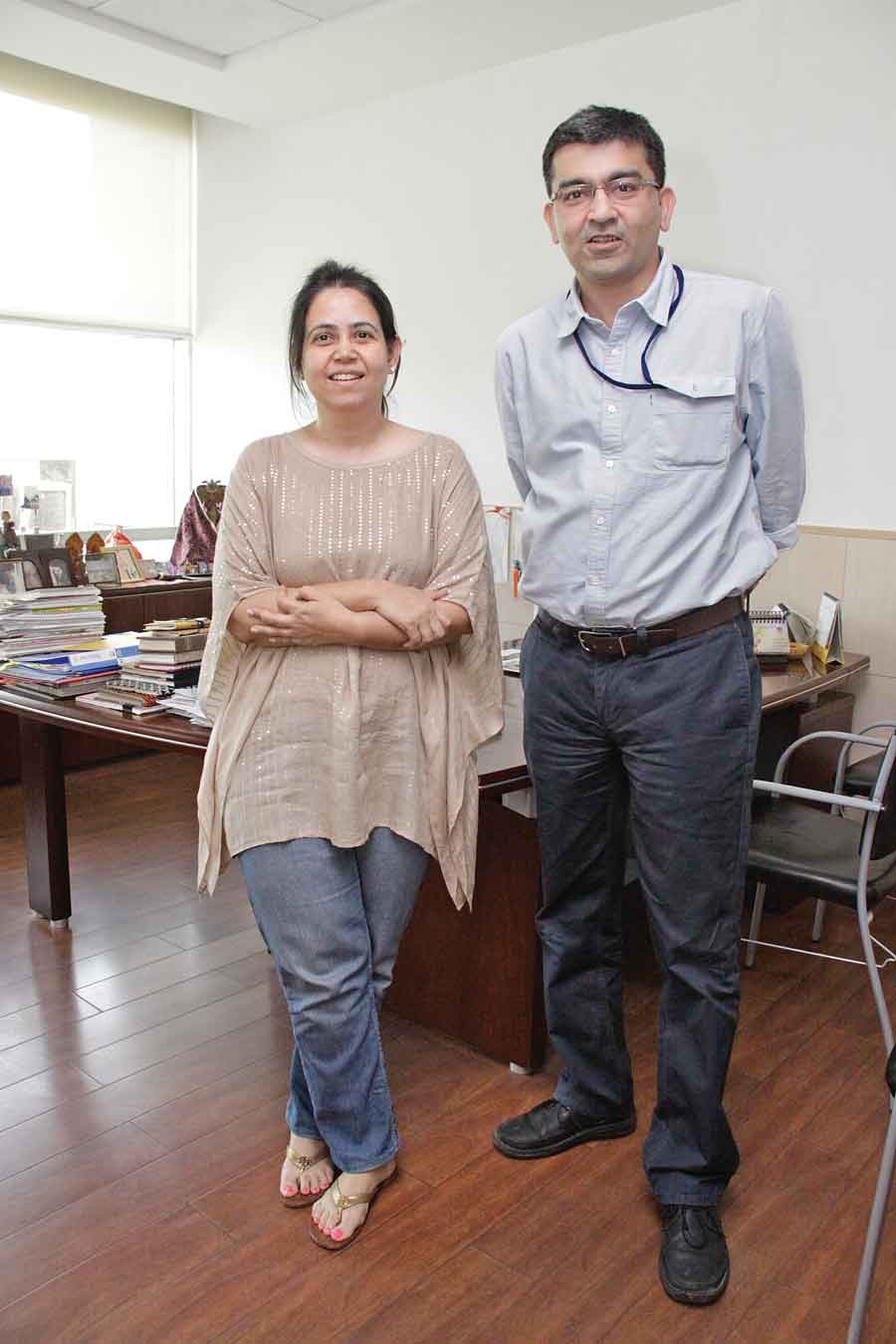
With a rich legacy of over 20 years in the home textiles industry, Sarita Handa Exports is a name synonymous with quality, design and exclusivity that has survived through the economic downturn which forced many manufacturers to cut down operations, due to the foresight of the second generation handling the core operations. In conversation with StitchWorld, Suparna Handa and Vivek Trehan, both Executive Directors, talk about the survival strategy of their company which is still a leader in the home furnishing business and respected for their credibility in the market.
Born in 1992 from Mrs. Sarita Handa’s love for detail and craftsmanship, Sarita Handa Exports is today carried forward with the same passion by the second generation, who are constantly meeting market demands while building new strategies to run the business successfully. According to Vivek, the company’s survival strategy has been innovation in terms of design and how you run your factory. “With great design, one should always have a good R&D team on the spot for execution,” says Vivek. Adds Suparna, “There are several times when you come up with great new ideas for a product, but it should be supported by a sound team with the right experience, who can think of various ways to execute a particular idea and transform it into reality.”
At Sarita Handa, the support of the product development team comprising of kaarigars, pattern masters, designers and sewers is critical to the effective running of the organization, facilitated through continuous communication within various departments.

Following the ‘open door’ policy, the company stresses on the importance of constant employee engagement. “When we moved to Manesar we took a conscious decision to move the entire merchandising and design team under one roof for enabling continuous interaction and brain storming, providing a better and much more suitable solution and which is much more satisfying,” declares Suparna.
Largely untouched by the economic setback, Sarita Handa Exports continues to grow, having carved a niche in the market. “I strongly believe there is enough work in the industry as long as you are good at what you do. The industry has got tougher, so one needs to raise the bar a bit, be more innovative not just in terms of design but also in terms of handling the production floor. I remember when I got into the business in 1994; it was much easier, but today to achieve margins you have to be more competitive,” says Suparna. The company believes in the theory of ‘having the shortest line which is the most efficient, to produce a product coupled with the right sourcing’.

An example of how much the company stands by its products, the Founder and Managing Director of the company Mrs. Sarita Handa herself, rejected an entire shipment as the buyers were not happy with the product, though they had earlier approved it, culminating into huge losses. “I don’t think it’s just the design that sets us apart, though it is imperative, it is actually the confidence to stand by your product. I am not saying we are perfect, we have had our own share of imperfections and we too have burnt our fingers like any other manufacturer, but it’s a part of the training that we have learnt the hard way,” reasons Suparna.
When the global recession was just at the horizon of the Indian export industry, back in 2008, Sarita Handa Exports realized the need for upscaling its systems and operations for sustaining the difficult times ahead. Instead of just installing machinery, technologies or software to achieve the same, the company focussed on reducing the process times within the facility, right from the stores-to-the-cutting-to-the-sewing-to-the-final-packaging. An example is the restructuring layouts for reducing the internal process times by moving the washing section closer to the finishing department, reducing the internal processing times from 30 to just 18-19 days.

The company defines automation as the means to reduce the time taken in doing any of the operation but with a justifiable Return-on-Investment. Last year, the company installed a wide width (12 metres) automatic cutter from Yin Japan with a capacity of cutting 16,000 to 17,000 pieces per day and the company already has a wide width spreader from Richpeace. Both the machines, now working in tandem, have created a strong platform for the future influx of orders that the company is looking at. Further improving the product quality and output, the company has recently installed direct-drive dry head sewing machines from Juki. However, due to the extent of value additions in its products and the small quantities, the company believes that total automation is yet a dream far away, and hence it relies on a mix of man and machine.
Unlike most apparel and home furnishings manufacturers, the flow of information regarding the product and other manufacturing-related issues is both ways, i.e. from the top management to the shop floor and vice versa. Vivek Trehan believes the same has been achieved with continuous interaction with the sewing operators and other shop floor staff. “My job is to train two people each every month and in turn they further train two people each under them or with them,” he details. What the company gained with this was that the people actually sewing and handling the products got not only aligned with the company’s definition of quality, but it also encouraged on the spot R&D for solving various manufacturing-related bottlenecks.
As a next achievable for the company, the focus would be on further improving the information flow within the organization and how faster can the same be made available to the respective personnel. The company is now planning to upgrade its ERP system to coordinate its entire technology and sourcing of all the inventories, resulting in reducing the line, and increasing the transparency of its inventory and sourcing operations. Presently, it takes at least 2-3 days’ time to answer queries put up to the merchandising and other similar departments, which the company plans to half with the new system.
The company which started exports with the European markets through Otto AGN, is currently not working with these markets, but is building a base to re-enter in 2014. “When you get used to working with the American market through retail giants like Macy’s and Williams-Sonoma Group, it’s very difficult to work with Europe, as it’s a completely different setup. Meanwhile, through Maison et Objet, we are meeting different people from different countries; so it’s interesting and I feel today we are in a position to look outside but not so aggressively,” remarks Suparna, who after her stint with FIT was responsible for the American business model.
With a turnover of US $ 26 million, the company is looking at a Pan-India retail expansion next year with its ‘She-Home’ brand. “This year our goal is to work on our processes and to increase our efficiencies. It’s definitely going to consolidate the system, putting it into place and then going forward with the growth in the next year,” declares Suparna. With the simplistic approach of being true to your business and internally providing solutions to problems, the organization heavily relies on the solution, finding approach rather than lamenting about the struggles that lie ahead. “Your business should sustain you; this should be the mindset amid people and one should find different approaches to the same. As long as you are putting back in your business and you are true to it, you are bound to survive. We are the second generation, we are here to stay and we are not going anywhere,” concludes Suparna.