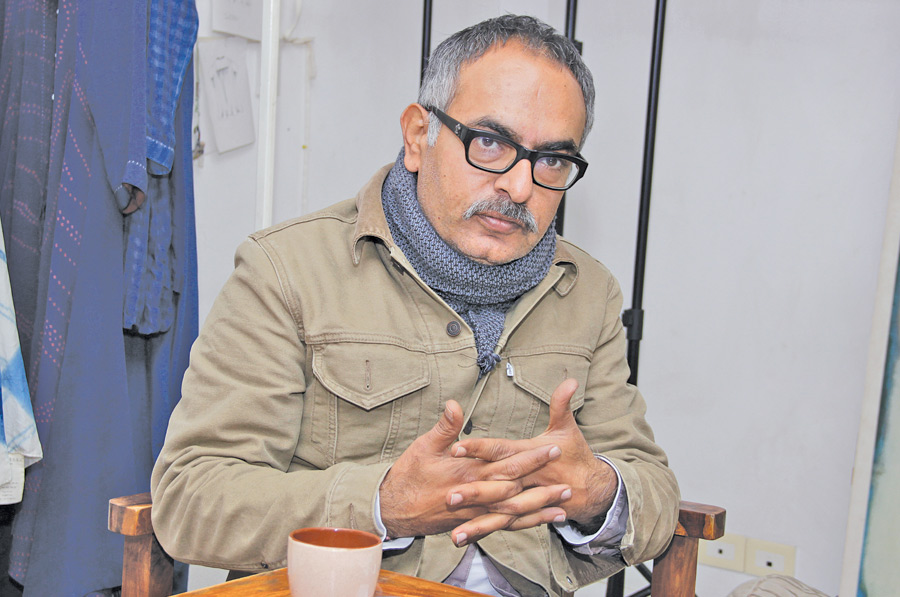
Very few people understand what selvedge denim is and even if they do, they don’t appreciate enough to pay a special price, leading to very small demand, as selvedge denim fabric can only be produced on old or special looms, making the fabric price significantly higher compared to non-selvedge denim fabric. Besides the tedious process of fabric production, there is also a lot of fabric wastage in manufacturing selvedge denim jeans. Yet, a Delhi-based start-up, Goodpeople Clothing Company (GCC) has been retailing selvedge denim jeans for the Indian market under the brand name Korra, at just Rs. 2,900, a little less than US $ 50, which is half the price of the cheapest selvedge denim jeans retailed in the US. Founded by Shyam Sukhramani, who has 17 years of experience working with companies such as Levis and Dockers, along with 3 other partners, Korra not only sells selvedge denim but also has a sustainable manufacturing ideology. In an exclusive interaction with Team StitchWorld, Shyam highlights the manufacturing model of his company which has enabled him to create a sustainable product, while keeping it affordable.
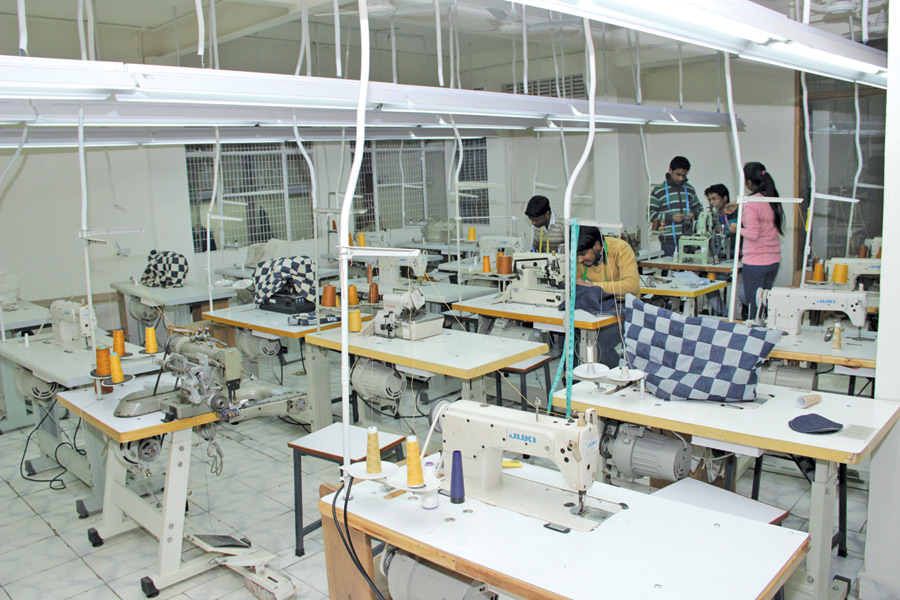
With a unique manufacturing setup, GCC is manufacturing Korra at its Delhi-based workshop with 14 single needle lockstitch machines and one machine each for chainstitch, bartack, overlock, feed-off-the-arm and eyelet buttonholing, handled by 6 operators, making it possible to furnish a single denim jean in 4 hours – right from fabric checking and cutting to sewing and finishing the denim jeans. Even for jean manufacturing experts and tailors, the time is beyond comprehension. Many working in apparel factories might argue about the increased waiting time due to the sharing of sewing machines, but Shyam explains that neither the order quantities nor the frequency of orders is huge enough to push operators for saving every 2 minutes, and more importantly, the operators are not required to do overtime. “Since all the operators have to share the special machines, they are responsible for the maintenance and consequently our downtime is significantly lower compared to any other apparel factory. The operators are all on salary basis instead of piece rate, so even they are not under constant pressure to produce more to earn more,” shares Shyam.

Due to the different approach required in the making of selvedge denim jeans, training of operators is of utmost importance. The operators first unlearn and are then trained for 3 months. An important part of the company’s training programme is unravelling of an already sewn jean, seam by seam, for a complete week, for understanding all the 52 sewing operations involved in sewing a jean. “We have produced a final prototype of each style and fit after repeated sampling and these prototypes serve as a sample of workmanship and quality required from the tailors and also helps in quality standardization,” explains Shyam. A tradition of the company, which showcases how it values workmanship of its operators, is the practice to mention the name of the operator who sews the complete denim on the label, and in case the customer is not happy with the fitting or sewing, the same is communicated to the operator. “Even the operators are told about the person, for whom they are making the jeans, which is a very non-industrial practice,” says Shyam. But there is still a final check by the production coordinator before packing the jeans for shipment.
There is no requirement of any specialized or different sewing machine for making selvedge denim jeans. Aspects such as seam and stitch types are defined by the buyer or retailer and since such demands are ever changing with fashion, Vibemac’s machines are equipped to accommodate all possible variations.
The key to the product popularity of selvedge denim jeans is in the intricacies involved in the manufacturing and the unique features that come with every pair. Since the selvedge has to be included in the seams, the edges of front and back panels are completely straight resulting in more than usual fabric wastages in case of cutting. “One of the major trademarks of selvedge jeans is the visible red selvedge of the fabric on the seams of the front and back panel of jeans so their position cannot be changed for improving the marker efficiencies.” explains Shyam.
During sewing, the bottom hemming of the jeans is done with chainstitch and not lockstitch, to give the hem some amount of stretch. Again due to the selvedge structure, the edges of outseam are not overlocked, instead the panels are topstitched together, and then pressed to highlight the trademark red selvedge. “The beauty of a selvedge denim jeans is that the jeans transforms as per the lifestyle of the wearer – the fading, whisker and other effects are very unique and individual to every jeans, which is the opposite in case of non-selvedge denim because the look of jeans is locked with dry and wet finishing processes,” elaborates Shyam. A selvedge denim jean from Korra also shrinks by 2% to 4% on an average, a percentage which can go up to 14% in case of international brands such as RAW. “As the waist increases the shrinkage increases, so in case of size 42 jeans, the shrinkage would be by 2 inches but the same would be just 1 inch in case of size 30,” adds Shyam.
Sustainable Materials & Practices
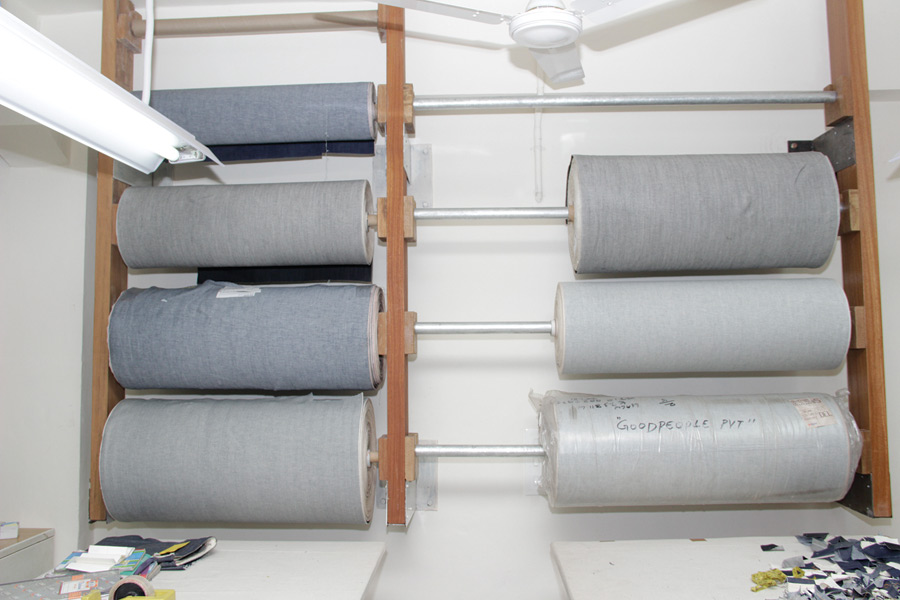
For Korra, GCC sources three different types of selvedge denim fabrics from Raymond using organic cotton and natural indigo dyes, as also three types of fabrics from the Italian fabric mill Candiani. The denim fabric types are – with 1% elastane blended into 99% organic cotton, 100% organic cotton over-dyed with a vegetable dye, 35% linen blended into 65% organic cotton, 2% elastane blended into 25% better cotton mixed with 73% cotton, 25% better cotton mixed with 75% cotton and the same in black; now the company is also in the process of developing specialized fabrics for its own consumption. It is not just the fabric which is sustainable, even the zippers used are eco-friendly, sourced from Ideal Fastener Corporation, made from recycled polyester tape and recycled fabric. The sewing threads used by the company are made of organic cotton at Vardhman’s unit in Ludhiana.
Right from the packaging of jeans, to the doormats and machine covers, everything at the factory speaks of the efforts of the company to recycle left over denim fabrics. “It is our company’s ideology to be a sustainable manufacturer with the lowest impact on the environment,” asserts Shyam. The real innovation has been the bags made of selvedge denim in which denim jeans are shipped to the customers. “We do not use cardboard or plastic for packaging. Our bags have been tested and approved by companies such as FedEx and UPS, as it can withstand all weather conditions,” shares Shyam.
Interestingly, the entire costing of producing each jean is shared on the company’s website, according to which Rs. 755 is the margin per jeans, Rs. 1‚082 is the cost of raw materials, Rs. 600 is the manufacturing cost and Rs. 483 for miscellaneous costs such as taxes, transaction and shipping, a price which is at least 100% lower than the jeans available in the market. “We chose this approach and cost structure because we don’t want to inflate the price and then build inventory and sell the same over 6 months,” concludes Shyam.
What are selvedge denim jeans?
Selvedge denim jeans have straight cut along the seam, and open edges at side seam, which are overlocked or lapped side seam in case of a traditional jeans. Original selvedge jeans was initially started using narrow width shuttle loom fabrics where side seam of pattern is kept straight and aligned with fabric selvedge. All four leg patterns were arranged along fabric selvedge and side seam were joined by single needle chainstitch and seam was opened by seam bursting irons. While typical cult selvedge jeans brands such as Raw, Levis, Samurai and Pure Blue Japan are still made like this, many other brands like Uniqlo have started offering selvedge jeans at economical price. Typically retailed at US $ 49, 60-72” width fabric is used, to save fabric consumption. All four leg patterns are not kept along selvedge, but at the middle of fabric. The side seam of leg panels are then serged using 2-thread overlock, side seam is closed by single needle chainstitch and seam bursting is done as usual. While looking at the markers of selvedge denim one can see the changed side seam in leg patterns which are of straight shape. Serging unit is only required when making selvedge denim jeans using wider width fabric and overlocking the side seams.