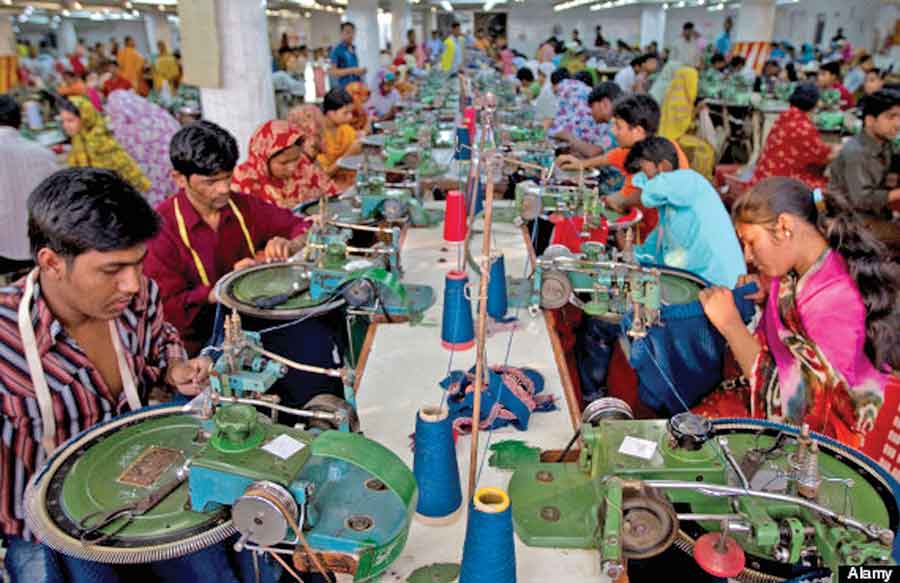
 With minimum wages going up to Tk. 5,300, what would the RMG sector opt as a solution to help Bangladesh remain a cost-effective manufacturing destination? Will the CMs shoot up drastically and Bangladesh lose its competitive edge in pricing? Will buyers come forward to give better prices or will the manufacturers work on even lesser margins? Speculations are galore…! Many questioned, “No clue which worker is actually drawing Tk. 3-4,000 in Bangladesh… The take home for a skilled worker is actually much higher to even the minimum proposed wage of Tk. 5,300!” Apparel Online gets the first-hand pulse from the garment manufacturers and has found that many have already chalked out a strategy to combat the rising wages.
It goes without saying that Bangladesh’s garmenting sector in all odds has done stupendously well for itself and the industry is always prepared to face challenges. With wages hiking up considerably, the industry is again taking the challenge face on. Some are looking at increasing efficiencies at the shop floor, some to retrench the middle management staff, which are drawing hefty salaries and some to negotiate with their buyers to give them better prices. Gazi Mohiuddin Ahmed, Managing Director, Wisteria Group, producers of knitted fabrics and garments says, “To me the best way out to subsidize the impact of rising minimum wages is to enhance efficiencies at all levels. We are convincing our managers and IE to improve efficiencies. Places where same work is being done by two people, we are looking at maintaining one person. Like for example, if the supervisor and QC are doing similar tasks, we discuss with production manager that only one does the work and not both of them. Actually, I have asked my senior staff to give a proposal to me on how can they increase the efficiency levels in each division. If I impose something, it will not be effective suddenly; the inputs should come from the team; I can only give suggestions, implementation has to be from their side, also they will give more pragmatic suggestions as they are the ones to execute it.”
Ahmed admits that they can’t reduce helpers 100%, but with motion study, 20 or 30% of helpers in each line can be reduced. “It is better if we can improve productivity in terms of quality and upgrade the skills, for which we are going in for time and action plan, as it’s very effective. Most merchandisers don’t have an idea of what will be happening next month, but by time and action plan from sampling, dyeing, and knitting to production, everyone will get to know who is doing what and in what stipulated time,” says Ahmed.
Defying the notion that garment manufacturers are paying their workers just what is the existing minimum wage, Mozammal Hossain, Managing Director, Capri Group says, “If the existing minimum wage is Tk. 3,000, then with overtime and other incentives like attendance and productivity incentives, it reaches to minimum Tk. 5,500 to Tk. 6,000. In my view the existing minimum wages must be going only to the helpers who are absolutely raw.” Corroborating to Hossain’s views, Md. Asheek Bhuiyan, Managing Director, UNI Group of Companies, specialising in bra manufacturing says, “Our skilled workers are in no way cheap because right now we are paying US $ 100 per month to a good operator, so this hike is just going to impact at helper level. Nevertheless it would be an added cost on our CM.”
Many garment exporters feel that rise in minimum wages would be very tough for the first few months as the orders booked just a month back, would be executed in the next 3-4 months or even 6 months. So the CM calculated is on the basis of previous wages, however the garment manufacturers will bear the additional wage hike cost alone. Laments Hossain, “Say for example we have taken orders in June till August from the buyers, the delivery of the same would be in March-April; the increase in salary is effective from December this year. We have already taken lesser price order and we have to now bear additional burden of increased salaries.”
One interesting solution came from a buying office cum manufacturing company based in Dhaka which is looking at cutting down its production cost drastically with retrenchment at middle management level as comparatively the hiked worker’s salary is not that much but the real chunk of the salary goes to the middle management. There are people who are drawing whopping salary of US $ 5,300 per month so it’s better to reduce the burden at the middle management level, both in merchandising and QC divisions, rather than crying over minimum wage hike! One can calculate that how many workers salary can be adjusted with just one hefty package at the middle management level.
From the perspective of foreign companies which shifted their manufacturing base to Bangladesh because of very low labour wages, Kim Youn Ki, Managing Director, GH Haewae Co, a Korean company known for manufacturing casual jackets shares, “For making one piece of jacket we put 70 operators with 20 helpers; for such labour-oriented work it made sense to enter Bangladesh as we saw advantage of cheap workforce, but I don’t know how long we will be able to maintain our manufacturing base here!”