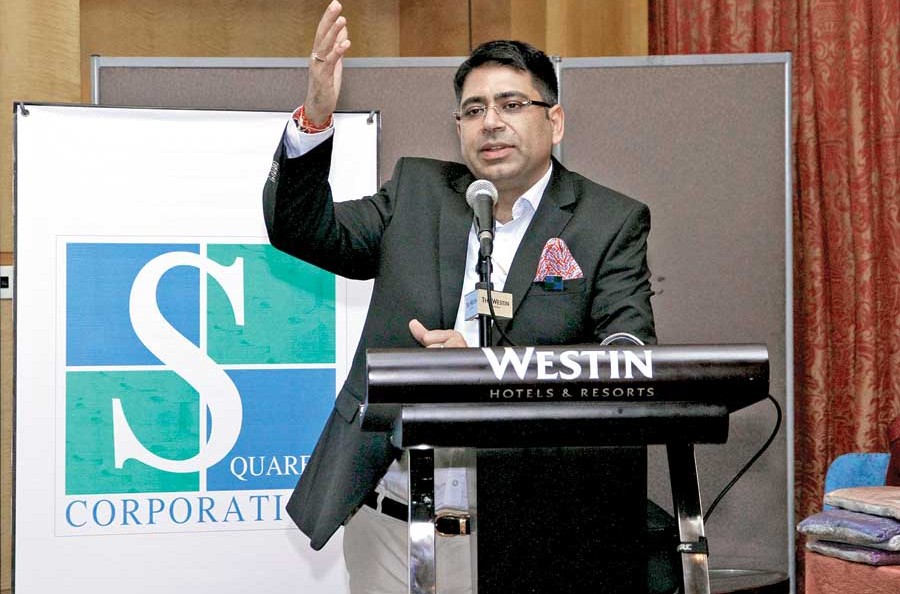
Celebrating in style a successful business journey of last 24 years and entrance into 25th year of association with Bangladesh, Ludhiana (India) based Yarn Export Agency Company Square Corporation invited several business associates both from Bangladesh and India to be a part of the merriment. The event drew in big names including the MD’s & CEOs of Envoy Textiles, Knit Asia, Benetex Industries, GMS Composite, Robintex, Anowara Group, Comfit Composite, to mention a few along with senior management of the Indian yarn manufacturing companies like Vardhman Polytex Ltd., Nahar Spg. Mills Ltd., RSWM, Ahuja Cotspin. Taking the audience through memory lane with exciting visual presentation, Vivek Verma, Managing Director, Square Corporation stated, “Initially there were many obstacles; the Government policies were not consistent, infrastructure was poor, technology was not advanced which led to frequent quality complaints. However, with confidence of clients in us and our hard work, we travelled this journey together. Time flies and today as I stand before you to mark 24 years of this pleasurable journey, I am humbled with all the love and affection that I have received from Bangladesh.”
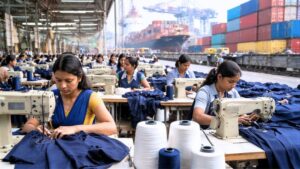
From a small agency in early ’90s, catering only to Bangladesh market, Square has grown into a robust yarn sourcing and service company of India with an annual turnover of US $ 236 million in 2013. Catering to customers in 15 countries, the company is now back full circle to penetrate deeper into Bangladesh. The scaling up of the spinning sector in India with companies adding capacities and many new spinning mills coming up between 1991 and 1997, coincided with the growth of the RMG sector in Bangladesh as many new and large garment factories were setup during that period, presenting an opportunity of logical growth for Square Corporation. “I entered Bangladesh in 1991 and at that time the RMG sector was typically an owner-driven small/medium enterprise, the capacities were small and very few companies had vertical setup (composite setup) because of which the factories were dependent on Indian spinning mills for their yarn requirements. Sensing a business opening and seizing the opportunity, there has been no looking back,” shares Vivek.
“Our buyers prefer working with us instead of working directly with spinning mills because over a period of time we have won their trust by sharing honest market feedback. Based on our information network we advise when to buy; we try to locate correct supplier for each buyer depending on their quality needs; they also have faith in our quality testing procedures and they expect us to resolve any problem that arises during the course of business. In a way we work like their yarn buying department.” – Vivek Verma, Managing Director, Square Corporation
With own offices in Bangladesh, Egypt and Turkey and associate offices in Korea, China, Hong Kong, Colombia, Peru,Tunisia and Brazil, Square is catering to leading European and US brands and department stores by offering competitive sourcing of all kinds of yarns from Asian countries, having different strengths. So, while India and Pakistan’s strength are 100% cotton, poly cotton and mélange yarns, China is strong in synthetic (100% polyester, polycotton and acrylic) and mélanges. Thailand is strong in 100% polyester and polycotton and Korea in 100% cotton, while Vietnam’s strength lies in its polycotton and 100% cotton (mainly carded). Specialty yarns such as mélanges, value-added cotton and its blends are being sourced from Korea, Indonesia and Vietnam. “Our services go beyond being a supplier of yarns; we give competitive sourcing and quality assurance. We do pre-shipment inspections and continuously feed our customers with information on market news, trends and fluctuation in prices,” informs Vivek according to whom, the continuous endeavour is to reduce cycle time for samples, production and shipments.
Even though spinning capacities have increased manifold in Bangladesh in the last 10 years, giving tough competition to Indian spinning mills, Vikas is still very upbeat of the market and feels that the Bangladesh will comfortably cross the US $ 50 billion landmark in garment exports in the next 5 years. In the meanwhile, the biggest challenge in the present scenario is lead times, which are getting shorter even as the prices are constantly under pressure. However, the margins for value-added yarns are still good. “Price is definitely important but not the main concern in Bangladesh especially for value-added yarns,” concludes Vivek who is now looking at increasing the product basket by supplying related products like raw cotton, woven and knitted fabrics in future.