On the surface, with less than one per cent of cotton grown being organic, the noise around the subject may seem exaggerated, but a deeper look clearly shows that organic cotton in reality can be at the heart of a healthy environment and farmer community. The challenges in this sector, nevertheless, seem to outpace the efforts that many organisations are making to encourage organic farming. Cotton Trailblazers, an event organised recently in Bhopal, was an eye-opener for all stakeholders, and with the agenda of ‘farmers first’, it was heartening to see many farmers attending the conference, being felicitated for their efforts and also participating in various discussions. C&A Foundation brought to the platform the complete supply chain in organic cotton and created an environment of exchange, engagement and commitment that will go a long way in promoting organic cotton.
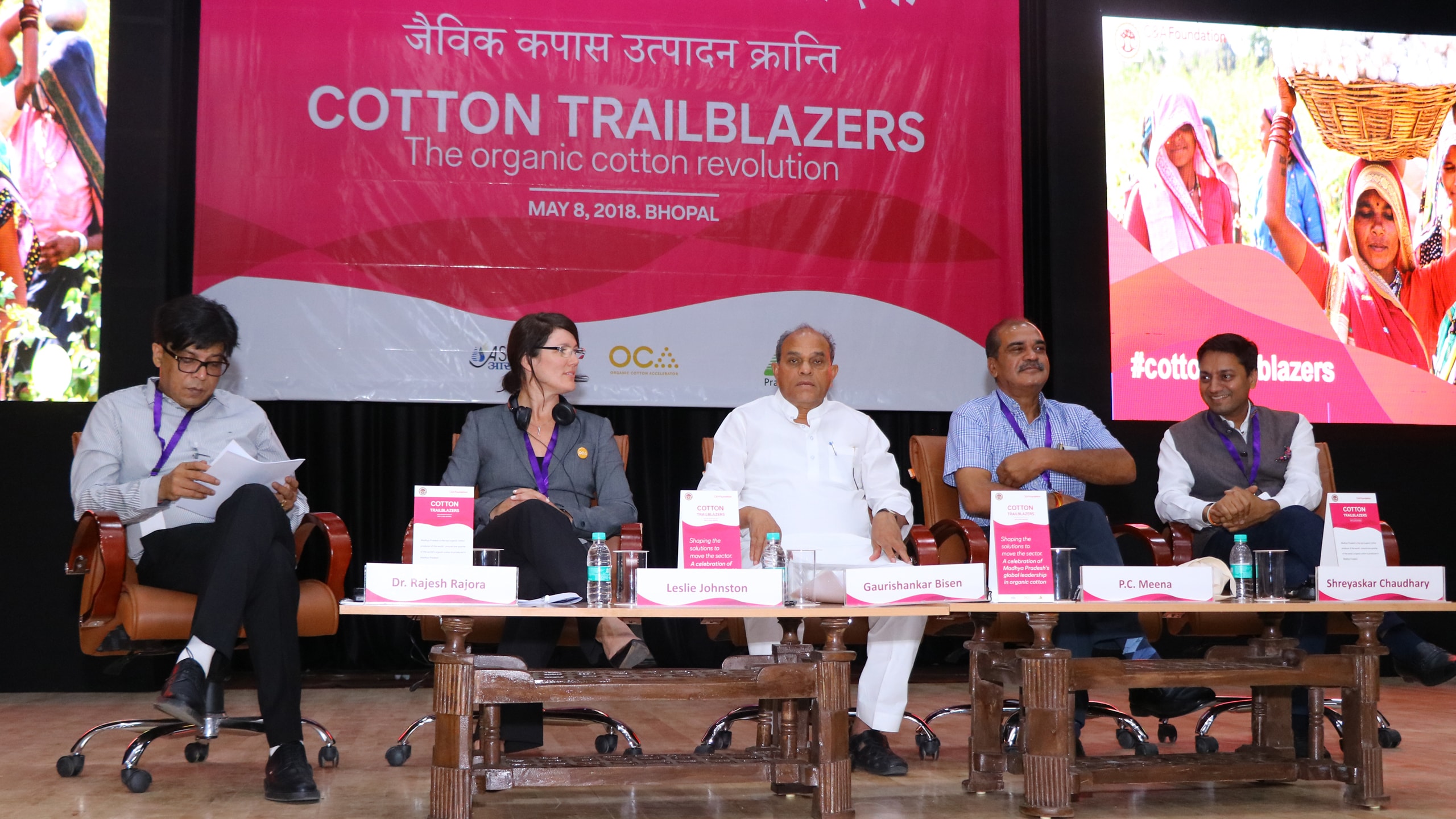
India is of prime importance in global organic cotton production, with over 1,90,000 certified organic cotton farmers in the country accounting for 56% of world’s production. And it was only befitting that Bhopal was the location for the event as Madhya Pradesh (MP) accounts for 43% of the organic cotton grown in India and 24% of the total world production, generating business worth around US $ 4 billion annually. The very fact that the conference was inaugurated by Gaurishankar Bisen, Minister, Farmer Welfare & Agriculture Development, Government of Madhya Pradesh, highlighted the importance of the event for the state and also the proactiveness of the Government to find solutions that enhance production and make a successful business model out of organic cotton. With players like Pratibha Syntex Ltd. in MP, the focus on organic farming has steadily grown over the years, but the challenges relating to access to seeds, technical capacity and unequitable sharing of value has continued to plague the industry.
With a 360-degree approach, C&A Foundation has taken up the challenge to find solutions to these challenges with a proactive and collaborative approach. Sharing the vision of the Foundation and its importance and focus on organic cotton, despite it being a negligible portion of the fashion chain, Leslie Johnston, Executive Director, of the C&A Foundation said, “We feel that fashion has the ability to transform lives…, so our mission is to make fashion a force for good. We want to make the industry ‘good’ not less bad…; the vision is to make the industry regenerative and restorative. In this pursuit, we as a Foundation have the unique role and ability to think big, in the long-term and take risks by making big bets on what is good for the future… We strongly feel that organic cotton is something we need to support, so we are in the middle of an exciting revolution for change, betting big on organic cotton.”
Taking the discussion forward, Anita Chester, Head of Sustainable Raw Materials, C&A Foundation, gave the audience a bird’s eye view of the challenges they are facing and the gains the Foundation can be proud of: “Our interventions have resulted in a 21% income increase for farmers in MP, despite a decrease in yields,” she shared. Anita further added that the Foundation has collaborated with the Government to foster a policy and regulatory environment for the benefit of the organic cotton farmers, as also to develop a strong network of local stakeholders in MP to accelerate the change.
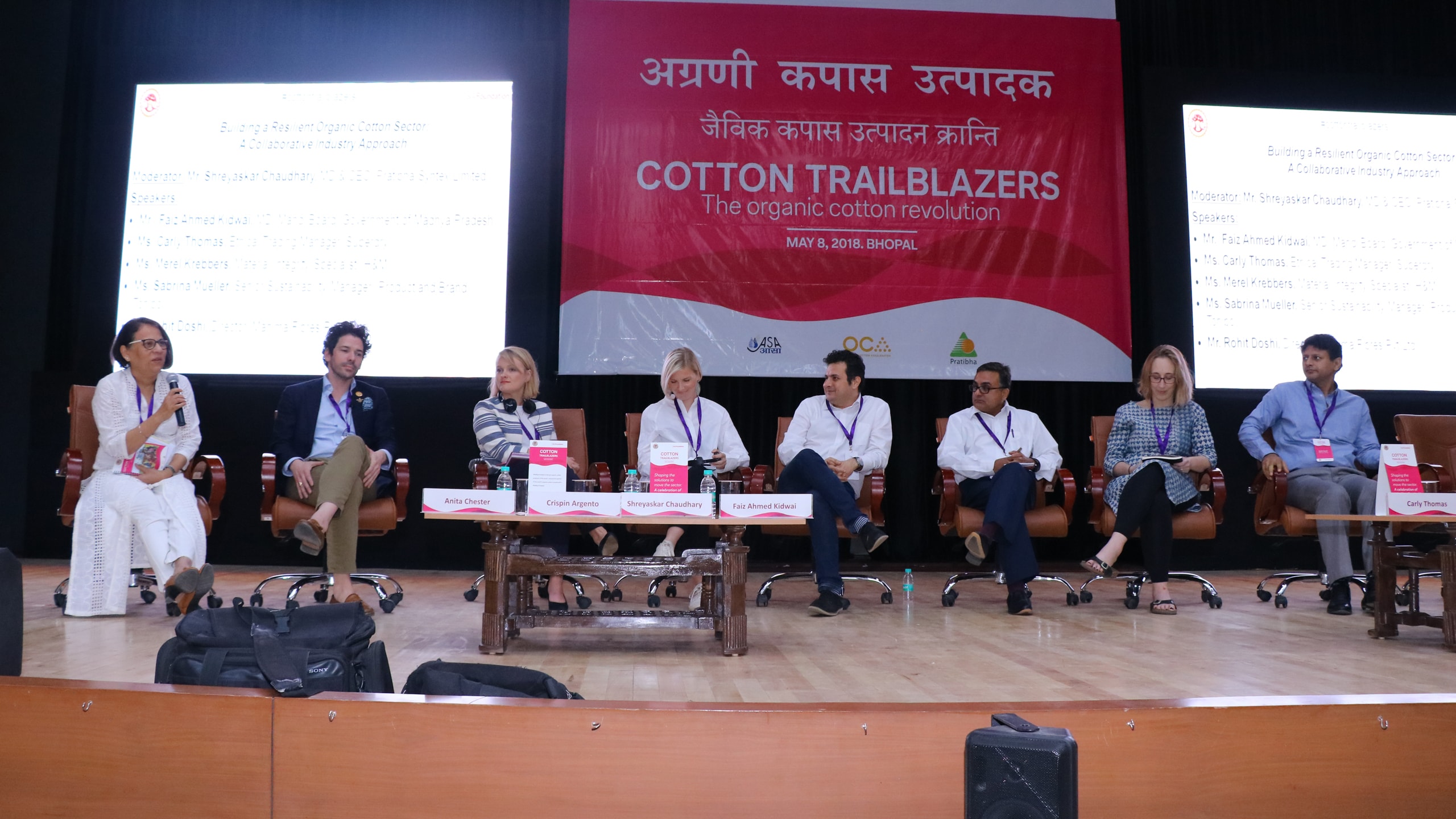
Among the most recent organisations created to support the organic cotton industry – The Organic Cotton Accelerator (OCA) focuses on creating a prosperous organic cotton sector that benefits everyone – from farmer to consumer. “Our investments tackle the challenges in the sector and realise the benefits that organic cotton can bring for people, planet and long-term prosperity,” said Crispin Argento, Executive Director, OCA. Representing 70% of global organic cotton sourcing by volume, OCA was established in 2016, in collaboration with brands that believe in the organic cotton story. Working along the supply chain, OCA invests in farmers, seed, and integrity solutions through targeted interventions and programmes.
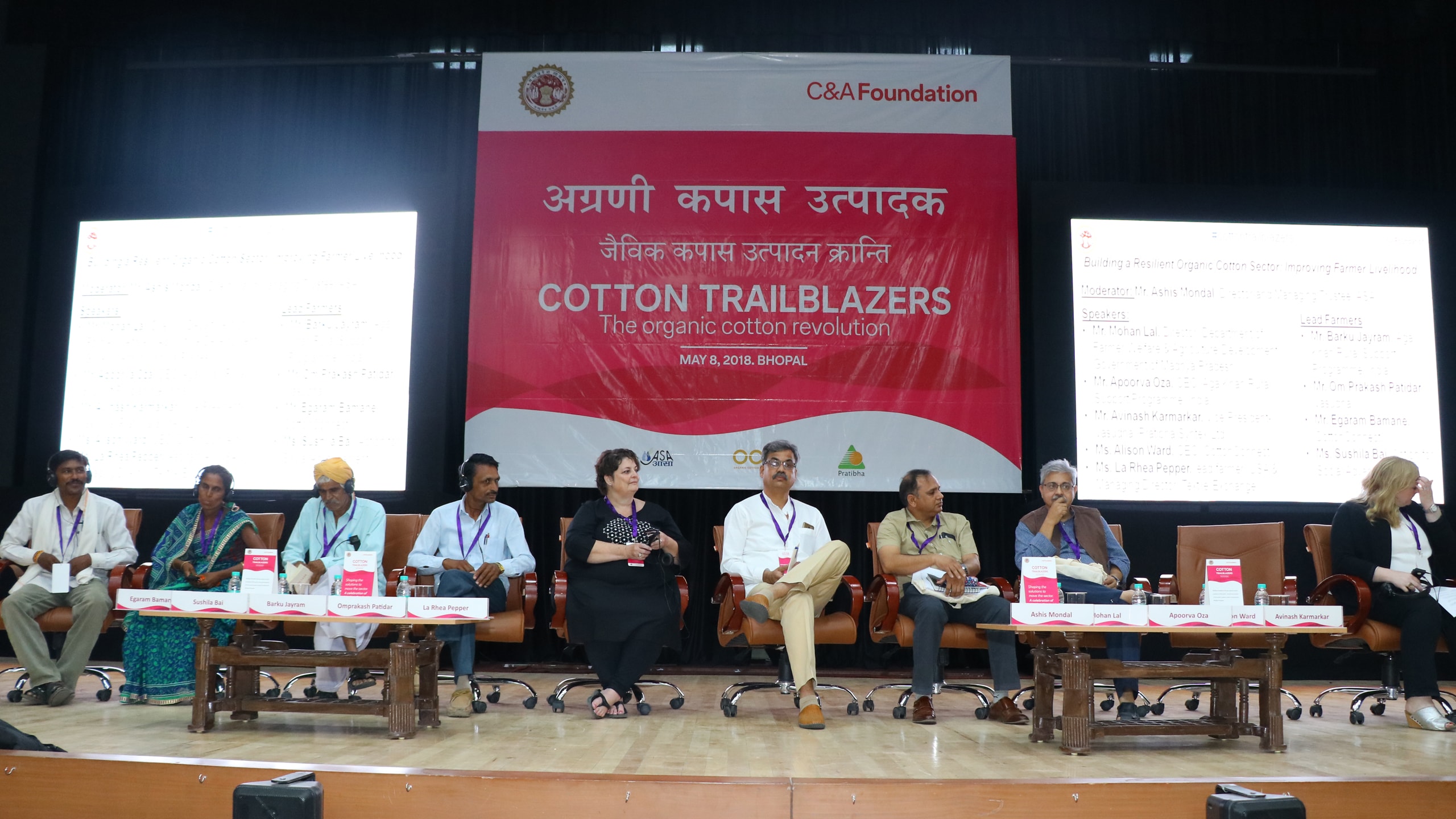
During the session – ‘Building a Resilient Organic Cotton Sector: Improving Farmer Livelihood’ – all speakers including the lead farmers, Alison Ward, Chief Executive Officer (CEO) of CottonConnect and La Rhea Pepper, Managing Director (MD) of Textile Exchange, shared their experience and collectively agreed that although the cost of doing organic farming is around 12% less than chemical farming, the effort and patience required to nurture the farmers is much higher. Countering the lower input cost, the productivity in the initial stages is much lower than conventional cotton, which is again a challenge for the farmers. It was underscored over and over again that the viability and future of the industry is only possible if organic cotton is treated as ‘exclusive’ and price points are higher than conventional cotton.
Industry voices…
As manufacturer of organic yarn and fabrics, Rohit Doshi, Director of Mahima Fibres Pvt. Ltd. shared that many ‘costs’ were involved in the process and though they want to pay the farmers well, the price at which the industry is willing to buy, puts pressure on them all the time. Agreeing with Rohit, Shreyaskar Chaudhary, MD & CEO of Pratibha Syntex Ltd. urged the brands to look at organic cotton products in a fresh light that would make it more viable for companies to manufacture garments using organic cotton. “Organic cotton is good for the farmers and for the environment, everyone agrees on that. But it is important to bring all stakeholders on to the table to recognise the gaps and work together to find solutions that will enhance this segment. That includes educating the end customer on what actually buying an organic product means – from improving the livelihood of small farmers to a healthier world for future generations,” implored Shreyaskar.
Brand commitments & concerns…
The biggest concern for brands working with organic cotton is ‘visibility’ or ‘traceability’ to ensure that what they are getting is actually organic cotton. “We need to ensure that we are driving real change. Visibility is also very important for the fair distribution of profitability throughout the chain,” averred Merel Krebbers, Material Integrity Specialist of H&M. Though H&M is among the biggest brands working with organic cotton, its concerns are shared by all brands. For Superdry, which has picked up its first order of organic cotton from MP last December, the biggest factor that has driven the brand to organic cotton is the power to change lives. “We have started small and it is important to ensure that we are actually benefiting the organic cotton farmer, and that is possible only if there is visibility through the supply chain,” said Carly Thomas, Ethical Trading Manager of Superdry. The brand is looking to scale up in organic cotton and has joined OCA in its effort to make a successful business model and be the enablers of change.
Ensuring integrity involves cost and who pays that cost is very critical to the movement. In fact, the high cost of certifications and traceability programmes was also a matter of concern. Sabrina Müller, Senior Sustainability Manager (Product and Brand) of Tchibo was very upfront when she said that the impact is always at the core when it comes to sustainability. “If, after solving the integrity and material as well as financial transparency in the sector, we see that it is still not sufficient to support the lives of farmers and the cultivation of organic cotton, we will have to address the mechanisms and price structure of it all.”
What was very obvious from the discussions that took place was that the issues surrounding visibility can only be addressed with a collaborative approach. Every stakeholder has a role to play, and commitment from each is important to achieve the common goal of giving a better life and livelihood opportunities to the farmers who embark on the organic journey.
Government takes on the challenges…
The honesty with which the day-long session proceeded was indeed an indication of the seriousness of the stakeholders to turn the industry around. Even the representatives of the State Government were straight forward in their approach and did not avoid even the most difficult of questions from the audience and panel. Sharing a proposal to improve traceability in this complex organic chain, Dr. Tarun Bajaj, General Manager of Agriculture & Processed Food Products Export Development Authority, Ministry of Commerce & Industry, Government of India emphasised that there is a need to build an end-to-end integrity and traceability tool from farm to finished product under the control of the Government. “It is important to have a chain of custody for traceability,” said Dr. Bajaj. His recommendations included – bringing organic textile processing under National Programme for Organic Production (not as a separate programme); processing standards to be defined in consultation with industry; traceability to be monitored through verification of all stages; movement of goods with transaction certificate; and facilitating the use of an ‘India Organic’ logo as a symbol of trust on final produce.
It was also emphasised that though the Government was more than ready to support the cause, the industry and various organisations also need to be transparent for the change to happen. “We need data to help the farmers… How can we give funds or even make policies without proper and reliable data?” reasoned Mohan Lal, Director of Farmer Welfare & Agriculture Development, Government of MP. The commitment of the department was aptly demonstrated by the views shared by Dr. Rajesh Rajora, Principal Secretary, Farmer Welfare & Agriculture Development, Government of MP. “MP is a big player in organic cultivation and with the efforts of all the organisations and stakeholders, I feel that we would be able to make a change,” he said. Dr. Rajora broke down the organic challenge into four areas – firstly R&D; second the Extension; third Certification; and lastly, Marketing. Each of them is intertwined and interdependent and very complex individually, though they may sound very simplistic, he emphasised. “We have to find out the ways through which organic farming becomes lucrative for the farmer through inter cropping, through crop rotation, through proper use of agriculture land. It is very important that cotton cultivation becomes important in these areas,” he averred.
Committing support from the Mandi Board, Government of MP, Faiz Ahmed Kidwai, MD of the board urged the industry to scale up so that they could offer various marketing tools for a robust buying and selling of organic cotton. He also showed responsiveness in working with the industry for testing solutions, and providing various subsidies and incentives to encourage the farmers, in case the volumes justified the effort.
Government Commitment
“We are proud of Madhya Pradesh’s achievements in spearheading the organic cotton revolution and aim to increase organic cotton farming from 30,000 to 75,000 hectares in the next 3 years. To further reinforce the organic cotton initiative, the Government of Madhya Pradesh has sanctioned at least 100 organic cotton clusters under Paramparagat Krishi Vikas Yojana (PKVY). In a bid to further strengthen research through the state agriculture universities, the state has also established a pesticides residue testing centre to improve quality of exports. In addition, we are establishing India’s first dedicated Centre of Excellence for organic research centre in Mandla and organic cotton research in Khandwa. Soon, Madhya Pradesh will become the first state in India with a dedicated agriculture produce and export promotion agency that will also boost organic cotton export. We strongly believe that these steps would be key enablers in overcoming the barriers to organic cotton cultivation, addressing agricultural concerns for farmers, in a sustainable manner.” – Dr. Rajesh Rajora, Hon’ble Principal Secretary, Department of Farmer Welfare & Agriculture Development, Government of Madhya Pradesh
Take away from the event…
It was unanimously agreed upon that there is big scope in the industry and by 2020, organic cotton is expected to be a 20-lakh hectares, business from the current 7 lakh hectares in terms of area of farming. However, inadequate supply of good quality non-GMO seeds along with complex certification procedures and lack of traceability throughout the supply chain are major issues. Market linkage for small vendors is almost non-existent, which is a major concern as most of the organic cotton farmers are smallholder farmers with a lack of business case that they can leverage on.
Impacting the knowledge of organic farmers in cultivation of cotton and scaling skills and capacity of farmers, is a potential solution to the various issues surrounding the industry, underlined Ashis Mondal, Director and Managing Trustee of Action for Social Advancement. It was acknowledged that though the farmers are entrepreneurial and they know how to do organic farming, but there are technological advancements and skills they need to learn. Incentives to the farmers during the conversion period is important, as converting a conventional land to organic land takes three to four years and during that period whatever is produced has to be incentivised, otherwise farmers get demotivated. He further added that investment on building farmers’ organisation or cooperatives with organic cotton producers shall leave a lasting impact in not only ensuring sustainable sourcing, but will also establish their organisations firmly in the supply chain of organic cotton.
It was also stressed by Apoorva Oza, CEO of the Aga Khan Rural Support Programme (India) that providing access to technology, which could verify organic cotton at the initial stage, would revolutionise the industry, similar to what Amul did for the dairy industry. It was also pointed out that there is a need for greater collaboration between the industry and Government and small and marginal farmers and their collectives.”
And last but not the least, it was acknowledged that greater awareness for organic cotton and its advantages over conventional cotton need to be built for long-term sustainable growth of the segment. Every participant at the event, including the farmers were happy with the findings and are already looking forward towards a sustainable and collaborative game plan.





 Bharat Tex Special Report 2026