If there is one word the textile industry has abused the most, it is sustainability. It appears in almost every product brochure, industry meets, and sourcing discussions.
Yet, where’s the impact on the ground? Adoption is negligible. Volumes are small. Costs are high.
A clear sign of this slow progress can be seen in the start-up ecosystem, which often reflects the real health of an industry. Several start-ups once seen as the future of sustainable materials have struggled to survive. Bolt Threads, whose leather and silk alternatives were used by brands like Stella McCartney, has exited textile materials to focus on beauty. Natural Fiber Welding, backed by Allbirds and Ralph Lauren, is winding down operations. Renewcell, a textile-to-textile recycling player supported by H&M, filed for bankruptcy in 2024. Ananas Anam, the company behind Piñatex, entered administration.
The biggest hurdle remains the price. Most next generation and alternative fibres are way more expensive than conventional materials. As these materials move through the value chain, costs increase further, making it difficult for brands to use them widely.
Many new materials also had problems with how they worked. Some recycled fabrics wore out too quickly. Certain silk alternatives did not handle humidity or sunlight well. Some leather substitutes were stiff, cracked when bent, or were hard to sew. In other cases, colour fastness and surface durability left a lot to be desired.
Still, not all progress has stalled. Textile-to-textile recycling, though still a very small part of global fibre output, is slowly gaining momentum.
Companies such as Ambercycle, Circ, Syre and Circulose are making good progress. Ambercycle focuses on textile-to-textile recycling of polyester and has secured long-term offtake agreements with brands including Inditex and REI. Circ is developing technologies and industrial-scale facilities to recycle blended textile waste, including poly-cotton mixes. Syre, backed by H&M Group, TPG and Vargas, is building large-scale textile-to-textile recycled polyester capacity with committed demand from brands such as H&M and Nike. Circulose, formerly Renewcell, converts cotton-rich textile waste into a regenerated cellulose pulp and has restructured its model to support value-chain integration and narrow cost gaps with virgin materials.
Rather than targeting niche or luxury applications, they are working with mass-market brands and securing long-term offtake agreements, helping close the price gap with virgin materials.
Initiatives like Fashion for Good’s Price Parity Toolkit are helping brands and suppliers manage the higher cost of next-generation materials. The brand absorbs the extra cost upfront and supports the material innovator directly. This allows fibres or fabrics to move through spinning, processing, and garment making at costs closer to conventional materials, preventing price build-up at each stage.
In India too, new sustainable textile start-ups are slowly emerging. Canvaloop works with fibres made from agricultural waste. Vritti Designs focuses on organic clothing. Anuprerna works with artisanal handloom fabrics, apparel and home products. AltMat converts agricultural waste into natural fibre alternatives to cotton and linen.
Herbal Fab supplies GOTS-certified organic fabrics. Bunko Junko works on upcycled fashion and eco-friendly gifts. ATKO Planning focuses on recycled real leather and leather fibre. DESCATUK, based in Uttarakhand, works with naturally dyed handspun yarns, handloom fabrics and slow fashion products. Most of these companies are still small. Progress is visible. But scale remains the main challenge.
Sustainability by Order, Not Option
Most experts agree that real change will not come from voluntary action. It will come from pressure.
As we step into 2026, sustainability has shifted from a choice to an order. Regulations are the stick. Compliance is no longer optional. Buyers are auditing harder, contracts are getting stricter, and suppliers who cannot prove progress are losing relevance.
In the European Union, laws such as the Corporate Sustainability Reporting Directive (CSRD), the Ecodesign for Sustainable Products Regulation (ESPR), and the Corporate Sustainability Due Diligence Directive (CSDDD) require brands to report in detail on carbon emissions, water use, chemical management, sourcing practices, and product traceability. Similar moves are underway in other large markets.
In the United States, rules such as the SEC Climate-Related Disclosure framework, state-level Extended Producer Responsibility (EPR) laws for textiles, and chemical control under the Toxic Substances Control Act (TSCA) are increasing pressure on brands to measure emissions, material use, and environmental impact. The UK is strengthening oversight through the Environment Act, Streamlined Energy and Carbon Reporting (SECR), and the Environment Act 2021. Japan and Australia are also moving toward mandatory climate and sustainability disclosures. Together, these shifts are reshaping how textile supply chains are assessed globally.
Price, quality, and delivery still matter. But data, transparency, and measurable progress now carry equal weight.
In India, the focus on sustainability is also picking up. The country is moving ahead with a sustainability framework for textiles, aimed at improving environmental performance, traceability and global competitiveness.
Against this backdrop, a smaller group of companies is pushing ahead. They are investing despite cost challenges. They are building capabilities ahead of demand. The idea is to position sustainability not as a marketing tool, but as a long-term competitive advantage.
This is most visible at the fibre, yarn, and fabric level, where every garment story begins.
Circularity and Impact Reduction Take Centre Stage
Traditional fashion models are built on producing more every year, consuming virgin materials and resources and creating huge amounts of waste. Circular models aim to slow this cycle. They focus on reducing dependence on virgin materials, using less water and chemicals, using fibres that are biodegradable, and designing products that last longer.
It also means sourcing raw materials responsibly, with clear traceability and ethical practices at the fibre level.
In 2024, total material production hit a record 132 million tonnes, nearly 6% higher than the year before. Most of this growth still came from fossil fuel-based polyester, which remains the world’s most widely used fibre. At the same time, recycled fibres and regenerated materials are slowly gaining ground.
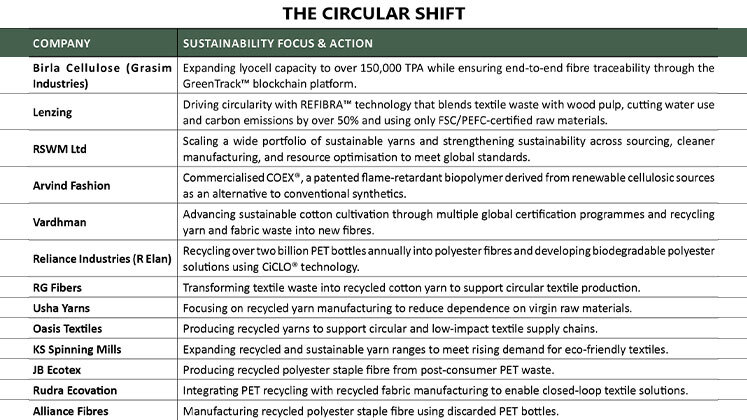
According to Vadiraj Kulkarni, Business Head- Birla Cellulose, Grasim Industries Ltd, a leading producer of Cellulosic Staple Fibre (CSF) and Cellulosic Fashion Yarn (CFY), demand for sustainably sourced viscose, modal and speciality fibres will continue to grow as brands shift towards biodegradable and lower-carbon alternatives.
“We are expanding Lyocell capacity at our Harihar plant in Karnataka by adding 110,000 TPA, with 55,000 TPA in phase one. This will take our total Lyocell capacity to over 150,000 TPA,” mentioned Vadiraj.
The company’s in-house traceability platform, GreenTrack™, which tracks materials from pulp source to finished garment using blockchain technology, is becoming a key part of brand sustainability programmes and is helping enable deeper partnerships.
A similar focus on circularity and impact reduction is visible at Lenzing, a global producer of cellulose-based fibres and filaments through brands such as TENCEL™, VEOCEL™ and LENZING™ ECOVERO™.

“Our LENZING™ ECOVERO™ fibers produced using REFIBRA™ technology are an innovation that combines pre- and post-consumer textile waste with wood pulp to create new fibers, reducing reliance on virgin materials and supporting a circular economy,” said Rohit Aggarwal, CEO, Lenzing.
Beyond circularity, Lenzing is focusing on lowering the environmental footprint of fibre production. Based on lifecycle assessments aligned with ISO 14040 and 14044 standards, and reflected in tools such as the Higg Materials Sustainability Index (MSI), TENCEL™ Lyocell and Modal fibres show at least 50 % lower water use and carbon emissions compared to conventional lyocell and modal.
The company also produces VEOCEL™ fibres with low emissions to air and water, measured under cradle to fibre gate assessments.
On raw material sourcing, Lenzing uses wood and pulp only from FSC or PEFC certified and controlled sources.
Likewise RSWM is also expanding its portfolio of sustainable yarns, including Organic Cotton, Recycled Polyester, Jute, Hemp, Banana, Bamboo, Modal, Tencel, Seacell, Nettle, Linen and Lyocell among others. The company with a turnover of Rs 4,825 crores (US $534 million) offers a wide range of products, including cotton, synthetic, core-spun, hollow-core, and zero-twist yarns, as well as greige, dyed, mélange and ecofriendly yarns.
“Sustainability plays a significant role in our growth approach for 2026. We are improving sustainability performance across the value chain, from responsible sourcing and fibre selection to cleaner manufacturing and resource optimisation. This helps ensure our growth stays aligned with international environmental standards and buyer expectations,” said Rajeev Gupta, JMD, RSWM Ltd.
Other players in the industry are also stepping up their sustainability effort. For example, Arvind Fashion had commercialised COEX®, a patented flame-retardant biopolymer derived from cellulosic sources.
Vardhman is using a mix of green fibres across both natural and manmade categories. For sustainable cotton cultivation, the company works with programmes such as Organic Cotton, Fair Trade Cotton, Cotton Made in Africa, Recycled Cotton, Better Cotton and Cotton Leads. It also operates a recycling unit in Baddi (Himachal Pradesh), where waste from yarns and fabrics is used to produce recycled fibre.
Another industry leader, Reliance Industries’ B2B2C brand R|Elan is also focused on sustainability. The company recycles over two billion post-consumer PET bottles every year to make polyester fibre. One of its key offerings, R|Elan™ EcoGold with CiCLO® technology, is designed to reduce the long-term persistence of textile waste in landfills, soil and water. The technology enables microbes in the environment to break down the material into natural elements such as carbon dioxide and water, similar to how natural fibres degrade.
Several emerging Indian manufacturers are also active in sustainable textiles. RG Fibers works with recycled cotton yarn, converting waste into usable fibres. Usha Yarns and Oasis Textiles focus on recycled yarns, while KS Spinning Mills is expanding its recycled and sustainable yarn offerings.
JB Ecotex produces recycled polyester staple fibre from post-consumer PET waste. Rudra Ecovation operates across PET recycling and recycled fabric manufacturing. Alliance Fibres manufactures recycled polyester staple fibre using PET bottle waste. Together, these efforts prove that the industry is slowly marching towards sustainability.