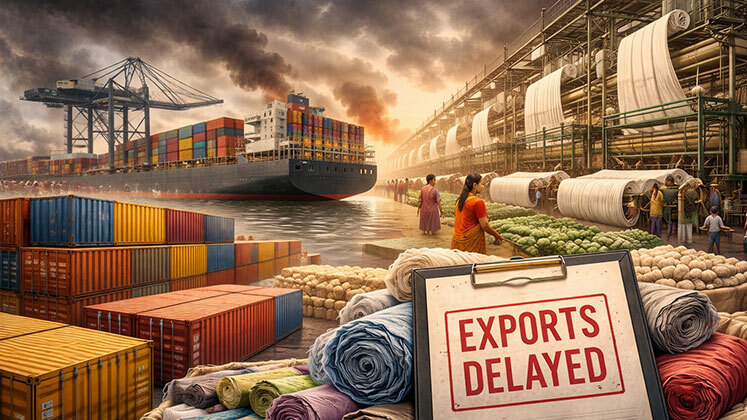
The ongoing conflict in West Asia has begun to disrupt the textile industry in Bhilwara, Rajasthan, with export orders being delayed and shipments worth an estimated Rs. 800 crore (US $ 86.66 million)–Rs. 1,000 crore (US $ 108 million) facing uncertainty, according to industry representatives.
Bhilwara, widely regarded as one of India’s key textile manufacturing centres, hosts hundreds of textile units and supports a large workforce across spinning, processing and fabric production.
R.K. Jain, General Secretary of the Mewar Chamber of Commerce and Industry Organisation, said the city’s textile sector had begun to experience the effects of the conflict in the Gulf region, particularly through disruptions to export markets.
He stated that Bhilwara had earned its reputation as a major textile hub, with more than 450 fabric units, over 20 spinning units, 21 processing units and more than five denim manufacturing facilities operating in the city. According to Jain, the cluster produces approximately 10 crore metres of cloth every month and provides direct or indirect employment to more than two lakh people.
Jain indicated that the ongoing geopolitical tensions had begun to affect export activity. He noted that textile manufacturers were encountering difficulties as a result of the conflict and warned that exports from the region could face further disruptions if the situation continued.
He explained that export orders had already been put on hold in several cases due to uncertainty in overseas markets.
Industry representatives also said a number of shipments were currently stalled within India or awaiting movement at ports. In other instances, international buyers had temporarily paused orders while monitoring developments in the region.
Jain cautioned that if the conflict persisted for an extended period, the consequences for Bhilwara’s export-oriented textile industry could become more severe.
The Gulf region and Europe remain among the most important export markets for Bhilwara’s textile sector. Yarn manufactured in the region is exported to Bangladesh and several European countries, while additional volumes are shipped to Gulf markets. Fabric exports from Bhilwara are largely directed towards Gulf countries and Europe.
With trade routes and logistics networks facing disruption due to the ongoing conflict, the pace of export movement has slowed significantly. Industry participants say this has already affected business sentiment among textile manufacturers in the region.
Sector representatives warned that prolonged geopolitical instability could pose deeper challenges for the cluster, particularly in sustaining export volumes and maintaining stable production levels.