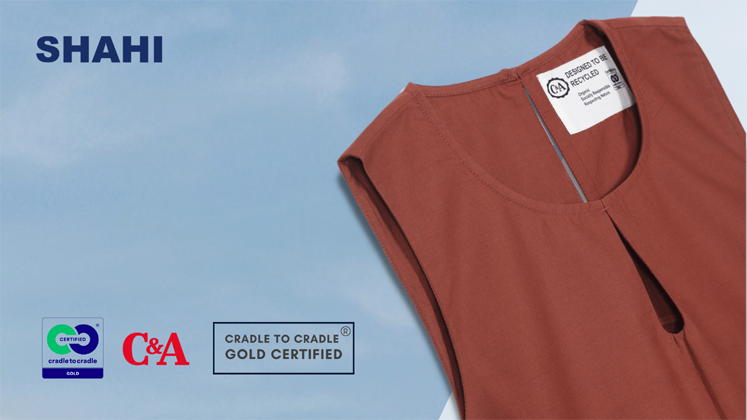
India’s number one apparel manufacturing company Shahi Exports has achieved one more milestone. The company has become India’s first woven apparel and textiles manufacturer to create Cradle to Cradle Certified® Gold products under Version 3.1.
It is a globally recognised measure of safer, more sustainable products made for the circular economy.
In a statement, the company informed, the collection of products that has received this certification is called ‘Arth’ (Meaning) and comprises women’s dresses made for C&A. It’s a massive step towards the transition to a circular fashion industry.
Ruchi Asija, Vice President, Marketing, Shahi Exports said, “We are grateful to our partner C&A for working with us to create this truly innovative, first-of-its-kind, circular product. At every step of the design process, C&A and Shahi worked together to find the right alternative materials, chemicals and other raw materials to achieve the Cradle to Cradle Certified® Gold level.”
It is pertinent to mention here that Cradle to Cradle Certified® is awarded by the Cradle to Cradle Products Innovation Institute, a global non-profit organisation, dedicated to powering innovation for the circular economy through products that have a positive impact on people and the planet.
Product designers, manufacturers and brands around the world rely on the Cradle to Cradle Certified® Product Standard as a transformative pathway for designing and making products with a positive impact on people and the planet.
To receive certification, products are assessed for environmental and social performance across five critical sustainability categories: material health, product circularity, clean air & climate protection, water & soil stewardship and social fairness.
The product is assigned an achievement level (bronze, silver, gold and platinum) for each category. Shahi Exports has achieved a platinum performance level for material health, and the gold level on the other four standard categories. The lead assessment body for this process was Eco Intelligent Growth (EIG) and the material health assessment body was McDonough Braungart Design Chemistry, LLC (MBDC).
The fabric for the ‘Arth’ collection was made at the company’s weaving mill and the garments were stitched also in its apparel factory. The entire collection is made using Global Organic Textile Standard (GOTS) certified organic cotton, more than 96 per cent of which is rapidly renewable cotton.
Further, 86 per cent of the water used in fabric processing was recycled at our mill having zero liquid discharge (ZLD).
The finished products are 100 per cent carbon neutral and the products are made keeping the principles of circularity in mind and are 100 per cent recyclable.
“The Arth collection is a powerful example of how suppliers and brands can work together to design and create materials and products that meet shared objectives for circularity and sustainability,” said Christina Raab, Vice President of Strategy and Development for the Cradle to Cradle Products Innovation Institute. “By achieving one of the highest levels of Cradle to Cradle certification for the collection, Shahi Exports is not only demonstrating the scope of opportunity for supplier-brand partnerships, but also the vast innovation and leadership potential of India’s textile mills.”
The global sourcing & sustainability team at C&A said, “Shahi continues to be a steadfast strategic partner for C&A and a driving force for innovation across the global fashion supply chain. When we began bringing Cradle to Cradle Certified® products to market it was clear that Shahi would be a key partner in scaling Cradle to Cradle across categories. For a product and supply chain to become Cradle to Cradle Certified® it takes an incredible amount of detail and commitment. Most of all, however, it takes supply chain partners with a deep understanding of sustainability, innovation and their importance to customers, brands and suppliers. We look forward to working together to drive Cradle to Cradle Certified® innovations and other ground-breaking sustainability initiatives forward.”