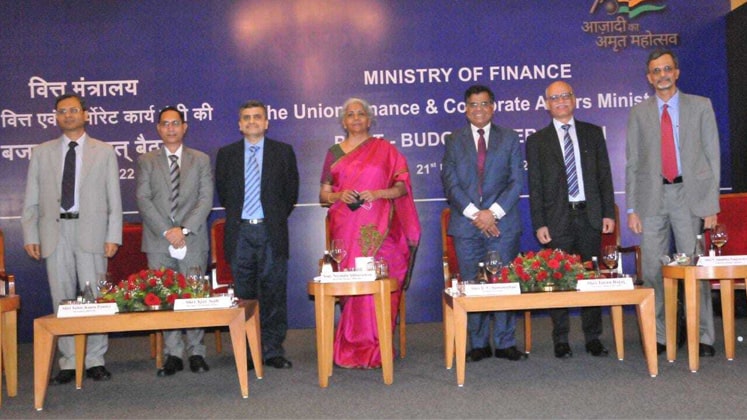
Finance Minister Nirmala Sitharaman has said that correcting the inverted duty structure in the textiles value chain is essential to attract investment in the sector.
Addressing a post-Budget meeting with industry and trade representatives in Mumbai, the Minister said that the correction is required for the production-linked incentive scheme for the sector, or else investments are not going to come to certain areas.
Her statement holds relevance considering the Goods and Services Tax (GST) Council had to drop a plan to hike the GST rates for most textile products in the man-made fibre (MMF) value chain from 5 per cent to 12 per cent in late December 2021 amidst protests from the industry; the Government, however, may revisit the same soon.
Notably, the rate hike was to take effect from 1 January 2022, but the decision was rolled back a day before as there were protests across India from the industry.
A group of ministers (GoM), which is currently reviewing the entire GST rates structure, would review the issues with regard to the textiles value chain too and submit its report in February-March.
It is pertinent to mention here that the GST Council’s decision to alter the rate structure for textile products was aimed at resolving the long-unresolved issue of inverted duty structure in the synthetic textile segment.
Manufacturers of MMF have long suffered from the duty disparity with the natural fibre (mainly cotton) segment, and, in the GST system, these units suffered from accumulated input tax credit.
As of now, the tax rate on MMF, yarn and fabrics is 18 per cent, 12 per cent and 5 per cent, respectively. To illustrate, the GST rate is 18 per cent on mono-ethylene glycol (MEG) and purified terephthalic acid (PTA), 12 per cent on polyester partially oriented yarn (POY) and 5 per cent on grey fabrics, finished fabrics and garments. Natural yarns like cotton, silk, wool are in the 5 per cent slab.
Also Read: Industry reiterates to withdraw the proposed GST tax on textiles





 Bharat Tex Special Report 2026