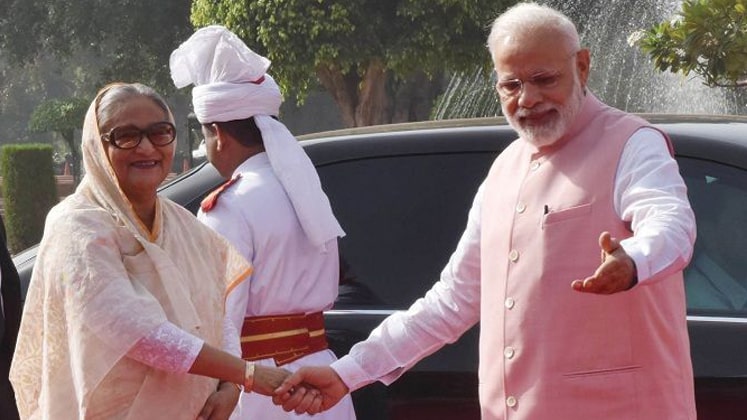
Once again, many stakeholders of the industry have not only acknowledged Apparel Resources’ point of view, but are also strategising to follow the same. For years, AR has been advocating (through its editorials, articles, sourcing event Apparel Sourcing Week, etc.) the point that India and Bangladesh are not competitors, and that they have to grow collectively by supporting each other’s strengths… and it should be a win-win for both the countries. This is the only way the two nations can give strong competition to China.
And now finally, the Indian Government is following the same path, as in a recent virtual meeting in which textile ministers, senior bureaucrats and industry stalwarts from both the sides unanimously agreed that India and Bangladesh should target to have a 35 per cent share of global textile and apparel trade in the next 5 years. Indian Government feels that it is time to work as one Asia without a sense of competition with Bangladesh.
Now the bigger question is – is it possible that both the countries can achieve this ambitious share in the global textile market of US $ 1 trillion which is expected to reach US $1.600 trillion by 2025?
As of now, India’s overall textile and apparel export is around US $ 39 billion (FY19), and before the coronavirus pandemic, it was said that it is expected to reach US $ 82 billion in 2021.
While on the other hand, Bangladesh apparel export was US 27.95 billion in FY20 compared to US $34.13 billion in the previous fiscal year. Earlier, its target for 2020-21 was US $ 50 billion, while looking at the current conditions, it has now changed and is set at US $ 33.78 billion.
So together, both the countries have textile and apparel exports of US $ 66.95 billion, and together they have to achieve at least US $ 350 billion in the next 5 years. This clearly means that they have to grow collectively with the rate of 5.22 times.
Currently, in the global textile and apparel export, India has a share of just 5 per cent, while Bangladesh has a 6.8 per cent share in garment export.
Looking at the trends in the last few years, it seems difficult for India’s export to grow rapidly in future, as things have become stagnant. However, as per the Government, this target can be achieved by developing regional value chains, with India supplying raw materials and Bangladesh exporting value-added goods like fabric and apparel clothing to the world.
Issues like India’s FTA with core markets EU, US pending for decades are being pushed, and if get done, India will have considerable growth in its apparel export.
Without foreign investment, this target seems almost impossible to achieve, and the good thing is that Indian textile industry attracted Foreign Direct Investment (FDI) worth US $ 3.44 billion from April 2000 to March 2020. Looking forward, there are enough chances that once things improve after COVID-19, FDI will also increase. India has given permission of 100 per cent FDI in the textiles industry.
In all this positivity, availability of resources as well as opportunities, India has to focus on its strength regarding MMF, as the tilt in the global market is more towards MMF and without having strong control on a variety of synthetic fabrics. India is dependent on China and other countries in terms of synthetics, different kinds of fibres, yarns and fabrics. Bangladesh is strong enough in the production of trims, so with some improvements, there is no reason that both these countries can’t give strong competition to China or even Vietnam which is another major player in apparel export.
Also Read: MMF – It’s now or never for India
There are hundreds of brands, retailers, wholesale buyers/importers who are sourcing from both the countries, being nominated suppliers of various products. Similarly, many technology suppliers have the same strong hold in both the countries, so all in all, there is an eco-system which just needs to strengthen with a positive mindset to achieve a common goal.
Together, India and Bangladesh cover most of the product categories including basic to high value-added and even technical textiles.
Apart from any country-specific developments as well as developments affecting many countries, strong collaborative efforts between India and Bangladesh are the first condition. For decades, India has been trying to increase yarn and fabric exports to Bangladesh. Few Indian apparel exporters started their own factories in Bangladesh to get the advantage of low wages and duty structure of the Western world. Indian retail giant Reliance Retail, textile major Vardhman Textile Ltd. and few others have their offices in Bangladesh, which further wishes to have more investment from India and specific SEZ for India.
Bangladesh is the biggest market for Indian cotton, as India exported cotton worth Rs. 5,456.59 crore to Bangladesh in 2017-18. And there are enough opportunities to increase the same.
On the other hand, in FY 19-20, Bangladesh’s apparel exports to India stood at US $ 421 million.
But at the same time, when India compares its share of imports in Bangladesh with China, while China stands at 54 per cent, India stands at only 17 per cent given the high tariff on Indian textiles and apparel export products.
Logistics and high duties are two major factors between both the countries which need to sort out on a priority basis. And now, things seem to move ahead in this regard, as after India’s delegation visit to Bangladesh in February 2020, now Indian ministry of textiles is desperately waiting for the India visit of Bangladeshi delegation, so that any issues between both the countries’ textile industries can be discussed on a priority basis.
There was, however, a need for removing the irritants to trade from both sides before this could fructify. Indian textile secretary Ravi Capoor has said that India would request Bangladesh to consider removing the duties on Indian raw materials.
The Indian textile minister assured that India is actively looking at addressing logistics challenges which emanate at our borders to facilitate quicker turnaround time for both the industries in India and Bangladesh. The issues being faced in the movement of cargo through Petrapole and Benapole ports are also being investigated. Regarding logistics, good thing is that the train movement has started.
One of the main demands from Indian apparel manufacturers is that Bangladesh should allow retail of ethnic apparel from India at zero duties. India’s strength in this product category and cultural similarities also make ‘Made in India’ ethnic apparels favourite in Bangladesh.
Not only the Government, but the industry leaders also believe that both the countries must work together.
Dr. Rubana Huq, President, Bangladesh Garment Manufacturers and Exporters Association (BGMEA), insists on collective efforts and urges to focus on ‘go regional, go green’. While Dr. A. Sakthivel, Chairman, Apparel Export Promotion Council (AEPC), suggests having a joint expo of Indian and Bangladeshi companies where they can approach buyers together and get better value and more business collectively.
For years, Indian textile and apparel industry has been targeted to be worth US $ 300 billion by 2025. In fact, 2 years ago in an event, Smriti Irani, Minister of Textiles, opined that the industry should not restrict itself to the US $ 300 billion mark, but should look beyond and achieve US $ 500 billion, if not more. And looking at the political stability in both the countries, focus on employment generation, and aggressive policy reforms, one can hope that the Government is serious to improve the industry.
Time and again, it has been said on various platforms that India is the sleeping giant of apparel and textile sourcing. It’s now time for the country to wake up, and there can’t be a better partner than Bangladesh to strategise with a collaborative focus.
On the other hand, if one closely observes that the development is taking place at various levels, be it US-China relations, Trump’s steps against China, overall sentiments against China, etc., the world is getting restructured. This is a rare opportunity to come together to create a huge supply chain. It will take a lot of efforts, but together, we can replace China in a big way, leading to both the countries emerge as strong regional powers.
Also Read: This is where leading textile and apparel states can improve