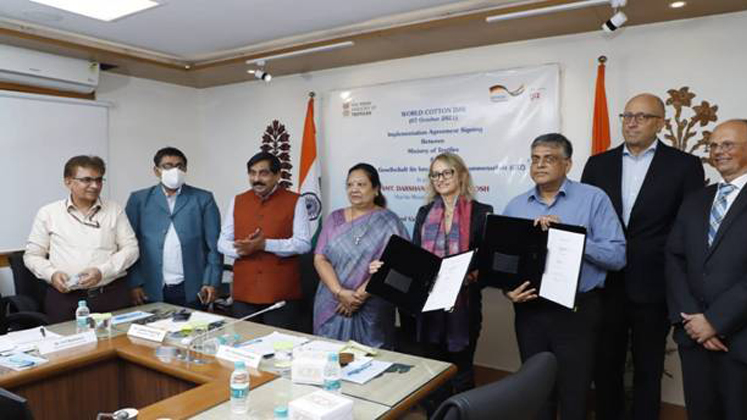
Ministry of Textiles (MoT) and Deutsche Gesellschaft fur InternationaleZusammenarbeit (GIZ) signed an MOU on Implementation Agreement of Indo German Technical Cooperation project on ‘Sustainability and Value Added in the Cotton Economy’.
As a part of the Indo German Development cooperation framework, the German Federal Ministry for Economic Cooperation and Development (BMZ) has collaborated with Ministry of Textiles (MoT) supported by Ministry of Agriculture and Farmers Welfare (MoAFW).
The objective of the project is `to increase the value addition from sustainable cotton production in India by focusing on sustainable cotton and strengthening of downstream processing’.
Four major cotton producing states – Maharashtra, Gujarat, Madhya Pradesh and Tamil Nadu – will be focused upon under this project and will work closely with the related agencies.
The MoU was signed by Sanjay Sharan, Joint Secretary on behalf of MoT, Mohd.-El-Khawab, Programme Coordinator, GIZ India and Dr. Rossitza Krueger, Programme Head, Sustainable Cotton Project, GIZ, in the presence of Minister of State for Textiles, Darshna Vikram Jardosh, who presided over the event and UP Singh, Secretary, Textiles.
The GIZ project will also help in enhancing employment and women empowerment in training and capacity building on sustainable cotton growing practices by innovation in new cotton processing procedures and ginning, etc.
Darshna Jardosh said that the GIZ project is aimed at increasing volume of cotton production at least on 90,000 hectare with participation of 1.50 lakh cotton farmers with yield increase by 10 per cent.
This will enable capacity building of 1.50 lakh farmers and entrepreneurs, of which about 30 per cent will be women beneficiaries.
The project follows ‘From shelf to field’ approach, with the strategy to link consumers to the cotton growers in India and work along the entire supply chain. The project is also focusing on creation and promotion of transparency about the prevalence and application of internationally recognised/accepted sustainability standards and promoting measures that reduce the water footprint in cotton production. This will help reduce vulnerability of cotton sector to ever-increasing water stress worsened by climate vagaries.
The MoT, as the lead partner on the Indian Government side, guides the project on main intervention areas based on its vision for textiles in India, through the establishment and convening of the project Steering Committee for project progress review and guide the project implementation.
UP Singh informed that focus of project is to work with major global textile companies to create the “pull” factor for improved market access by the farmers for their sustainably grown cotton.
The project envisages promotion of sustainable cotton cultivation methods emphasising on implementation of good agriculture practices, he added.
Notably, India is the largest cotton producer in the world and also the 2nd largest consumer of cotton in the world with estimated consumption of 303 lakh bales (5.15 million metric tonnes, i.e., 20 per cent of world cotton consumption of 1,505 lakh bales (25.59 million metric tonnes).
It plays a major role in sustaining the livelihood of an estimated 6 million cotton farmers and about 50 million people engaged in related activity such as cotton processing and trade.





 Bharat Tex Special Report 2026